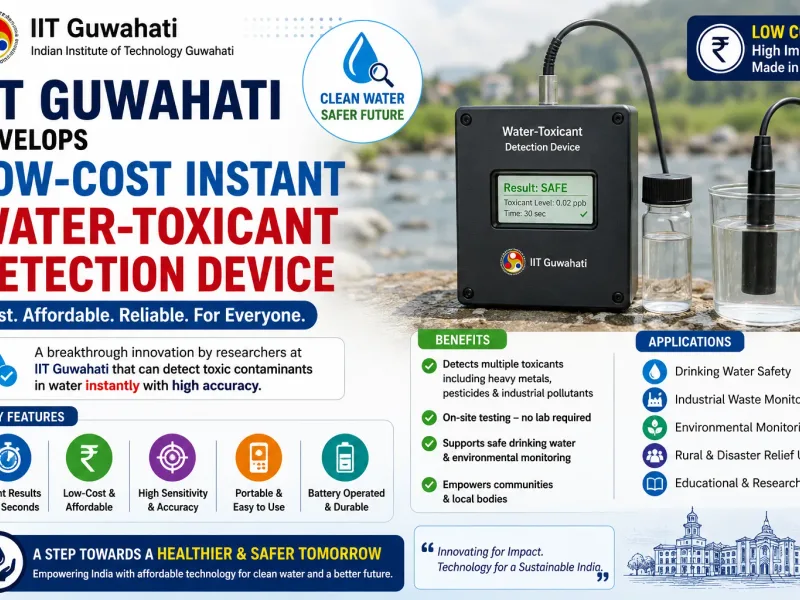
A Small Device That Could Catch Big Water Problems
A team at the Indian Institute of Technology (IIT) Guwahati has built a portable gadget that can test water for harmful substances almost instantly, right at the source. It's called E-Eye, and it's designed to do something that usually takes days: tell you whether your water is safe to drink.
If you've ever waited a week for a water sample report, you'll understand why this matters. Most water testing today still depends on sending samples to a certified lab, which is slow, expensive, and often out of reach for people in smaller towns and villages. E-Eye tries to close that gap.
How E-Eye Actually Works
The device works on a fairly simple scientific principle called the Beer-Lambert law, which is a fancy way of saying that the amount of light absorbed by a liquid tells you something about what's dissolved in it. When a toxicant reacts with a chemical inside the device, it produces a coloured compound. The deeper the colour, the higher the concentration of the contaminant. E-Eye reads that colour intensity, converts it into a digital reading, and shows the result — no laboratory equipment required.
According to Professor Tapas K. Mandal from the Department of Chemical Engineering, the device has "successfully detected toxicants including arsenic, lead, iron, chromium, fluoride and Escherichia coli bacteria" during testing. That's a fairly serious list. Arsenic and lead exposure, even at low levels over time, is linked to organ damage and developmental issues in children. E. coli contamination, on the other hand, is one of the most common causes of waterborne diarrhoeal illness in India.
The prototype reportedly costs around Rs 3,500 to build, with each individual test costing about Rs 2. Researchers say mass production could bring that cost down further, which — if true — would make this genuinely usable at scale.
Why This Fits Into a Bigger Public Health Push
E-Eye has been developed in line with the Jal Jeevan Mission, the central government's programme aimed at delivering safe piped drinking water to every rural household. On-site testing devices like this are meant to plug into that system, flagging contamination before it reaches someone's tap rather than after people start falling sick.
In clinical practice, waterborne illness often gets misdiagnosed early because the symptoms — stomach cramps, fatigue, mild fever — look like a dozen other things. By the time a doctor connects the dots to contaminated water, several people in the same household or neighbourhood may already be affected. A device that flags contamination at the source, before it becomes a cluster of sick patients, is the kind of upstream fix public health experts have wanted for years.
The device isn't limited to drinking water either. The research team says it can test environmental and biological samples too — vegetables, tea, herbal products, soil, and milk. That's a wider net than most portable testers cast, and the team has reportedly run more than 2,700 sample tests so far.
What This Means for You, Practically
Should you go out and buy one tomorrow? Not yet — E-Eye is a research prototype, not a retail product. It hasn't been commercially launched, and there's no public timeline for when (or if) it'll be available to individual households. Treat this as promising early-stage research, not a finished consumer gadget.
That said, if you're worried about water quality in your area right now, there are things worth doing today. Get your water tested through a certified diagnostic lab rather than relying on taste or clarity — those tell you almost nothing about heavy metals or bacteria. If you're seeing recurring stomach issues in your family, it's worth speaking to a gastroenterologist rather than assuming it's just "something going around." Children are more vulnerable to heavy metal exposure, so persistent, unexplained symptoms are worth flagging to a pediatrician early rather than waiting it out.
Skin issues like unexplained rashes or dryness can sometimes trace back to water quality too, and a dermatologist can help rule that in or out. Long-term heavy metal exposure has also been associated with cardiovascular strain, so if you have existing heart concerns and suspect your water source, it's reasonable to loop in a cardiologist during your next check-up. For general symptoms that don't fit neatly into a category, start with a general physician — they're usually the right first stop before a referral.
If you manage a household with elderly family members, a home visit doctor can be a practical option when a clinic trip isn't feasible. And if you're trying to figure out whether ongoing digestive symptoms are diet-related or water-related, a dietitian can help you separate the two.
Getting Water Actually Tested
Until affordable devices like E-Eye reach the market, your best bet is a proper lab test. You can locate a diagnostic center near you or search diagnostics services to find labs that test for heavy metals, bacterial contamination, and fluoride levels — the same markers E-Eye is designed to catch. If your municipal water report shows any red flags, don't wait for symptoms; get individual testing done, especially if you have young children or pregnant women at home, in which case an obstetrician or gynecologist can advise on precautions during pregnancy.
Hormonal and metabolic effects of long-term heavy metal exposure are also being studied, so if you have diabetes or thyroid concerns and live in an area with known contamination issues, it's worth a conversation with an endocrinologist. Respiratory symptoms are less directly linked but shouldn't be ignored either — a pulmonologist can assess if something environmental is contributing to persistent cough or breathlessness.
For families keeping an eye on multiple health concerns at once, it helps to have a nearby hospital or multi-specialty clinic on your radar rather than scrambling when something comes up. If a situation turns urgent, emergency services near you and ambulance booking are worth having saved in advance, not looked up in a panic.
Where This Research Stands Now
The findings have been published in the IEEE Sensors Journal, which is a peer-reviewed venue, so the science has been through some scrutiny — that's a meaningfully different bar from a press release claiming a breakthrough. Still, published research and a commercially available product are two very different things, and there's a long road between the two, involving regulatory approval, manufacturing scale-up, and field validation across different water sources.
Northeast India, and Assam in particular, has long dealt with arsenic and fluoride contamination in groundwater. A cheap, fast testing tool developed locally has an obvious use case close to home, even before it reaches a national rollout.
If you want to browse other health-tech and public health updates, DOCTAR's health news section and blog cover developments like this regularly. You can also learn more about DOCTAR's mission to connect patients with verified doctors across India, or explore doctor listings nationwide if you're looking for specialists beyond your immediate city — including in Delhi, Mumbai, Kolkata, Bangalore, Chennai, and Jaipur.