India Just Recorded Its Highest-Ever Number of Organ Transplants
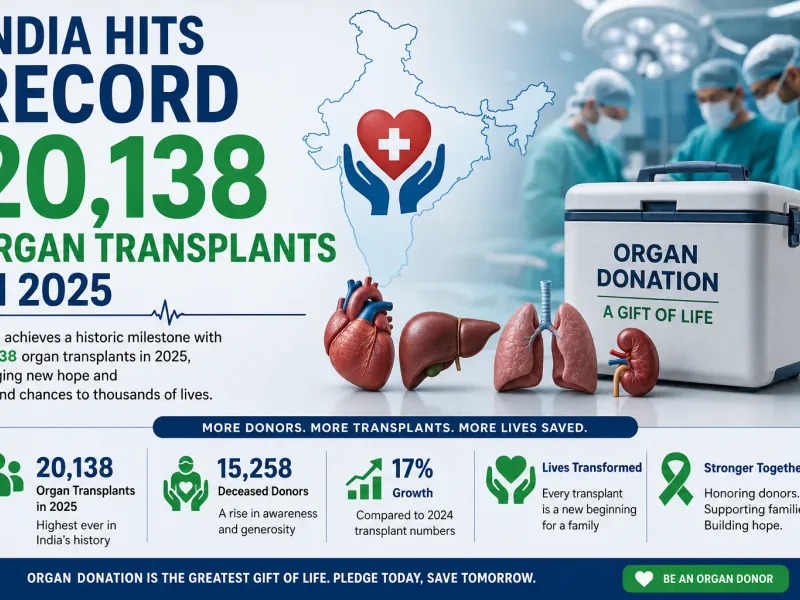
India performed 20,138 organ transplants in 2025. That's the highest figure the country has ever recorded in a single year, and it came up on 3 August as the National Organ and Tissue Transplant Organisation (NOTTO) marked the 16th Indian Organ Donation Day in New Delhi.
The date itself has meaning. India's first successful deceased-organ transplant was performed on 3 August 1994, a fact the Director General of Health Services pointed to at this year's event. Three decades on, the programme has gone from a handful of procedures a year to over 20,000.
Union Minister of State for Health Anupriya Patel shared the figures at the event, alongside the release of the NOTTO Annual Report 2025-26. She noted that transplant numbers have grown more than fourfold since 2013, when India managed just 4,990 procedures. Compare that to 2025's count, and the rise works out to roughly 322 percent over twelve years.
The Numbers, Broken Down
Kidney transplants made up the bulk of the total: 14,477 procedures. Liver transplants came next at 5,154. Heart transplants numbered 239, and lung transplants 210, according to the NOTTO report.
That kidney figure isn't surprising if you've followed India's chronic kidney disease burden for any length of time. Diabetes and hypertension, both widespread and often poorly controlled here, are the two biggest drivers of kidney failure. A nephrologist or kidney specialist will tell you the same thing dialysis units across the country see every week: demand for kidneys far outpaces supply.
Deceased donor transplants also grew, rising from 837 in 2013 to 3,526 in 2025, more than fourfold. That's a meaningful shift, because deceased donation is where India has historically lagged. The country still leads the world in living donor transplants, which is a different kind of achievement, but not one every health system would want to lean on so heavily.
Why Kidney and Liver Transplants Dominate
Kidney and liver transplants together accounted for close to 98 percent of all procedures in 2025. That pattern isn't unique to India, but the scale is striking.
In clinical practice, this is often missed because the public conversation around organ donation focuses heavily on the emotional side, pledges, awareness drives, and less on the medical bottleneck underneath. Having covered this beat for a few years now, the same point comes up in almost every conversation with transplant coordinators and general surgeons: the shortage isn't really about willingness to donate. It's about the gap between how many people need an organ and how many deceased donors actually come through the system in time.
Dr Sonal Asthana, a liver transplant surgeon, has been quoted in earlier coverage noting that India performs around 5,000 liver transplants a year, mostly from living donors, and that meeting real demand would require a much larger jump in deceased donation. This year's numbers suggest that gap is narrowing, slowly.
Where Deceased Donations Are Coming From
Delhi topped the list of states and union territories for organ donations in 2025-26, with 4,564. Tamil Nadu followed with 2,796. Punjab ranked ninth with 644.
Southern states have led deceased donation for years, partly because of earlier and more consistent hospital-level protocols for identifying and counselling families of brain-dead patients. That's not a small detail. Every deceased donor transplant depends on a hospital's ICU team recognising brain death, approaching a grieving family at the worst possible moment, and doing it with enough sensitivity that the family says yes. It's a process, not a policy line.
The government has also been expanding institutional infrastructure. Delhi got its own State Organ and Tissue Transplant Organisation (SOTTO) this year, and four more were set up across Meghalaya, Sikkim, Tripura, and Arunachal Pradesh, regions that have historically had little to no organised transplant coordination.
What the Global Ranking Actually Means
India now ranks third in the world for total organ transplants, behind the United States and China. That sounds impressive, and it is, given where the programme started. But raw numbers don't tell you about wait times, and wait times are what actually matter if you or someone in your family needs a transplant.
India's population is well over four times that of the US. Third place in absolute numbers still leaves a very large gap in transplants per capita. Worth remembering before treating the headline as the whole picture.
Over 2.58 lakh people pledged to donate organs in 2025 alone, and the total number of Aadhaar-verified pledges through the national digital portal has crossed 5 lakh since it launched in 2023. Pledging is a meaningful first step, though it's worth being clear-eyed that a pledge doesn't automatically translate into a donation. Family consent at the time of death still plays a deciding role in India, regardless of what a person may have registered years earlier.
If a Transplant Is Something You're Facing
None of this is medical advice, and it shouldn't be treated as a substitute for talking to a treating doctor. But a few things are worth knowing if organ failure has come up in your family.
Early referral matters. Patients with declining kidney or liver function do better when they're connected to a transplant centre or specialist well before the organ fails completely, not after. Ask your treating physician early about whether a transplant evaluation makes sense, rather than waiting for a crisis.
Living donation, when medically possible, still moves faster than waiting on a deceased donor list in most parts of India. That's simply the current reality of the system, not a recommendation either way. A hospital's transplant team can walk you through eligibility on both fronts.