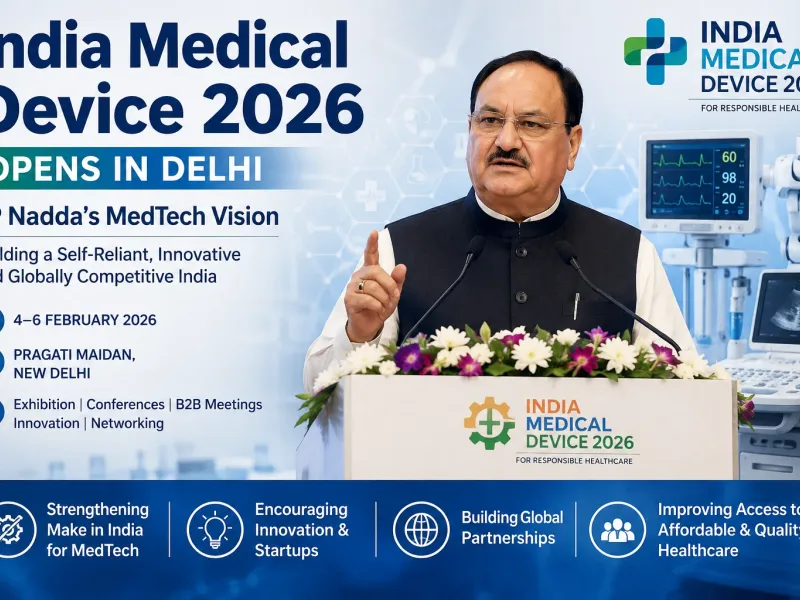
Delhi Just Hosted One of India's Most Important Healthcare Conferences
India Medical Device 2026 opened at Vigyan Bhawan in New Delhi on August 7 and 8, bringing together policymakers, regulators, industry leaders, innovators, startups, and global stakeholders to deliberate on the future of India's rapidly growing medical devices sector. This was the 9th edition of the flagship conference, jointly organised by the Department of Pharmaceuticals under the Ministry of Chemicals and Fertilizers, in collaboration with FICCI (the Federation of Indian Chambers of Commerce and Industry).
The theme this year was direct and ambitious: "Towards Viksit Bharat: Advancing India as a Global Hub for Quality Medical Devices." That is not marketing language — it reflects a genuine policy shift that has been building for several years, and the 2026 conference is its most visible expression yet.
If you are a patient, a healthcare professional, or someone who simply wants to understand where India's medical technology is headed, this matters to you. Better domestic manufacturing means more reliable access to quality equipment — from the diagnostic machine in your local hospital to the device your doctor may recommend for home use. To find doctors near you who are already working with advanced diagnostic technology, Doctar connects you directly.
What Exactly Is a Medical Device? A Quick Explanation
Before diving into the policy, it helps to be clear on what a medical device actually is — because the term covers far more than most people realise.
A medical device is any instrument, equipment, software, or material used for diagnosing, treating, monitoring, or preventing disease — without using chemical action inside the body (which would make it a drug instead). This includes stents used in heart surgery, insulin pumps, CT scanners, surgical gloves, hearing aids, pulse oximeters (the device clipped to your finger to measure oxygen), and even diagnostic software driven by artificial intelligence.
India currently imports a significant share of high-end medical devices. The India Medical Device 2026 conference exists largely to change that. The conference placed export competitiveness, deeper domestic value addition, and innovation at the centre of India's medical device manufacturing agenda — a signal that the government wants to move from being a consumer market to a production powerhouse.
You can search for hospitals near you that are already equipped with advanced diagnostic tools, or find diagnostic centres near you through Doctar.
Day One: Setting the Stage
Minister of State for Health and Family Welfare and Chemicals and Fertilizers, Anupriya Patel, inaugurated the conference on August 7. The opening sessions set a clear tone: this is not just an industry event, it is a policy declaration.
Manoj Joshi, Secretary of the Department of Pharmaceuticals, addressed the inaugural session and said the sector needed to be viewed from both healthcare and industrial perspectives. While healthcare providers need access to quality medical devices regardless of where they are made, strengthening domestic manufacturing matters for employment generation, industrial capability, and supply-chain resilience.
That balance — access for patients and self-reliance in production — is the core tension the government is trying to resolve. Getting it right affects everything from how much a stent costs in a government hospital to how quickly a new diagnostic device reaches rural India.
For healthcare professionals looking to stay current with medical technology available to their patients, Doctar's health blog covers healthcare developments across specialties with expert review.
Day Two: JP Nadda Takes the Stage
Union Minister for Chemicals and Fertilizers, Jagat Prakash Nadda, delivered the keynote address on August 8 on the theme "Atmanirbhar MedTech: Accelerating India's Journey towards Viksit Bharat," outlining the government's vision for building a globally competitive and innovation-driven medical devices ecosystem.
Atmanirbhar — which translates directly to "self-reliant" — is the philosophy running through India's manufacturing policy across sectors. In MedTech, it is particularly significant, because the country's dependence on imported high-end devices has long been a pressure point for healthcare costs and supply chains.
The second day included an exclusive CEO roundtable chaired by Nadda, and a dedicated session on reimbursement mechanisms for innovative therapies — a topic closely tied to India's goal of achieving Universal Health Coverage. Reimbursement, for context, means the process by which insurance schemes or government programmes pay for medical treatments. When reimbursement systems do not cover newer devices or procedures, patients often end up paying out of pocket — which shuts out large parts of the population.
From a clinical perspective, the reimbursement gap is something that affects patients every day. Doctors frequently find that the most appropriate device or procedure for a patient is not covered under their insurance, creating a difficult conversation about cost versus clinical need. A policy-level resolution of this gap would be genuinely transformative for patient outcomes.
If you need to find specialist doctors near you or book a home visit doctor for a consultation, Doctar makes that straightforward.
What Was Actually Discussed: The Big Topics
Over two days, the conference covered a wide range of topics: localisation of medical device component manufacturing, strengthening domestic production, technology leadership in high-impact devices, the use of artificial intelligence in healthcare, regulatory pathways for clinical evidence generation, expanding medical device exports, and improving service and maintenance ecosystems for medical equipment.
A few of these deserve closer attention.
Localisation of components means making the parts that go into medical devices inside India, rather than assembling imported components. This is harder than it sounds — the supply chain for precision components is complex — but it is essential for genuine self-reliance.
AI in healthcare is not a vague future aspiration at this point. AI is already being used in diagnostic imaging, pathology, and patient monitoring systems. The question the conference addressed was how India builds regulatory frameworks that allow AI-enabled devices to be tested, approved, and deployed safely and at scale. To understand what AI-driven diagnostics can mean for patients, explore healthcare technology content on Doctar's blog.
Export expansion is the outward-facing ambition. India already exports medical devices to multiple countries. The goal is to grow that significantly by meeting global quality standards — the same standards that currently make imported devices expensive in India.
The Policy Framework Driving This: What Already Exists
The conference did not emerge from a vacuum. Driven by the National Medical Devices Policy 2023, the Production Linked Incentive (PLI) Scheme, Medical Device Parks, and regulatory reforms, the government has been building the foundation for this ambition over the past few years.
The PLI Scheme offers financial incentives to manufacturers who hit domestic production targets — a mechanism that has already worked in mobile phones and pharmaceuticals. Medical Device Parks, set up in states like Andhra Pradesh and Kerala, are dedicated zones with shared infrastructure designed to reduce the cost of setting up manufacturing facilities for smaller companies and startups.
Leading companies including GE HealthCare, Abbott Healthcare, Philips India, Medtronic India, Johnson & Johnson MedTech, and Hindustan Syringes and Medical Devices participated alongside startups, researchers, and healthcare institutions. The presence of both global multinationals and Indian manufacturers at the same table is itself significant — it signals that the government wants partnerships, not just protectionism.
If you are a patient managing a chronic condition that involves medical devices — a pacemaker, insulin pump, CPAP machine, or hearing aid — connect with a specialist doctor near you through Doctar to understand your options as technology evolves.
What This Means for Ordinary Patients
Policy conferences can feel distant. But the decisions made at India Medical Device 2026 will eventually show up in real ways: in the price of a diagnostic scan, in whether your district hospital has a functioning MRI machine, in whether your health insurance covers a new cardiac stent.
A stronger domestic medical device industry means more competition, lower prices over time, faster availability of newer technologies, and less vulnerability to global supply disruptions — the kind India experienced during COVID-19, when shortages of ventilators, oximeters, and PPE exposed serious gaps.
The Universal Health Coverage session is particularly worth watching. Reimbursement mechanisms for innovative therapies will determine whether new devices reach public-sector hospitals and government health schemes, or remain available only to those who can pay privately.
To find hospitals near you with the right facilities for your medical needs, or to locate ambulance services in your area, Doctar's platform connects patients directly with verified healthcare providers.
You can also consult a general physician near you if you want to understand which medical technologies or diagnostic tools are relevant to your own health situation.
A Conference Worth Watching, Not Just Attending
India Medical Device 2026 is the kind of event that industry insiders track closely but that rarely gets communicated to the general public in plain language. That is a gap worth closing, because the outcomes directly affect patient care.
Tushar Sharma, Chair of the FICCI Medical Devices Committee and Managing Director for India and South Asia at Abbott Healthcare, highlighted the importance of sustained collaboration between policymakers, industry, academia, and healthcare experts. That collaboration — if it translates into practical policy rather than just panel discussion — is where the real patient benefit lies.
The 9th edition has set a clear direction. Whether the next few years deliver on it is the more important question.