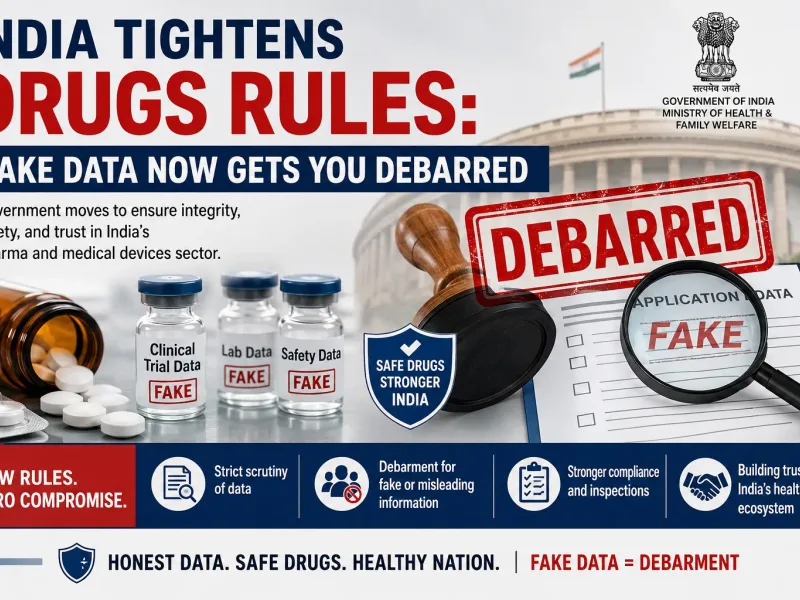
Why Fake Drug Data Is a Public Health Threat
A drug licence application is not just paperwork. It contains scientific data that regulators use to evaluate whether a medicine is safe, effective, and of consistent quality. The regulatory authority — primarily the Central Drugs Standard Control Organisation (CDSCO) at the national level — reviews this data before any drug can be legally manufactured or sold.
When that data is fabricated, the entire evaluation collapses. A medicine that has never actually been properly tested for safety can end up on pharmacy shelves, prescribed by doctors, and swallowed by patients who have no way of knowing any of this.
According to the government, scientific data submitted by applicants forms the basis for evaluating the quality, safety and efficacy of drugs. The submission of fake or fabricated data compromises the integrity of the regulatory process and may pose serious risks to public health.
According to the 2023-24 report by the CDSCO, out of approximately 5,500 drug samples tested, 3.2% were found to be substandard or spurious. That is not a trivial number when you consider how many people take prescription medicines every day. In a healthcare system where patients largely trust that a medicine on the shelf is what it says it is, this gap has real consequences.
Having worked around drug quality issues in health journalism for a while now, one thing that consistently surprises people is how difficult it is for an ordinary patient to know whether the medicine they bought is genuine. There is no visible sign on a tablet that tells you whether the clinical trial data used to approve it was real.
If you have concerns about the medicines prescribed to you, speaking with a general physician near you is a sensible starting point. You can also find a doctor near you on Doctar for a second opinion on any prescription.
What the New Rules Actually Say
With this amendment, applicants found to have submitted fabricated data would be debarred from filing further applications with the concerned regulatory authority, either State or Centre (as applicable) for a specified period of time.
The debarment applies across all applications filed under the Drugs Rules, 1945 — not just the specific type of application where the fake data was caught. So if a company fabricates data in a manufacturing licence application and gets debarred, it cannot file a fresh drug import application or a new product application with the same authority during the debarment period either.
Before any such action is taken, the licensing authority will issue a show-cause notice to the concerned applicant, ensuring due process. The amended rules also provide for an appeal mechanism.
That last part is important. The government has not simply given licensing authorities unchecked power to debar anyone. There is a defined process: the applicant gets a notice, a chance to respond, and a right of appeal. This is standard in administrative law and protects against misuse. But the deterrent effect is clear — the consequences of being caught submitting fake data are now significantly more serious than they were before.
How This Fits Into India's Broader Pharmaceutical Reforms
This amendment does not exist in isolation. The new provisions form part of the government's broader efforts to strengthen India's pharmaceutical regulatory framework in line with global best practices. The reforms are expected to promote greater compliance among drug manufacturers and distributors while enabling authorities to take stricter action against entities involved in regulatory malpractice.
India is a major global supplier of generic medicines. Its pharmaceutical sector exports to over 200 countries. A regulatory system that cannot credibly deter fraud undermines not just domestic patient safety, but India's standing as a reliable source of quality medicines for the world.
The government is also working on a new law to replace the Drugs and Cosmetics Act of 1940. Under this proposed law, the CDSCO would be granted statutory powers for the first time to take immediate action against fake or substandard medicines. The new law would also include provisions to digitise the licensing process, enhance coordination among state-level regulators and upgrade testing lab capacities.
The debarment amendment is, in other words, a building block — not a complete solution. Replacing an 86-year-old act, digitising licencing, and upgrading lab infrastructure are the bigger structural moves underway.
For patients who want to stay informed about drug safety developments, checking the Doctar blogs on diseases and conditions is a useful habit to build.
What This Means If You Are a Patient
Most patients will not interact with the Drugs Rules, 1945 directly. You will never file an application or receive a show-cause notice. But you are the person these rules are designed to protect.
The practical consequence is this: as the regulatory environment becomes stricter, the risk that a poorly tested or falsely certified medicine reaches you should, in theory, decrease. That is the goal. Whether it translates to that outcome depends heavily on enforcement capacity, which remains an ongoing challenge in a country with hundreds of licensed pharmaceutical manufacturers and stretched regulatory staff.
What can you do as a patient right now? A few practical things.
Buy medicines from reputable pharmacies and ask for a proper bill. If a medicine looks different from what you usually take — different colour, smell, texture, or packaging — flag it to your doctor rather than assuming it is fine. Find a doctor near you on Doctar quickly if you have a concern about a medication you have been given.
If you take regular prescription medicines for a chronic condition, consult a physician near you about which brands your doctor recommends and why. Search for specialists near you on Doctar if your condition requires specialist oversight — whether that is a cardiologist, a diabetologist, or a
For Children and Elderly Patients: Higher Stakes
Children and elderly people are disproportionately affected by substandard medicines because their bodies handle drug exposure differently. Children metabolise drugs through different pathways than adults, and the elderly often take multiple medicines simultaneously — a situation where a substandard or incorrectly dosed drug can interact dangerously with others.
If your child's doctor has prescribed a medicine, and you are unsure about its quality or authenticity, do not switch brands without medical guidance. Instead, consult a pediatrician near you who can advise on trusted formulations for children. For elderly family members managing multiple chronic conditions, find a geriatric specialist near you or ask their primary physician for a complete medication review.
You can also search for diagnostic centres near you on Doctar if you need lab tests to monitor how a medication is affecting the body — something especially important for drugs like blood thinners, immunosuppressants, or thyroid medications.
Related Health Topics on Doctar
Understanding drug safety is part of a wider picture of informed healthcare. The Doctar health blog covers many connected topics:
If you ever need to book a home visit doctor because you cannot travel to a clinic — particularly relevant for elderly patients or those with mobility issues — Doctar connects you with verified home-visit services.
Practical Takeaway
India has taken a meaningful regulatory step. Companies that submit fabricated data to get drugs approved now face something they did not face before: being locked out of the entire licensing system for a period, not just losing one application.
For patients, this is worth knowing — not as cause for alarm, but as context for why medicines regulation exists and why it matters to your daily life. The medicines you take have passed through a system designed to verify their safety. That system just got a little harder to game.
If you want to stay on top of health policy updates that affect patients directly, bookmark the Doctar health news section. And if anything about your current medications or treatments concerns you, find and book a doctor on Doctar rather than relying on guesswork.