What Was Actually Reviewed — and Why It's Not Routine
This wasn't a generic policy meeting. Detailed deliberations covered the National One Health Programme for Prevention and Control of Zoonoses, the National Rabies Control Programme, the Programme for Prevention and Control of Leptospirosis, the National Programme for Prevention and Control of Snakebite Envenoming, Disaster Management, the Integrated Disease Surveillance Programme (IDSP), Pandemic Preparedness, the Field Epidemiology Training Programme (FETP), Antimicrobial Resistance (AMR), the National Programme on Climate Change and Human Health, and the National Bio-Monitoring Programme for Chemical Toxicants.
That's a wide remit. And it reflects something public health practitioners will recognise immediately: India's disease burden doesn't follow neat categories. Rabies, snakebite deaths, leptospirosis — these are diseases that kill people in rural India with alarming regularity but receive far less media attention than, say, a new respiratory virus. In field epidemiology, these "neglected" programmes are often the first to lose momentum between reviews.
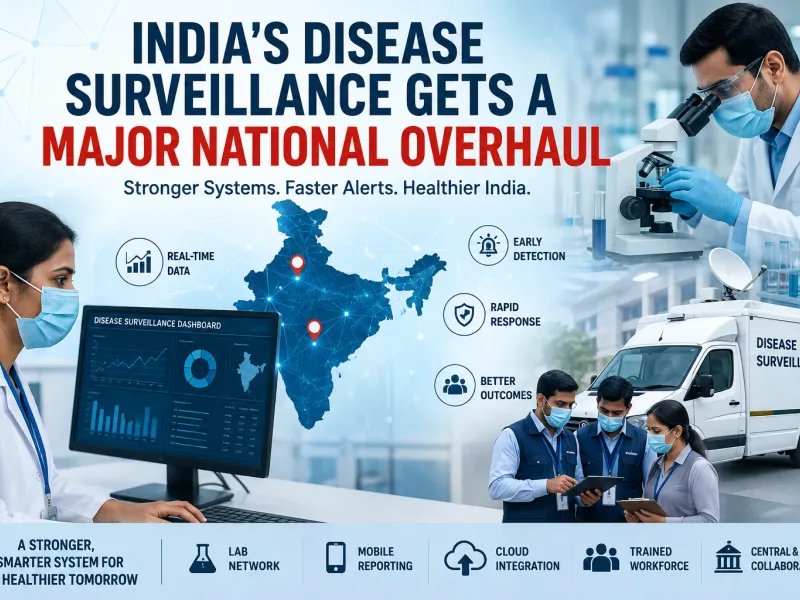
The Integrated Disease Surveillance Programme (IDSP) is particularly worth watching. It's the backbone of India's outbreak detection system, and its effectiveness depends almost entirely on how well district-level data feeds up to state and national dashboards. If that pipeline has gaps, early warnings don't reach the people who can act on them.
If you've ever been treated by a general physician during a monsoon fever and heard them say "let's rule out leptospirosis" — that kind of clinical awareness is downstream of exactly the surveillance systems being discussed in this meeting.
The KPI Framework: Accountability, Not Just Paperwork
All 36 states and union territories unanimously adopted a Key Performance Indicator (KPI) framework. That unanimity is notable. Indian public health policy often struggles with the gap between central mandates and state-level implementation.
The Centre and States also agreed to undertake monthly performance reviews to assess progress against the defined KPIs, identify implementation gaps, and facilitate timely corrective action. Monthly reviews are ambitious. Whether that cadence holds beyond the first quarter remains to be seen, but the commitment itself signals a shift toward data-driven accountability.
KPIs in public health — performance benchmarks that measure specific outcomes, like vaccination coverage rates or outbreak response times — are only useful if the underlying data is clean and timely. That's where the IDSP's digital infrastructure becomes critical. If you're curious about how disease outbreaks are tracked in your area, finding a diagnostic centre near you is a practical first step when symptoms arise, rather than waiting.
One Health: The Framework That Connects Humans, Animals, and the Environment
One of the more forward-looking aspects of this meeting was its emphasis on the One Health approach — a concept that recognises human health, animal health, and environmental health are deeply interconnected. Zoonoses (diseases that jump from animals to humans) like rabies, leptospirosis, and avian influenza are the clearest examples.
The National Rabies Control Programme, reviewed in this meeting, is directly relevant to millions of Indians who live in areas with large stray dog populations. Rabies is almost always fatal once symptoms appear, yet it is entirely preventable with timely post-exposure treatment. If you or someone you know is bitten by an animal, this is not a "wait and see" situation — see a doctor immediately.
For zoonotic disease risks, consulting an infectious disease specialist or a general physician as soon as you notice symptoms after potential animal exposure can be the difference between a preventable illness and a serious outcome.
AMR — The Threat That's Harder to See
Antimicrobial Resistance (AMR) — when bacteria, viruses, or other microbes stop responding to the medicines designed to kill them — featured prominently in the meeting's agenda. This is where the gap between awareness and action is widest.
In clinical practice, AMR is often missed because patients and even some practitioners treat antibiotics as a catch-all for fever. The result: resistant strains spread quietly, and infections that should be routine become difficult or impossible to treat. India has one of the highest rates of antibiotic use globally, which makes the inclusion of AMR in a national surveillance review genuinely important.
If you're concerned about how diseases and resistance patterns are evolving, India's network of hospitals and diagnostic centres play a front-line role in tracking these trends at the community level.
Pandemic Preparedness: Reading the Room in 2026
It would be strange if pandemic preparedness wasn't on the agenda. The Covid-19 experience exposed fault lines in India's surveillance and response infrastructure that this very meeting is, in part, trying to address. The Field Epidemiology Training Programme (FETP) — a structured training programme that produces rapid-response investigators for disease outbreaks — was also reviewed. These trained professionals are often the first to the scene when an unusual cluster of cases appears.
The National Programme on Climate Change and Human Health is newer but increasingly urgent. Heat-related illness, vector-borne diseases expanding into new geographies, and water-borne infections intensified by flooding — these are not future projections. They're happening now. Monsoon-related disease prevention is something Indian families navigate every year, often without enough reliable information.
For seasonal health concerns, a home visit doctor can be particularly useful during monsoon months when travel is difficult and fever or rashes need prompt evaluation.
What States Are Supposed to Do Now
Based on the findings of supportive supervision undertaken by SPOT members, the States and Union Territories committed to addressing critical operational bottlenecks and enhancing the delivery of disease surveillance and other public health programmes.
The meeting also served as a space for states to share what's working. That peer learning element is underrated. A state that has found an effective way to improve rabies post-exposure prophylaxis uptake in rural areas has something genuinely valuable to offer the rest of the country.
If you need to locate a hospital near you for any of these public health concerns, or want to check which specialists are available in your city, a platform with verified listings saves time when it matters.
H3: What This Means for You as a Patient
Public health policy lives far from most people's daily concerns until it doesn't. Disease surveillance is the infrastructure that catches an outbreak before it spreads to your neighbourhood. When the system works, you don't notice it. When it fails, the consequences are real — delayed warnings, unprepared hospitals, overwhelmed emergency services.
A few things worth knowing:
The IDSP has a disease alert system that flags unusual clusters. If your local area sees a surge in fever cases or a known disease, district health officials are supposed to act — and this new KPI framework is designed to hold them accountable for doing so.
If you live in an area with flood risk, high stray animal density, or dense agricultural land (leptospirosis risk zones), knowing your nearest diagnostic centre and having a trusted general physician is practical preparation, not paranoia.
For families with children, staying current on vaccines and knowing your nearest paediatrician is part of the same chain of preparedness that this national review is trying to strengthen from the top down.
AMR is something you can act on too — avoid self-medicating with antibiotics. If you're unwell, consult a qualified doctor before reaching for the pharmacy shelf.