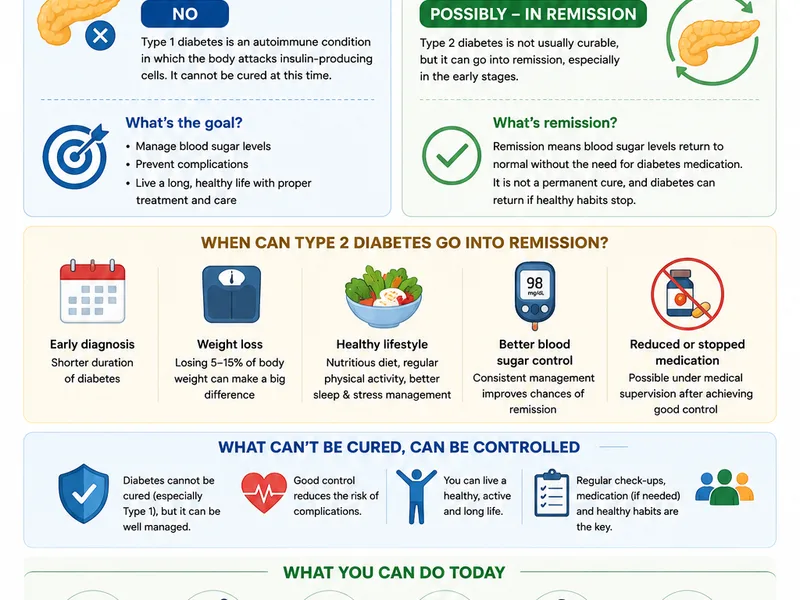
No, diabetes is not currently curable. <cite index="128-1">There are no treatments that make diabetes go away completely, and many people with diabetes will need medication for life. Some people with type 2 diabetes may be able to reach remission, but this is different from a cure.</cite> Type 1 diabetes has no remission pathway at all — it requires lifelong insulin regardless of lifestyle changes.
[REVIEWER: add clinical insight here — e.g., how you respond when a patient asks about a "cure" they've read about online]
Why "Cure" and "Remission" Aren't the Same Thing
This distinction matters enough that a coalition of major diabetes organizations formally addressed it. <cite index="130-1">A consensus report from the American Diabetes Association, the European Association for the Study of Diabetes, Diabetes UK, the Endocrine Society, and the Diabetes Surgery Summit clarified that a "cure" would mean all aspects of diabetes are completely normalized, with no further clinical follow-up or management needed to prevent high blood sugar or related health risks. There is no cure for diabetes by this definition.</cite>
Remission is a narrower, more honest claim. <cite index="129-1">When diabetes goes into remission, the body shows no signs of diabetes, but the disease is technically still considered present.</cite> The formal criteria are specific: <cite index="133-1">remission means hemoglobin A1c (a measure of average blood sugar over about three months) staying below 6.5% for at least three months without any diabetes medication. Remission can only be diagnosed after all diabetes medications have been stopped for at least that long — it can't be claimed while someone is still taking medication.</cite>
There's a reason experts chose this specific word instead of "cured." <cite index="133-1">The term remission is used because a person's diabetes may not currently be active or progressing, but this change isn't guaranteed to be permanent.</cite>
What About "Reversal"?
A third term shows up often in casual conversation, and it's worth untangling too. <cite index="130-1">Diabetes "reversal" describes returning to blood glucose levels below the diagnostic threshold for diabetes, but — unlike remission — it doesn't necessarily imply that ongoing support is still needed to prevent blood sugar from rising again.</cite> In practice, "remission," "reversal," and even "resolution" are often used loosely and interchangeably online, which is part of why confusion about a "cure" persists. Medically, none of these terms mean diabetes has been eliminated for good.
How Common Is Remission, Really?
Even among people who achieve remission, it's a minority outcome, not a typical one. <cite index="133-1">Estimates suggest that around 5% of people living with diabetes could go into remission,</cite> and that's with meaningful effort behind it — most often substantial weight loss, sometimes combined with intensive lifestyle programs, medication changes, or bariatric surgery.
It's also not evenly distributed. Remission tends to be more achievable for people who are younger, have had diabetes for a shorter time, started with less severe blood sugar elevation, and needed fewer medications to begin with — all signs that the pancreas's insulin-producing cells still had more capacity left to recover.
Why Remission Still Requires Ongoing Monitoring
Reaching remission doesn't mean stepping away from medical care. <cite index="133-1">People who achieve remission still need regular monitoring — HbA1c and other blood sugar testing at least once a year — to watch for the return of high blood sugar. There can also be lingering effects from blood sugar elevation that occurred in the past, even after remission is reached.</cite>
This ongoing risk isn't rare. <cite index="132-1">Even people who normalize their blood sugar for years can relapse if they regain weight, get older, or experience other metabolic stress — remission is not a permanent state, and doctors deliberately avoid calling it a cure because the underlying risk never fully disappears.</cite> One physician described it through a useful analogy: <cite index="127-1">managing type 2 diabetes remission is similar to recovering from a shoulder injury through surgery and physical therapy — you have to continue the ongoing effort that got you there to keep the problem from coming back.</cite>
[REVIEWER: add clinical insight here — e.g., how often you recommend follow-up testing for a patient in remission, or what you watch for that might signal early relapse]
What About Type 1 Diabetes and Prediabetes?
Type 1 diabetes doesn't have a remission pathway comparable to type 2. <cite index="129-1">Type 1 diabetes is an autoimmune disease where the body destroys the insulin-producing cells in the pancreas, meaning people with type 1 diabetes don't make insulin at all — without it, the body can't regulate blood glucose,</cite> and no lifestyle change reverses that underlying destruction.
Prediabetes is a different story, and arguably where the "reversible" language fits best. <cite index="128-1">Prediabetes — the stage before diabetes develops — may be reversible with committed lifestyle changes, including diet and exercise,</cite> which is part of why catching elevated blood sugar early, before a full diabetes diagnosis, offers the most flexibility.
Practical Takeaway
Diabetes isn't curable, and it's worth being skeptical of any claim that says otherwise. What is real, for some people with type 2 diabetes, is remission — a meaningful but narrower outcome that requires sustained effort and ongoing monitoring, not something achieved once and then forgotten. Type 1 diabetes has no remission pathway at all, while prediabetes offers the most genuine opportunity to reverse course before diabetes fully develops. Anyone interested in pursuing remission should talk to a doctor about a realistic, personalized plan rather than relying on generic online claims.
Frequently Asked Questions
Is there a cure for diabetes? No. There is currently no treatment that eliminates diabetes completely for any type. Some people with type 2 diabetes can achieve remission, a distinct medical term meaning blood sugar returns to normal without medication, but this isn't the same as a cure.
What's the difference between diabetes remission and a cure? A cure would mean diabetes is completely gone with no further monitoring needed, which doesn't currently exist. Remission means blood sugar has returned to normal without medication for at least three months, but ongoing monitoring is still required since the condition can return.
Can type 1 diabetes go into remission? No, not in the way type 2 diabetes can. Type 1 diabetes results from the destruction of insulin-producing cells in the pancreas, and this damage doesn't reverse, meaning lifelong insulin is required regardless of lifestyle changes.
How common is diabetes remission? Remission is possible but uncommon — estimates suggest roughly 5% of people with diabetes achieve it, typically through significant weight loss and sustained lifestyle changes. It's more achievable for people with a shorter diabetes duration and less severe blood sugar elevation at the outset.
Can prediabetes be reversed? Yes, prediabetes has the best chance of being reversed compared to diagnosed diabetes. Committed lifestyle changes, including diet and physical activity, can bring blood sugar back to a normal range before it progresses to type 2 diabetes.