A hospital visit most Indians will recognise
Anyone who has taken an elderly parent to a large government hospital knows the drill. You get the prescription, then you're on your own figuring out which building, which floor, which counter. Corridors branch off in every direction. Nobody explains where the X-ray department actually is.
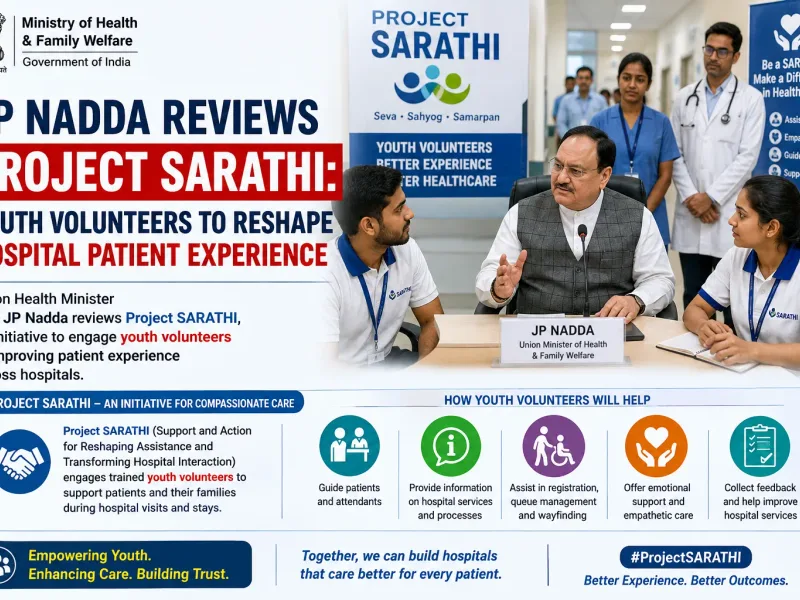
That gap — the space between "you've been diagnosed" and "you know what to do next" — is exactly what Project SARATHI is trying to close. Union Health Minister JP Nadda chaired a high-level meeting on August 1 to review whether this youth-volunteer programme, currently running at PGIMER Chandigarh, should be rolled out across central government hospitals nationwide.
What is Project SARATHI, exactly?
SARATHI trains young volunteers to do the unglamorous but genuinely useful work that clinical staff rarely have time for. That includes guiding patients through hospital navigation, offering wheelchair and stretcher assistance, and pointing people toward the right diagnostic services. None of it involves clinical decisions. It's closer to what a good caregiver or a well-briefed family member would do — except most patients don't have that person available, especially those travelling from smaller towns for tertiary care.
During the meeting, Nadda made a point that's easy to nod along to but harder to actually build into a hospital system: patient-centric healthcare extends beyond clinical treatment. It includes whether patients and their attendants get timely guidance and a bit of compassion during a hospital visit that's often already stressful.
The numbers behind the pilot
According to the Ministry of Health and Family Welfare, the PGIMER Chandigarh pilot has mobilised more than 2,500 volunteers who've logged over 1.5 lakh service hours. A study by PGIMER's Department of Community Medicine found a 26% reduction in overall patient navigation time for those assisted under the scheme.
That 26% figure deserves a moment of scrutiny rather than blind repetition. It comes from one hospital, one study, over a defined period — it's not yet proof that the same result will hold at, say, a large district hospital in a different state with different patient volumes and different physical layouts. Still, it's a real, measured outcome from a real pilot, which is more than most pilot programmes can claim this early. If you're researching government health insurance and hospital access schemes more broadly, this kind of operational-level data is worth tracking alongside coverage numbers.
Why non-clinical support actually matters clinically
In clinical practice, this is often the part that gets missed: a patient who arrives late for a diagnostic scan because they got lost isn't just inconvenienced, they can end up rescheduling, which delays diagnosis and treatment. A confused attendant who doesn't know where to collect reports can hold up a discharge by hours. None of this shows up in mortality statistics, but it eats into bed turnover, staff time, and patient trust.
Mansukh Mandaviya, Union Minister for Youth Affairs and Sports, also attended the review — a signal that this isn't being framed purely as a health ministry project. It's being pitched as youth mobilisation too, with plans to integrate SARATHI with the MY Bharat (Mera Yuva Bharat) platform for structured volunteer engagement. That's a sensible pairing on paper: India has a large pool of young people looking for meaningful, resume-relevant volunteer work, and hospitals genuinely need reliable, punctual help with tasks that don't require a medical degree.
The harder questions before nationwide scale-up
Expanding a Chandigarh-sized pilot to hospitals across the country isn't just a matter of copying a template. A few things stand out.
Funding and staffing structure need clarity — will volunteers be paid a stipend, purely voluntary, or something in between, and who supervises them day to day? Training consistency matters too; a volunteer at a busy metro hospital handling elderly patients with mobility issues needs different preparation than one at a smaller facility. And there's the question of accountability — what happens if a volunteer gives incorrect guidance, or a wheelchair transfer goes wrong?
The meeting reportedly discussed a "scalable framework with digital monitoring systems," which suggests these concerns are at least on the ministry's radar. Whether that translates into workable safeguards is something worth watching over the next few months, not assuming.
A modest but real improvement, if it holds
Is Project SARATHI going to fix India's public hospital system on its own? No — and to be fair, nobody involved is claiming that. What it can do, if scaled carefully, is shave off the friction that makes an already difficult hospital visit worse. For patients dealing with chronic conditions requiring repeat hospital visits or neurological conditions needing multiple diagnostic steps, that kind of friction adds up fast.
If your family is navigating a public hospital system right now, it's reasonable to ask staff or the hospital helpdesk whether a volunteer-assistance programme is available at your facility, rather than assuming one exists everywhere yet — the rollout, as of this review, is still in the planning stage for most of the country. For anything involving your own diagnosis, medication, or treatment plan, that conversation still belongs with your treating doctor — a volunteer guide is not a substitute for medical consultation and expert opinion.