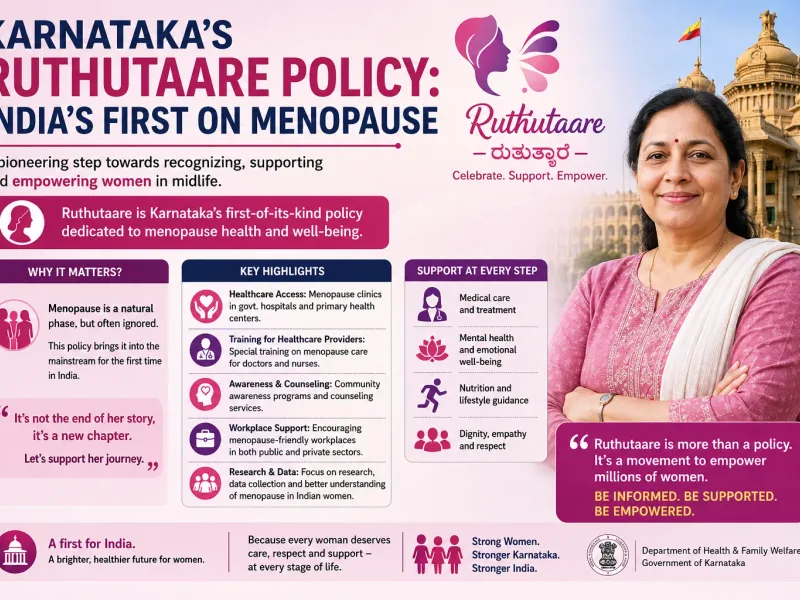
No state in India — and no national programme either — has ever built a health policy around menopause specifically. Karnataka is now trying to change that with a new initiative called Ruthutaare, announced by Health and Family Welfare Minister U.T. Khader. In clinical terms, this gap has always been strange: half of India's population will go through menopause, and yet the health system has treated it as something to quietly endure rather than manage.
Khader made the announcement in Bengaluru, saying plainly that Karnataka's existing health policy doesn't adequately address women's health concerns once you move past pregnancy and childbirth. That's not a small admission from a government official. It's also, frankly, accurate — most public health infrastructure in India is built around maternal and reproductive-years care, and everything after that tends to fall through the cracks.
You might wonder why the state chose menopause as the entry point rather than something broader. Khader's own explanation was fairly direct: doctors have told the government that women face a significant mental and physical burden during this transition, and there's currently no structured way to help them manage it.
The policy's stated goal is preventive, not medical-first. It focuses on lifestyle guidance, nutrition, sleep, and stress management rather than leading with medication. That's a meaningful design choice — a lot of menopause-related distress in clinical practice actually responds well to basic lifestyle and awareness interventions, and starting there before jumping to hormone therapy or prescriptions is a reasonable, low-risk first step for a public programme reaching this many women.
The government has set up an expert committee to draft the policy framework, headed by Dr. Jyotsna Mirlay, a consultant and infertility specialist. According to reporting on the announcement, the committee's job includes studying the typical age of menopause onset in the state, distinguishing between natural and surgically induced menopause, and identifying the health risks tied to each.
Actor and former MP Ramya (Divya Spandana) has been named brand ambassador for the awareness campaign — a fairly deliberate move to get a subject that's rarely discussed openly into everyday conversation.
The most concrete piece of the plan so far involves India's existing network of Accredited Social Health Activists, or ASHA workers. These are community health workers who already do door-to-door outreach on maternal and child health, and the government plans to train them over roughly six months to extend that same model to menopause.
Their job under Ruthutaare will be to conduct household visits, collect data on women experiencing perimenopause and post-menopause, and share basic information on nutrition, lifestyle changes, and self-care. It's an unglamorous but genuinely practical approach — ASHA workers already have trust and reach in rural areas that a clinic-based programme alone wouldn't get close to.
What the Data Collection Is Actually For
This isn't just an awareness drive. The state wants real numbers — how many women in a given district are going through menopause, what symptoms are most common, what's driving complications. Dr. Mirlay has pointed to stress, poor food habits, excessive bleeding, and shifting lifestyles as factors already showing up as concerns among women in the state.
Once that data comes in, the expert committee is expected to turn it into specific recommendations the health department can actually implement — screening programmes, midlife women's health clinics, and district-level checks for things like bone and breast health have all been mentioned as part of the broader framework taking shape around Ruthutaare.
A Cautious Read on What This Means
It's worth being honest about where things stand. This is a policy being built, not one that's fully operational yet — the committee is still gathering data, ASHA training is only starting, and there's no confirmed budget or state-wide clinic rollout timeline publicly available as of this writing. Khader has also said the state intends to eventually take the proposal to the Union Ministry of Health and Family Welfare, with the hope that other states might adopt something similar. Whether that happens is genuinely an open question.
What's already meaningful, though, is the acknowledgment itself. A state government publicly naming menopause as a health policy priority — rather than a private, individual issue women are expected to just get through — is a shift in framing that public health advocates have been asking for a long time.
FAQ
What is the Karnataka Women's Health Policy called?
It's named Ruthutaare (also written as Ruthu Thare), announced by Karnataka Health Minister U.T. Khader as the state's first dedicated women's health policy, with its initial phase built around menopause and perimenopause care.
Is this India's first menopause-focused health policy?
Yes, according to state officials, no other Indian state or the central government has previously introduced a policy specifically dedicated to menopause. Karnataka's health minister has described it as a first-of-its-kind initiative.
What will ASHA workers do under this policy?
ASHA workers will be trained over roughly six months to conduct door-to-door visits, collect data on women in perimenopause and post-menopause, and share basic guidance on nutrition, lifestyle, and self-care during this stage.
Who is leading the Ruthutaare policy committee?
An expert committee headed by Dr. Jyotsna Mirlay, a consultant and infertility specialist, has been constituted to study menopause patterns in Karnataka and draft recommendations for the state health department.
Does the policy focus on medication or lifestyle changes?
The stated approach is preventive first — nutrition, sleep, stress management, and lifestyle guidance — rather than leading with medication, though the broader framework is expected to include screening and clinical support as it develops.