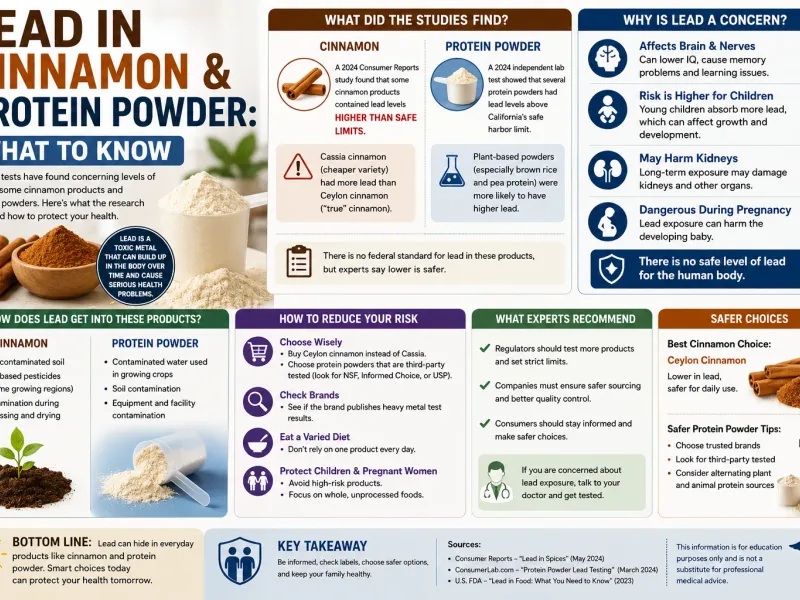
Lead contamination in food isn't new, but two separate investigations have put it back in the spotlight: FDA recalls of ground cinnamon going back to 2023, and a 2025 Consumer Reports investigation that found elevated lead in most of the protein powders it tested. Neither product is inherently dangerous in normal use, but both stories point to a bigger gap — heavy metal contamination in food products that aren't tightly regulated for this specific risk.
The cinnamon issue began with a scare, not a slow discovery. In October 2023, the FDA issued an urgent recall for cinnamon apple puree and applesauce pouches after testing found extremely high lead levels — <cite index="32-1">the original applesauce products contained lead levels as high as 2,270 to 5,110 parts per million</cite>, and the incident ultimately led to <cite index="32-1">460 reported cases of lead toxicity in children</cite>.
Investigators traced the contamination to the cinnamon used in the products, and in 2024 the FDA shifted its focus specifically to ground cinnamon sold on its own. That led to a string of recalls covering multiple brands, with lead levels in the ground cinnamon itself measured far lower than the applesauce incident — <cite index="32-1">in the range of 2.03 to 3.4 parts per million</cite> — but still elevated enough to warrant action.
The recall list has kept growing since. By late 2025, more than a dozen ground cinnamon brands had been flagged, including products distributed through major retailers such as Dollar Tree, Family Dollar, Patel Brothers, and Save-A-Lot. New brands, including SWAD Cinnamon Powder and Lucky Foods brand Cinnamon Powder, were added to the list as recently as October 2025, some found by state agriculture departments testing products independently.
[REVIEWER: add clinical insight here — e.g., how you approach counseling a parent whose child may have consumed recalled cinnamon or applesauce, including when blood lead testing is actually warranted]
Lead exposure isn't like most foodborne risks — the danger builds with repeated exposure rather than causing sudden illness. According to the CDC, <cite index="35-1">lead exposure in children can cause nervous system and brain damage, stunted growth, developmental delays, hearing and speech problems, behavioral problems, and learning disabilities</cite>. Cinnamon shows up disproportionately often in foods marketed to babies and toddlers — applesauce pouches, oatmeal, and snack bars — which is part of why the FDA has treated these recalls with particular urgency.
Symptoms of lead exposure are often invisible at first. As one FDA recall notice put it, <cite index="31-1">short-term exposures to very low levels of lead may not elicit any symptoms, and increased blood lead levels may be the only apparent sign of exposure</cite> in many cases. That's exactly why testing — not waiting for symptoms — is the tool health officials recommend for anyone concerned about exposure.
What the Protein Powder Investigation Found
Separately from the cinnamon recalls, Consumer Reports published a 2025 investigation testing 23 best-selling protein powders and ready-to-drink shakes, spanning dairy, plant-based, and beef-based products from brands including Optimum Nutrition, Garden of Life, Huel, Muscle Milk, Orgain, and Vega. The results were more concerning than the group's last such test 15 years earlier. <cite index="37-1">More than two-thirds of the 23 products tested contained more lead in a single serving than the 0.5 microgram daily threshold Consumer Reports considers safe</cite> — a standard the organization notes matches a California state law, since no federal limit for heavy metals in supplements currently exists.
Some products stood out sharply from the rest. <cite index="39-1">Naked Nutrition's Vegan Mass Gainer measured 7.7 micrograms of lead per serving, and Huel's Black Edition measured 6.3 micrograms — both more than 1,200% over Consumer Reports' level of concern</cite>. Plant-based protein powders were flagged as a particular pattern in the data, with <cite index="39-1">nearly all of the plant-based products tested showing elevated lead levels</cite>, though the group noted two products were concerning enough that its experts recommended against using them at all.
Consumer Reports' lead researcher on the project, chemist Tunde Akinleye, said the results were more troubling than the organization's prior benchmark testing, since <cite index="46-1">the contamination levels turned out to be even worse than the last time the group tested protein powders 15 years earlier</cite>.
[REVIEWER: add clinical insight here — e.g., how you'd counsel a patient who uses protein powder daily about realistic risk versus overreaction, and any groups — such as pregnant patients or young children — who warrant extra caution]
Is Every Protein Powder a Problem?
No — and follow-up testing backs that up. After the initial investigation drew pushback from parts of the supplement industry, Consumer Reports ran a smaller follow-up test in early 2026 on five reader-requested chocolate-flavored protein powders: Premier Protein, Equate, Truvani, Clean Simple Eats, and Ritual. That round found <cite index="43-1">acceptable levels of lead per serving across the board</cite>, which Consumer Reports said contradicted industry claims that low-lead chocolate or plant-based protein powders were essentially impossible to make.
The takeaway isn't that protein powder as a category is unsafe — it's that lead content varies significantly by brand and formulation, and there's currently no regulatory requirement forcing manufacturers to test for it or disclose results. Only a small number of the companies Consumer Reports contacted, including Momentous and Transparent Labs, publish their own heavy metal testing results publicly.
What You Can Actually Do
For cinnamon, the FDA's guidance is straightforward: check any ground cinnamon in your pantry against the current recall list, and if a product matches, stop using it and throw it away rather than returning it to a store. Products with a long shelf life are worth double-checking even if they were purchased a while ago.
For protein powder, Consumer Reports' researchers have suggested a few practical steps rather than avoiding the category entirely: rotate between different brands rather than relying on one product daily, favor brands that publish independent heavy metal testing results, and treat protein powder as a supplement to a protein-rich diet rather than the primary source, since whole foods aren't subject to the same contamination risk pattern.
For both products, anyone with a specific concern about a child's exposure — particularly repeated or heavy use of a recalled or high-lead product — should talk to a pediatrician or health care provider about whether blood lead testing makes sense, rather than trying to interpret exposure risk without it.
FAQ
How do I know if my cinnamon has been recalled for lead? Check the product name, lot code, and best-by date against the FDA's current recall list for ground cinnamon, which has expanded several times since 2023. If your product matches, the FDA recommends disposing of it rather than continuing to use it or returning it to the store.
Is lead in protein powder dangerous? It depends on the brand, the amount consumed, and how often. A 2025 Consumer Reports investigation found more than two-thirds of 23 tested products exceeded the group's daily safety threshold for lead, though there's currently no federal limit on heavy metals in supplements, and a smaller 2026 follow-up test found several other brands within acceptable levels.
Which protein powders had the highest lead levels in the Consumer Reports test? Naked Nutrition's Vegan Mass Gainer and Huel's Black Edition had the highest measured lead levels in the 2025 investigation, both exceeding Consumer Reports' level of concern by more than 1,200%. Several other plant-based products also showed elevated levels, though not as extreme.
Why does cinnamon end up contaminated with lead? Investigators haven't pinned down a single universal cause, but lead contamination in spices like cinnamon has been linked in past cases to contamination during harvesting, processing, or adulteration with lead-containing additives in some supply chains, particularly for products sourced or processed outside strict food-safety oversight.
Should I stop giving my child cinnamon or protein powder? Check any cinnamon against the current recall list and discard matches immediately. For protein powder, most experts don't recommend children rely on protein supplements as a routine part of their diet in the first place, and any parent with a specific exposure concern should talk to a pediatrician about testing rather than guessing.