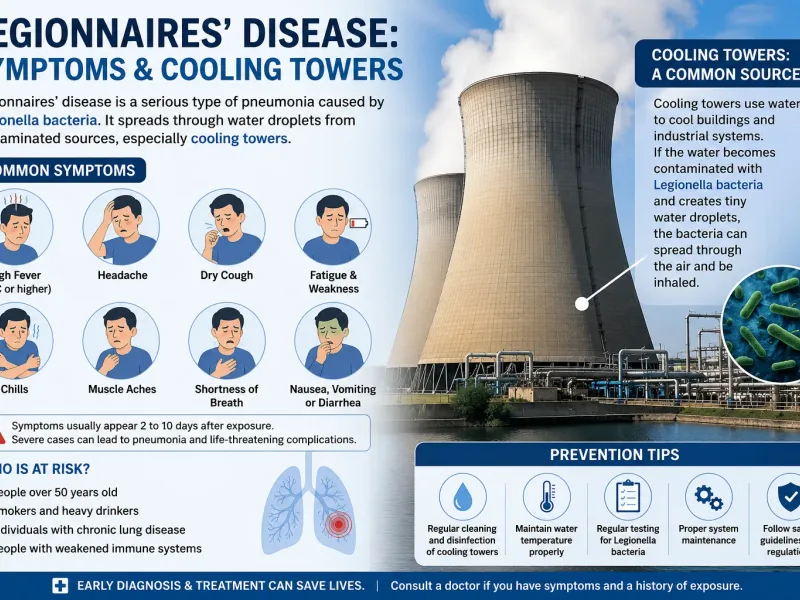
Legionnaires' disease is a severe form of pneumonia caused by inhaling mist or water vapor contaminated with Legionella bacteria. Symptoms typically begin 2 to 10 days after exposure and include high fever, cough, shortness of breath, and muscle aches. The disease is not contagious — it cannot spread from person to person — but it can be fatal if not treated promptly with the right antibiotics.
Legionnaires' disease gets its name from the first documented outbreak: a 1976 American Legion convention in Philadelphia, where 182 attendees fell ill with a mysterious pneumonia and 29 died. The CDC later identified the culprit as a previously unknown bacterium, now called Legionella pneumophila.
The disease is a type of bacterial pneumonia — a lung infection that causes the air sacs to fill with fluid, making it difficult to breathe. In severe cases it can lead to respiratory failure, kidney failure, and septic shock (a life-threatening drop in blood pressure caused by infection). The CDC estimates between 8,000 and 18,000 people are hospitalized with Legionnaires' disease each year in the United States alone.
The Cooling Tower Connection
Cooling towers are a primary source of large-scale Legionnaires' outbreaks. They are the heat-exchange units — often large, industrial structures on rooftops — used by office buildings, hotels, hospitals, and shopping centers to cool water used in air conditioning and refrigeration systems.
The problem is what happens inside them. Cooling towers circulate warm water, which creates ideal conditions for Legionella to multiply. As the towers operate, they release a fine mist — and if that mist is contaminated with the bacteria, anyone nearby who breathes it in can become infected. Because towers are on rooftops and the mist can drift, outbreaks can affect people who never entered the building and may not even know a cooling tower was nearby.
A 2025 outbreak in Central Harlem, New York City illustrates the pattern precisely. The New York City Health Department identified 118 confirmed cases and seven deaths; whole-genome sequencing linked the clinical isolates to two cooling towers on the same city block, according to a peer-reviewed report in NEJM Evidence. In July 2026, a separate cluster on the Upper East Side confirmed 82 cases linked to Legionella-positive cooling towers in 34 buildings.
The symptoms of Legionnaires' disease closely resemble those of other forms of pneumonia — which is one reason it is frequently misdiagnosed early.
According to the New York State Department of Health and the CDC, symptoms include:
High fever — often above 104°F (40°C)
Cough — dry at first, sometimes producing mucus
Shortness of breath and chest pain
Muscle aches and headaches
Fatigue, chills, and low appetite
Confusion or altered mental status — more common in older adults and severe cases
Diarrhea and nausea in some patients
Symptoms typically begin 2 to 10 days after exposure. The range matters: someone who attended a public event or walked near a building with a contaminated cooling tower may not feel sick for over a week, making the source of exposure difficult to trace without active investigation.
A milder form of the illness — Pontiac fever — causes flu-like symptoms without pneumonia and typically resolves on its own within a few days. It is caused by the same bacteria but does not require antibiotic treatment.
[REVIEWER: add clinical insight here — e.g., how Legionnaires' disease presents differently from community-acquired pneumonia caused by other bacteria, and what prompts a clinician to test specifically for Legionella rather than treating empirically for typical pneumonia]
Who Is Most at Risk?
Most healthy people exposed to Legionella do not become infected. The bacteria tend to cause serious illness in those with underlying vulnerabilities, according to the New York State Department of Health:
Adults aged 50 and older
Current or former smokers — smoking damages the airways' ability to clear bacteria
People with chronic lung disease, such as COPD or emphysema
People with weakened immune systems — including those with cancer, diabetes, or kidney failure, and those on immunosuppressive medications after organ transplants or chemotherapy
Men are diagnosed more often than women, and incidence rates are highest in Black Americans, according to a 2022 study in Emerging Infectious Diseases published by the CDC. Cases peak in summer and early fall, when cooling towers are most active and temperatures are highest.
How Cases Have Grown in the US
The trend line is striking. Reported Legionnaires' disease cases began rising in the US around 2003 and continued climbing for nearly two decades. The age-standardized average incidence was 0.48 cases per 100,000 people during 1992–2002, rising to 2.71 per 100,000 by 2018 — a more than five-fold increase, according to the Emerging Infectious Diseases study. Nearly 10,000 confirmed cases were reported in 2018 alone, and true numbers are likely higher because many cases are never diagnosed.
The reasons for the rise are not fully understood. Dr. Laura Cooley of the CDC's Respiratory Diseases Branch has pointed to multiple contributing factors: an aging population, more people on immunosuppressive medications, warmer ambient temperatures creating better conditions for bacterial growth, and possibly more Legionella in building water systems.
How Is It Diagnosed and Treated?
Diagnosis is the critical bottleneck. Because Legionnaires' disease looks like many other kinds of pneumonia, it is easy to miss without specific testing. The most commonly used test is a urine antigen test — a quick test that detects proteins shed by the bacteria in urine. The urine antigen test is fast and widely available, but it primarily detects Legionella pneumophila serogroup 1 (the most common type). Culture testing — growing the bacteria from a sputum or lung sample — takes three to five days but can identify other Legionella strains.
During the 2025 Central Harlem outbreak, NYC Health Department investigators reached out to clinicians across the outbreak zone and added reminders in hospital medical record systems to order Legionella cultures, illustrating how actively case-finding must be pursued during community clusters.
Legionnaires' disease is treatable with antibiotics, but the choice of antibiotic matters. The bacteria respond poorly to penicillin and standard beta-lactam antibiotics used for typical pneumonia. OSHA guidance and the Infectious Diseases Society of America identify fluoroquinolones such as levofloxacin and newer macrolides such as azithromycin as appropriate first-line treatments. Earlier treatment leads to better outcomes.
The CDC reports that approximately 1 in 10 people who get Legionnaires' disease will die; that rate rises in hospital-acquired cases and in people with underlying health conditions.
[REVIEWER: add clinical insight here — e.g., typical inpatient vs. outpatient management decisions, clinical red flags that indicate ICU-level care, and whether outcomes differ meaningfully between early and late antibiotic initiation]
How Cooling Towers Are Regulated
New York State, which has experienced multiple large outbreaks, was among the first US jurisdictions to mandate Legionella testing and water management for cooling towers. Buildings are required to register cooling towers, conduct routine disinfection, and test water for bacteria. NYC's Cooling Tower Registry tracks towers citywide, enabling rapid environmental sampling when cases are detected.
Despite these regulations, contaminated towers continue to appear in outbreak investigations — often because maintenance lapses between required testing periods, or because new construction introduces unregistered systems. The 2025 Central Harlem outbreak identified one cooling tower system in a new building that was not yet in the registry.
Building water management plans — systematic programs to control Legionella risk across a building's entire water system — are recommended by the CDC and OSHA for healthcare facilities, hotels, and large commercial buildings. Whether these plans are required varies by jurisdiction.
FAQ
What are the first symptoms of Legionnaires' disease? The first signs are typically high fever, chills, muscle aches, and headache — symptoms that resemble a bad case of flu. A cough and shortness of breath usually follow as the infection progresses to pneumonia. Symptoms begin 2 to 10 days after exposure to contaminated water vapor, according to the New York State Department of Health.
Can you get Legionnaires' disease from a cooling tower if you're outside? Yes. Cooling towers release fine water mist that can carry Legionella bacteria into the surrounding air. People walking near a building with a contaminated cooling tower can inhale the mist and become infected without entering the building. Multiple large outbreaks have been traced to this mechanism, including the 2025 Central Harlem outbreak.
Is Legionnaires' disease contagious? No. Legionnaires' disease cannot spread from one person to another. You can only get it by breathing in mist or water droplets that contain Legionella bacteria. You cannot get it from drinking contaminated water, from air conditioning units that recirculate indoor air, or from contact with a sick person.
How is Legionnaires' disease different from other types of pneumonia? The symptoms overlap significantly, which makes it easy to miss. Unlike typical bacterial pneumonia, Legionnaires' disease does not respond well to standard penicillin-type antibiotics — it requires specific antibiotics such as fluoroquinolones or azithromycin. A urine antigen test or sputum culture is needed to confirm the diagnosis, according to OSHA and the CDC.
When should I see a doctor if I think I have Legionnaires' disease? Seek medical care promptly if you develop a high fever, cough, shortness of breath, or muscle aches — especially if you have been in or near an area where a Legionnaires' outbreak has been announced, or if you've recently used a hotel hot tub, visited a hospital, or spent time near large buildings. Tell your doctor about possible exposures; that information can guide whether a Legionella-specific test is ordered.
Practical Takeaway
Legionnaires' disease is treatable, but treatment must be prompt and must use the right antibiotics. If you have high fever, cough, and shortness of breath — particularly during summer months or following an announcement of a local Legionnaires' cluster — see a doctor and mention any potential exposure to cooling tower mist, hot tubs, or large building water systems. Do not assume it is a common cold or typical flu. Standard penicillin-type antibiotics will not work; your doctor needs to consider Legionella specifically to order the right test and the right treatment.
This article must be reviewed and attributed to a named, qualified medical reviewer — such as a board-certified infectious disease physician or pulmonologist — before publishing. It is intended for general education only and does not constitute medical advice or treatment recommendations. Consult a licensed healthcare provider if you have symptoms or concerns.
Sources
US Centers for Disease Control and Prevention (CDC). About Legionnaires' Disease, 2025.
US Occupational Safety and Health Administration (OSHA). Legionellosis: Medical Information.
New York State Department of Health. New York State Response to Legionella and Cooling Towers — Questions and Answers.
New York City Department of Health and Mental Hygiene. Legionnaires' Disease. (July 2026 outbreak data)
Barskey AE, Derado G, Edens C. Rising Incidence of Legionnaires' Disease and Associated Epidemiologic Patterns, United States, 1992–2018. Emerging Infectious Diseases. 2022;28(3):527–538. CDC/DOAJ.
Outbreak of Legionnaires' Disease Associated with Cooling Tower Systems in Central Harlem. NEJM Evidence, 2026.
CDC MMWR. Legionnaires Disease Associated with a Private-Use Hot Tub in a Vacation Rental Property — New York, October 2024–April 2025.
Auwaerter PG (Johns Hopkins University). Comment on rising Legionnaires' incidence, via Medscape, February 2022.
Image Suggestion
An editorial photograph taken from street level looking up at industrial rooftop cooling towers on a large urban building — ideally showing the vapor/mist plumes visible in warm weather. The framing should convey the scale and proximity to street-level pedestrians. Avoid generic "petri dish" or "lungs" medical stock imagery; the environmental, urban angle is the story.
Schema Suggestion
MedicalWebPage + FAQPage MedicalWebPage signals E-E-A-T credibility appropriate for a YMYL health topic with named clinical sources; FAQPage enables rich result display for all five FAQ entries in Google Search and AI Overviews, maximizing the likelihood of direct citation in featured snippets and AI-generated responses.