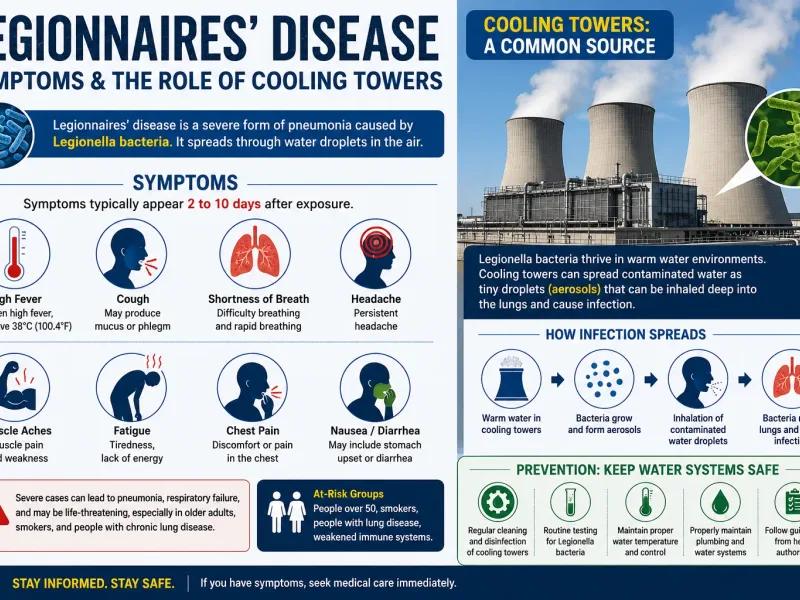
Legionnaires' disease typically causes fever, cough, chills, muscle aches, headache, and shortness of breath, with symptoms appearing two days to two weeks after exposure to contaminated water mist, according to the CDC. Because it's a form of pneumonia, it can also cause chest pain, fatigue, and in more severe cases, confusion or gastrointestinal symptoms like diarrhea.
Legionella bacteria occur naturally in freshwater environments like lakes and streams, but they become a health hazard when they multiply in human-made water systems that aren't properly maintained. According to OSHA, this includes <cite index="46-1">poorly maintained domestic and industrial water systems, cooling towers, and heating, ventilation, and air conditioning (HVAC) systems</cite>.
Cooling towers — rooftop structures that use water and a fan to regulate temperature in large buildings — are a particularly common source in community-wide outbreaks. The Mayo Clinic explains why: <cite index="47-1">bacteria can grow and spread more easily in large water systems, and most people become infected by breathing in tiny water droplets containing Legionella, whether that's spray from a shower, sink, hot tub, or the water system that cools large buildings</cite>.
Cooling towers aren't the only source. The CDC notes that outbreaks are also linked to <cite index="49-1">hot tubs, hot water tanks, large plumbing systems, and decorative fountains</cite>, and are most common in buildings or structures with complex water systems such as hotels, hospitals, long-term care facilities, and cruise ships.
Importantly, a building's cooling tower is separate from home or car air conditioning. As Mayo Clinic points out, <cite index="47-1">home and car air conditioners don't use water for cooling</cite>, so they don't carry the same Legionella risk that rooftop cooling towers do.
[REVIEWER: add clinical insight here — e.g., how you counsel patients or building residents on realistic versus unnecessary precautions when a nearby cooling tower has tested positive for Legionella]
No. Health authorities are consistent on this point: Legionnaires' disease spreads by breathing in contaminated water mist, not from person to person. New York City's Health Department states plainly that <cite index="44-1">Legionnaires' disease is not contagious — you cannot get it from someone else, and you cannot get it by drinking water, cooking, or using air conditioning, since the bacteria does not spread through cooled air from air conditioners</cite>.
This is a distinction worth remembering during a community cluster: living or working near a contaminated cooling tower does not put someone at risk from casual contact with sick neighbors or coworkers. The risk comes specifically from breathing in the mist itself, typically within the vicinity of the contaminated water source.
Who's Most at Risk
Most people exposed to Legionella don't get sick at all. The NYC Health Department notes that <cite index="44-1">illness usually occurs after high or repeated exposure, especially in people who are already at increased risk</cite>.
Certain groups face meaningfully higher risk of severe illness. Health officials have repeatedly flagged people age 50 and older, current or former smokers (including vapers), and people with chronic lung disease or a weakened immune system as being at elevated risk. CNN's reporting on a recent outbreak underscored the same point: <cite index="43-1">most people exposed to Legionella bacteria don't get sick at all, but people can get sick after high or repeated exposure, especially in vulnerable groups including people over 50, those who vape or smoke, or people with weakened immune systems or underlying health conditions</cite>.
The stakes of an actual infection are significant. According to the CDC, roughly 1 in 10 people who develop Legionnaires' disease die from complications — a mortality rate that rises further among people who acquire it during a stay in a healthcare facility.
[REVIEWER: add clinical insight here — e.g., what specific factors you weigh when deciding to test a patient for Legionella versus treating empirically for common pneumonia, especially in someone without a known relevant exposure]
Community Clusters vs. Building Clusters
Public health investigations typically distinguish between two patterns of Legionnaires' disease cases. In a community cluster, multiple people across a neighborhood are diagnosed around the same time, and the common exposure source is often a cooling tower, hot tub, or spray fountain, according to the NYC Health Department. In a building cluster, multiple cases occur among people who live in the same building, and the exposure is typically tied to that building's plumbing system — most often its hot water system, which can expose residents through mist while showering.
Health departments generally investigate a building's water system when two or more confirmed cases are linked to it within a 12-month period. That distinction matters for figuring out where testing and remediation efforts should focus.
When to See a Doctor
Anyone who develops fever, cough, chills, muscle aches, or shortness of breath — particularly after time spent in an area with a known Legionella-positive water source, or after a recent stay in a hotel, hospital, or other large building — should contact a health care provider and mention the potential exposure. Early treatment matters: Legionnaires' disease is treatable with antibiotics and outcomes are meaningfully better when it's caught early, especially in higher-risk patients.
It's also worth mentioning recent travel or nights spent away from home, since public health guidance recommends flagging any overnight stays in the 10 days before symptoms began, as those locations may point investigators toward the exposure source.
FAQ
What are the first symptoms of Legionnaires' disease? Early symptoms typically include fever, cough, chills, muscle aches, and headache, usually appearing two days to two weeks after exposure to contaminated water mist. As the illness progresses, it can cause shortness of breath, chest pain, fatigue, and sometimes confusion or diarrhea.
Can you get Legionnaires' disease from a cooling tower? Yes. Cooling towers use water and a fan to regulate temperature in large buildings, and if not properly maintained, Legionella bacteria can grow in that water and spread through the fine mist the tower releases into the surrounding air, which people can then breathe in.
Is Legionnaires' disease contagious between people? No. It spreads only through breathing in contaminated water mist, not from person to person, and it isn't linked to drinking water, cooking, or air conditioning units, according to health officials.
Who is at higher risk for severe Legionnaires' disease? People age 50 and older, current or former smokers and vapers, and those with chronic lung disease or a weakened immune system face a higher risk of severe illness. About 1 in 10 people who develop Legionnaires' disease die from complications, according to the CDC.
Does air conditioning spread Legionella bacteria? Home and car air conditioners don't use water for cooling, so they don't carry Legionella risk. Large buildings that use water-based cooling towers for their air conditioning systems can be a source if the tower isn't properly maintained, but the bacteria doesn't spread through the cooled air itself.
Practical Takeaway
Legionnaires' disease symptoms overlap closely with ordinary pneumonia and flu, which is exactly why exposure matters: a recent stay in a large building, time spent near a known Legionella-positive cooling tower, or an overnight trip in the past 10 days are the details that help a clinician connect fever and cough to the right cause. Anyone in a higher-risk group who develops these symptoms after a plausible exposure should seek medical care and mention that exposure directly, since early antibiotic treatment significantly improves outcomes.
This article must be reviewed and attributed to a named, qualified medical reviewer — such as a board-certified infectious disease physician or pulmonologist — before publishing. This article is intended for general education only and does not constitute medical advice or a diagnosis.
Sources
US Centers for Disease Control and Prevention (CDC). Legionella (Legionnaires' Disease and Pontiac Fever): Signs and Symptoms.
Mayo Clinic. Legionnaires' Disease – Symptoms and Causes.
NYC Health Department. Legionnaires' Disease.
Occupational Safety and Health Administration (OSHA). Legionellosis (Legionnaires' Disease and Pontiac Fever) – Overview.
CNN Health. Dozens of New York cooling towers test positive for Legionnaires' bacteria as outbreak reaches 63 cases, July 2026.
PBS News. What to know about Legionnaires' disease making people sick in New York City, July 2026.
Category
Infectious Disease / Public Health / Patient Education
Image Suggestion
A realistic close-up photograph of a rooftop cooling tower structure — showing the fan housing and water basin design — rather than a generic bacteria microscope image, since understanding what a cooling tower actually looks like helps readers connect the exposure source to real buildings around them.
Schema Suggestion
MedicalWebPage + FAQPage — MedicalWebPage supports YMYL/E-E-A-T credibility appropriate for infectious disease patient education; FAQPage enables rich-result and AI Overview eligibility for the direct symptom and transmission questions in the FAQ section.