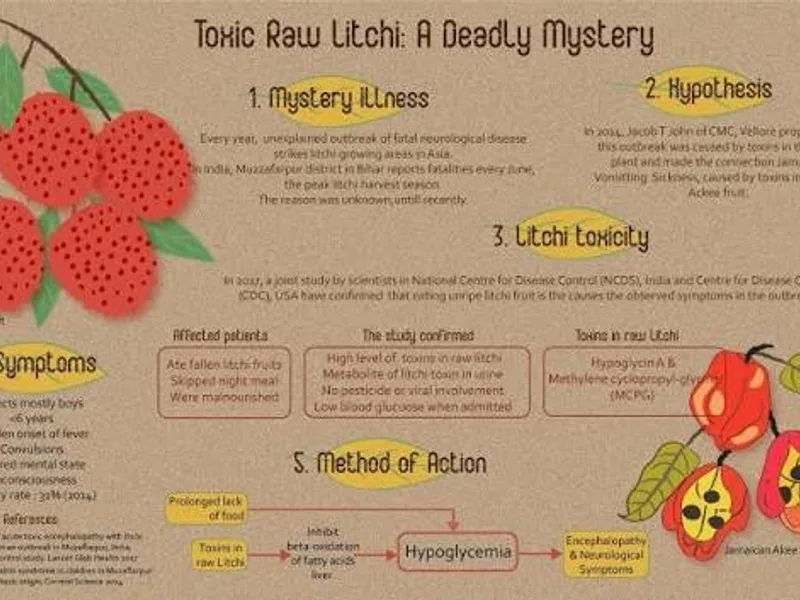
Muzaffarpur sits in the heart of India's biggest litchi-growing belt, and that geography comes with a public health responsibility most other districts don't have. Since the mid-2010s, after repeated seasonal outbreaks of Acute Encephalitis Syndrome (AES) — locally called chamki bukhar — linked to the litchi harvest, the district administration and state health department have issued a standing advisory each year ahead of the season.
The advisory isn't dramatic or alarmist when you actually read it. It's a short, practical set of dos and don'ts aimed mostly at families with young children, anganwadi workers, and school staff. The timing lines up almost exactly with the litchi harvest window, roughly mid-May through mid-June, and that overlap is deliberate — it's when case numbers have historically spiked.
What's Actually Behind the Risk
Research from India's National Centre for Disease Control and international health agencies has pointed to a toxin present in unripe litchi seeds, one that interferes with the body's ability to produce glucose overnight. A child who eats litchis through the day, especially on an empty stomach, and then skips dinner can experience a sharp overnight blood sugar drop. That combination appears to be the trigger behind a large share of chamki bukhar cases in the region.
In clinical practice, this is often missed because the pattern looks deceptively simple from the outside — a child seems fine at bedtime and is unresponsive by early morning. That gap is exactly what the advisory is trying to close, by getting parents to intervene earlier in the evening rather than reacting after symptoms appear.
The Core Advisory Points, Explained
Government advisories tend to read like a checklist, so here's what each point actually means in practice rather than just repeating the list.
Ensure Children Eat Dinner Every Night
This is the single most repeated instruction in every version of the advisory, and for good reason. A child who eats a proper meal before sleeping is far less likely to experience the blood-sugar crash linked to unripe litchi toxin exposure. If a child resists dinner after a day of playing and eating fruit, offering something small but real, rather than skipping the meal, matters more than people expect.
Avoid Litchis on an Empty Stomach
Children eating litchis first thing in the morning, before any other food, appears to carry higher risk than eating the same fruit later in the day after a meal. It's a small behavioural shift, but it's one of the few concrete, actionable pieces of prevention advice that exists for this specific illness.
Limit Time in Peak Afternoon Heat
Extended outdoor play during the hottest part of the day adds heat stress on top of everything else, and dehydration compounds the risk picture. Encouraging children indoors or in shade between roughly noon and 3 pm during the season is a small ask with real benefit.
Watch for Early Symptoms Without Delay
The advisory specifically flags sudden drowsiness, refusal to eat, unusual irritability, or any jerking movements as reasons to seek medical help immediately, not after a night of "let's see how they are in the morning." A pediatrician or the nearest hospital should be the first call, not the last resort.
Symptoms Parents Should Not Wait On
If a child shows any of these during litchi season, treat it as urgent rather than routine:
Sudden, unusual drowsiness or difficulty waking
Refusing food or repeated vomiting
High fever appearing suddenly
Jerking movements or seizures
Confusion or a child who "doesn't seem like themselves"
These symptoms can escalate within hours, which is the specific reason this advisory exists in the first place. Calling for an ambulance or getting to emergency care immediately is the right call, not an overreaction.
What Schools and Anganwadi Centres Are Asked to Do
The advisory also extends beyond individual households. Anganwadi workers are typically asked to reinforce evening-meal messaging with families during home visits through the season, and schools in affected blocks sometimes adjust outdoor activity timing during peak summer heat. If your child's school hasn't mentioned this, it's a fair question to raise with them directly, particularly if you're in one of the more affected blocks around Muzaffarpur, Vaishali, or East Champaran.
A Fair Question: Does the Advisory Actually Work?
Case numbers have dropped meaningfully since the advisory system and improved rural health centre response became consistent, and that's worth acknowledging rather than treating the whole thing as symbolic. But it isn't a guarantee, and families who assume "we've never had a case here" are sometimes the ones caught off guard. A general physician or a quick check at a diagnostic centre if anything feels off is a small, reasonable precaution, not overreaction.