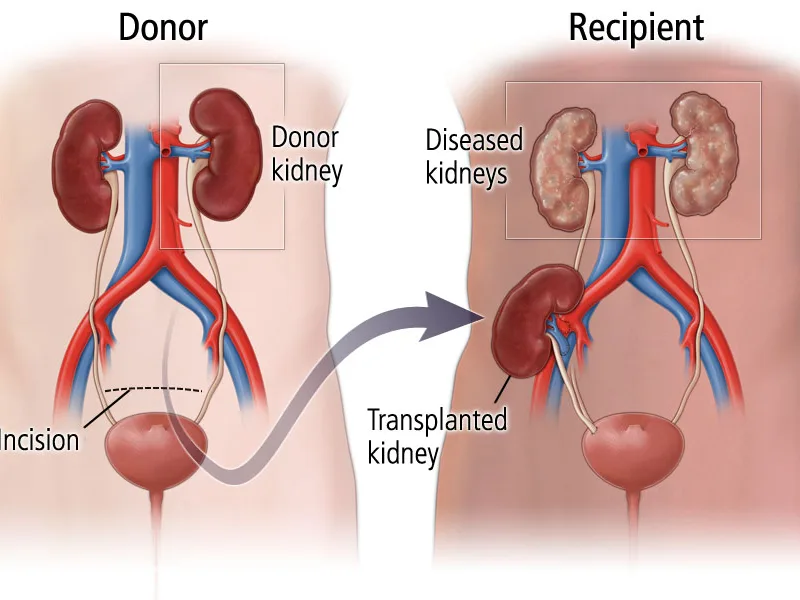
A living donor kidney program can turn a difficult transplant wait into a different path for some patients with kidney failure. But the person giving the kidney needs just as much careful medical attention as the person receiving it.
Living kidney donation means a healthy person gives one kidney to someone whose kidneys can no longer work adequately. Because most people can live with one healthy kidney, living donation is possible in carefully selected adults, but it is still major surgery with potential short- and long-term risks.
What is a living donor kidney program?
A living donor kidney program is a structured service within a transplant centre that evaluates potential donors and recipients before transplantation. The team usually includes transplant physicians, surgeons, nurses and other professionals involved in medical, psychological and social assessment.
The process is deliberately thorough. A person cannot simply volunteer a kidney and proceed directly to surgery.
The transplant team needs to establish whether donation is medically safe for the donor and whether transplantation is appropriate for the recipient. In India, transplant centres must also follow applicable legal and ethical requirements governing organ donation and transplantation.
Doctar's [nephrologist directory] Nephrologists in India can help patients identify kidney specialists for discussion about kidney disease, dialysis and transplant care.
Who may become a living kidney donor?
A potential donor generally needs to be an adult who is healthy enough to undergo surgery and live safely with one kidney. The exact criteria vary between transplant centres and depend on medical history, kidney function and other health factors.
Being a relative does not automatically make someone eligible. Nor does being unrelated automatically rule someone out. The transplant team has to assess each situation individually and apply the relevant legal framework.
Doctar's [kidney health information] Kidney Disease and Health Information discusses why kidney function and ongoing medical monitoring matter when kidney disease becomes more advanced.
Potential donors with significant kidney disease, certain uncontrolled medical conditions or other health concerns may not be suitable. That decision belongs to the transplant team, not the donor or recipient's family.
How donor evaluation works
Donor assessment is one of the most important parts of the program. The goal is not merely to determine whether a kidney can be removed, but whether donation is reasonably safe for the person giving it.
The evaluation may include blood and urine tests, kidney-function measurements, blood-pressure assessment, imaging and checks for other medical conditions. Doctors may also assess cardiovascular health and surgical fitness.
Blood-group testing is part of the compatibility process. Doctar's [guide to blood types] Understanding Blood Types in India explains the basic ABO and Rh blood-group systems.
Compatibility involves more than simply knowing whether two people have the same blood group. Transplant teams consider several immunological factors when assessing whether a donor kidney is suitable.
What happens if blood groups do not match?
A blood-group mismatch does not necessarily mean the discussion ends. Depending on the transplant centre and the specific case, doctors may consider specialised approaches or paired exchange programs where available.
Paired kidney exchange involves two or more donor-recipient pairs whose intended donations are incompatible, allowing compatible exchanges between pairs. Availability and eligibility depend on the transplant program and local regulations.
Patients should ask a transplant centre specifically about these options rather than assuming an incompatible blood group makes transplantation impossible.
Doctar's [kidney transplant information] Kidney Transplant and Treatment Options explains that kidney transplantation may involve a living or deceased donor and that suitability varies between patients.
Donor safety comes first
The central ethical principle of living donation is straightforward: the donor should not be pressured into giving an organ.
An independent assessment is therefore important. A potential donor should have the opportunity to understand the risks, ask questions privately and withdraw from the process without being forced to justify the decision.
This can become emotionally complicated when a parent, spouse, sibling or close friend is seriously ill. A person may genuinely want to help while also feeling that saying no would make them a bad family member. That is precisely why donor protection matters.
In clinical practice, this is often missed because the recipient's illness naturally becomes the focus of attention. A good living donor program keeps asking a separate question: is donation safe and freely chosen for this person?
What are the risks for the donor?
Kidney donation is generally performed in carefully selected people, but it is not risk-free. The operation carries the usual risks associated with major surgery, including bleeding, infection, blood clots, complications from anaesthesia and problems related to the surgical wound.
There are also longer-term considerations. Donors need appropriate follow-up to monitor blood pressure, kidney function and general health.
The risk profile varies from person to person. A transplant centre should explain the donor's individual risks rather than relying on general assurances.
Doctar's [kidney failure guide] Understanding Kidney Failure describes the importance of kidney function, blood pressure and other health factors in people with serious kidney disease.
Recovery after donation
Most donors need time away from normal activities after surgery. Recovery depends on the surgical technique, the donor's health and the nature of their work.
The transplant team usually provides instructions about wound care, physical activity, follow-up appointments and when normal activities can resume. Recovery should not be rushed simply because the recipient is waiting to return home.
Long-term follow-up is part of responsible donor care. A donor should continue routine healthcare and tell clinicians about their history of kidney donation.
Doctar's [kidney health and lifestyle information] Kidney Health and Lifestyle discusses factors that can influence kidney health, including blood pressure and lifestyle.
What happens to the recipient?
For the recipient, transplantation involves surgery to place the donor kidney into the body. The original kidneys are often left in place unless there is a specific medical reason to remove them.
After transplantation, the recipient needs ongoing medical care and medicines that suppress the immune system. These drugs help prevent the body from rejecting the transplanted kidney, but they can increase susceptibility to certain complications, including infections.
Doctar's [kidney transplant and dialysis guide] Dialysis and Kidney Transplant Options discusses transplantation as a kidney-replacement option for people with advanced kidney failure.
A successful transplant can reduce or eliminate the need for dialysis, but transplantation is not a permanent guarantee. The recipient needs lifelong follow-up.
Living donation and kidney failure
A living donor program is generally considered when a patient has advanced kidney disease and transplantation is medically appropriate.
The timing can vary. Some patients are evaluated for transplant before dialysis becomes necessary, while others reach transplantation after spending time on dialysis.
Doctar's [guide to managing kidney failure] Managing Kidney Failure Without Dialysis explains the role of transplantation alongside dialysis and other forms of kidney-failure management.
The right timing depends on kidney function, overall health, transplant eligibility and the medical team's assessment.
Choosing a transplant centre
Experience matters because living donation requires coordination between donor and recipient care. Patients should look for a transplant centre with an appropriate transplant team, donor evaluation process, surgical capability and long-term follow-up.
Doctar's [hospital directory] Hospitals in India includes transplant surgeons, nephrologists and other specialists among its searchable categories.
Some Doctar-listed facilities specifically mention kidney transplantation. [AIG Hospital in Hyderabad] AIG Hospital, Hyderabad lists nephrology, urology and kidney-and-transplantation services.
In Chennai, [Sri Hospitals] Sri Hospitals, Chennai lists nephrology, urology and kidney transplant services.
For Agartala, [Dr Mukut Debnath's clinic] Dr Mukut Debnath Clinic, Agartala describes kidney transplant surgery and pre- and post-transplant care.
Doctar also lists [Tripura Medical College and Dr. BRAM Teaching Hospital] Tripura Medical College and Dr. BRAM Teaching Hospital, Agartala with kidney transplant surgery among its listed specialist services.
These listings are examples of services shown on Doctar, not endorsements. Patients should confirm that the centre currently performs living-donor transplantation and ask about its donor evaluation and follow-up arrangements.
Finding the right kidney specialist
A nephrologist manages kidney disease and often plays a major role before and after transplantation. A transplant surgeon handles the operation, while other specialists may contribute to donor assessment and recipient care.
Doctar's profile for [Dr. Abhishek Shirkande] Dr. Abhishek Shirkande, Nephrologist and Renal Transplant Physician describes a clinical focus that includes nephrology and renal transplantation.
In Pune, [Dr. Mahesh Rokade] Dr. Mahesh Rokade, Nephrologist and Kidney Transplant Physician is listed by Doctar as a nephrologist and kidney transplant physician.
Doctar's [nephrology home-visit directory] Home-Visit Nephrologists in India can also help users explore nephrologists by location, although a transplant assessment itself will normally require a specialist centre.
For Mumbai patients, [Dr. Niranjan Kulkarni] Dr. Niranjan Kulkarni, Nephrologist is listed as having experience with both deceased-donor and living-donor transplantation.
In Kolkata, Doctar lists [Dr. Upal Sengupta] Dr. Upal Sengupta, Nephrologist with a clinical focus that includes kidney transplantation and dialysis.
What should a potential donor ask?
A potential donor should ask direct questions before making a decision. What tests will I need? Who pays for donor evaluation and care? What are the short- and long-term risks in my case? Who provides follow-up after donation?
The donor should also ask who they can speak with privately if they are uncertain. A transplant program should respect a donor's right to make a voluntary, informed decision.
No one should feel obliged to donate because a family member needs a kidney.