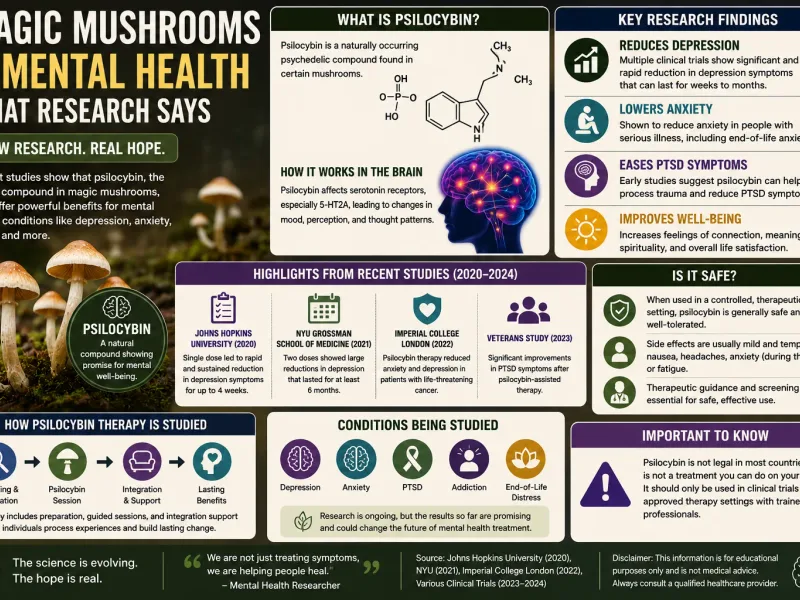
Psilocybin — the active psychedelic compound in "magic mushrooms" — has shown rapid, sustained benefits for treatment-resistant depression, major depressive disorder, PTSD, end-of-life anxiety, and addiction in multiple peer-reviewed randomized clinical trials. The FDA has granted psilocybin Breakthrough Therapy Designation for both treatment-resistant and major depression, and in April 2026 issued national priority review vouchers to three companies in an effort to accelerate the approval process. Psilocybin remains a Schedule I controlled substance at the US federal level and is not yet an approved prescription medicine.
Psilocybin is a naturally occurring psychedelic compound produced by more than 200 species of fungi, widely known as "magic mushrooms" or "psilocybe mushrooms." Following ingestion, the body converts psilocybin to psilocin, the compound that crosses the blood-brain barrier and produces psychedelic effects.
Psilocin works primarily as an agonist of the serotonin 2A receptor (5-HT2AR) — meaning it binds to and activates the same receptors targeted by selective serotonin reuptake inhibitors (SSRIs), the most commonly prescribed class of antidepressants, but through a different mechanism. Activation of the 5-HT2AR in the prefrontal cortex is associated with increased brain plasticity, disruption of rigid thought patterns, and heightened emotional processing, according to peer-reviewed neuropsychopharmacology literature.
The acute psychedelic experience — the "trip" — typically lasts 4 to 6 hours at therapeutic doses of 20–25 milligrams. But the therapeutic benefits observed in clinical trials have often persisted for weeks to months after a single session, a durability that sets psilocybin apart from conventional antidepressants and has driven sustained research interest.
The evidence base for psilocybin in depression is the most robust of any indication, with results from multiple randomized controlled trials published in top-tier journals.
Treatment-Resistant Depression
<cite index="68-1">In an open-label trial of psilocybin-assisted psychotherapy, 63% of 19 participants with treatment-resistant depression responded one week after treatment, and 32% were not on any antidepressant or therapy for a further year, according to results published by Carhart-Harris et al. in Lancet Psychiatry in 2016.</cite>
A 2022 randomized controlled trial published in the New England Journal of Medicine tested a single 25 mg dose of synthetic psilocybin against an active placebo in 233 patients with treatment-resistant depression. The 25 mg dose led to significant reductions in depression scores for at least 6 weeks post-treatment, according to the published trial protocol. Phase 3 trials for treatment-resistant depression are now in progress, with Compass Pathways having reported that its COMP360 psilocybin Phase 3 trial achieved its primary endpoint, according to GoodRx's reporting on clinical pipeline developments.
Major Depressive Disorder
<cite index="68-1">An RCT of 24 participants with major depressive disorder showed large effect sizes for psilocybin-assisted psychotherapy at week 1 (Cohen d = 2.5) and week 4 (Cohen d = 2.6) post-treatment compared with a waitlist control (Davis et al., JAMA Psychiatry, 2021). A long-term follow-up study of the same participants showed response and remission rates of 75% and 58%, respectively, at 12 months.</cite>
A 2021 NEJM randomized controlled trial by Carhart-Harris and colleagues found psilocybin was as effective as escitalopram (the SSRI commonly marketed as Lexapro) in reducing depressive symptoms over six weeks in patients with non-refractory depression, with secondary outcomes favoring psilocybin.
<cite index="67-1">Several psychedelic medications — including ones based on psilocybin — are in the final stages of FDA testing. Results from Phase 3 trials are expected in late 2026 or early 2027.</cite> The uAspire trial — a multicenter, randomized, double-blind Phase 3 study evaluating psilocybin in adults with major depressive disorder — is among those currently underway, according to a 2026 review in PMC.
[REVIEWER: add clinical insight here — e.g., how a psychiatrist would explain the difference between psilocybin-assisted therapy and standard antidepressant therapy to a patient considering clinical trial enrollment, including the role of preparation and integration sessions alongside the drug experience, and what "response" and "remission" mean in practical terms]
PTSD: Emerging Evidence
<cite index="65-1">A 2025 Phase 2 trial found a single 25 mg psilocybin dose improved PTSD symptoms for up to twelve weeks.</cite> PTSD is among the psychiatric conditions most difficult to treat with existing therapies — many patients do not respond to SSRIs or trauma-focused psychotherapy, or respond only partially. The early psilocybin data for PTSD has attracted significant interest from both researchers and federal policymakers.
MDMA-assisted therapy — using a different psychedelic compound — was considered a more advanced candidate for PTSD, but the FDA's advisory committee voted against approval in 2024, citing concerns about clinical trial methodology and blinding. Psilocybin research for PTSD has continued to advance in parallel.
Addiction and Other Conditions
Beyond depression and PTSD, psilocybin has shown preliminary positive effects in several other areas.
Alcohol use disorder: A 2022 randomized trial published in JAMA Psychiatry by Bogenschutz and colleagues found two doses of psilocybin significantly reduced alcohol consumption compared with placebo over 32 weeks.
Tobacco addiction: A landmark open-label study by Johnson and colleagues at Johns Hopkins showed that psilocybin-assisted therapy produced abstinence rates of 67% at 12-month follow-up — substantially higher than rates typically seen with standard nicotine replacement therapy.
End-of-life anxiety: Multiple randomized trials have shown psilocybin reduces existential anxiety, depression, and fear of death in patients with life-threatening cancer diagnoses. Effects persisted for six months or more in several studies.
Obsessive-compulsive disorder (OCD): Early pilot data have shown symptomatic improvement in OCD following psilocybin, according to a review in PMC, though large randomized trials have not yet been completed.
The FDA and Federal Policy in 2026
<cite index="65-1">The FDA has granted psilocybin Breakthrough Therapy Designation for both treatment-resistant and major depression.</cite> Breakthrough Therapy Designation is not approval — it is a process designed to expedite the development and review of drugs that show preliminary evidence of substantial improvement over existing therapies. It gives companies more intensive FDA guidance throughout the trial process.
<cite index="70-1">On April 24, 2026, the FDA issued national priority vouchers to three companies studying psychedelic-based medicines: psilocybin for treatment-resistant depression (Compass Pathways), psilocybin for major depressive disorder (Usona Institute), and methylone for PTSD (Transcend Therapeutics). These vouchers were granted under the FDA Commissioner's National Priority Voucher pilot program as a way to fast-track the review process, potentially cutting down the time it takes for them to reach patients.</cite>
<cite index="65-1">On April 18, 2026, President Trump signed an executive order accelerating the exploration of psychedelic medicines as treatments for psychiatric disorders and providing $50 million in funding for this research.</cite>
Despite this federal policy momentum, psilocybin remains a Schedule I controlled substance nationally, meaning it cannot be legally prescribed outside of authorized clinical trials. Oregon and Colorado have established regulated therapeutic access programs — supervised psilocybin services for adults — though these are distinct from the FDA prescription drug pathway.
What Psilocybin Therapy Actually Involves
Understanding what clinical psilocybin therapy looks like is important for anyone trying to evaluate it accurately.
<cite index="65-1">Psilocybin therapy involves extensive patient screening, multi-hour supervised dosing sessions, and potentially integration with psychotherapy.</cite> At therapeutic doses, the experience typically involves altered perceptions, deep emotional processing, and in many cases a significant subjective experience that participants have described as among the most meaningful of their lives.
<cite index="73-1">Two therapists typically work with each individual, because each patient's hallucinogenic journey could last for several hours.</cite> The therapeutic model treats the subjective experience itself as an important part of the mechanism — the psychological insights and shifts in perspective that occur during the session are thought to contribute directly to the subsequent improvements in symptoms.
This is why psilocybin is categorized as "psilocybin-assisted therapy" rather than simply a drug. The compound is not designed to be taken daily like an antidepressant. It is used in one or two carefully structured sessions, surrounded by preparatory and integrative psychotherapy.
[REVIEWER: add clinical insight here — e.g., what kinds of adverse events have been documented in psilocybin trials — including challenging psychological experiences during sessions — and how clinical settings mitigate these risks through screening, preparation, and real-time therapist support]
Known Risks and Open Questions
Psilocybin has a well-characterized safety profile in healthy adults in controlled settings. Physical toxicity is low: there are no documented cases of lethal psilocybin overdose, and it does not produce physical dependence or withdrawal, according to a review in PMC.
The primary clinical risks are psychological: challenging experiences during sessions (sometimes called "difficult trips"), including acute anxiety, confusion, or temporary paranoia. These are typically manageable with appropriate therapist support, and clinical trial protocols include extensive safety monitoring. However, psilocybin is contraindicated for people with personal or family history of psychosis or bipolar disorder with psychotic features, due to the risk of triggering or worsening psychotic episodes.
Several important questions remain open in the research literature:
Whether effects are permanent or require periodic repeat dosing
The long-term safety of repeated sessions in clinical populations, which has not yet been established through sufficiently large, long trials
How much of the therapeutic effect comes from the drug versus expectation and the surrounding psychotherapy
The optimal dose, preparation approach, and integration protocol for different diagnoses
<cite index="65-1">Most trials to date have involved small samples. Blinding is difficult because patients generally know whether they've received a psychedelic or a placebo.</cite> These are real methodological limitations that the field is actively working to address in larger Phase 3 studies.
FAQ
Does psilocybin actually work for depression? Multiple randomized controlled trials, including studies published in the New England Journal of Medicine and JAMA Psychiatry, have found psilocybin-assisted therapy produces significant improvements in both treatment-resistant and major depression. In one long-term follow-up study, 75% of patients who responded to psilocybin-assisted therapy maintained their response at 12 months. The FDA has granted Breakthrough Therapy Designation for both depression indications.
Is psilocybin legal for mental health treatment? Psilocybin remains a Schedule I controlled substance at the US federal level and is not an approved prescription medicine. It can only be legally administered in federally regulated clinical trials or through state-level regulated programs in Oregon and Colorado. The FDA issued priority review vouchers to three companies in April 2026, which may accelerate the path to approval, with Phase 3 results expected by late 2026 or early 2027.
What conditions is psilocybin being studied for? Psilocybin is under active clinical investigation for treatment-resistant depression, major depressive disorder, PTSD, alcohol use disorder, tobacco addiction, obsessive-compulsive disorder, and anxiety and depression in people with life-threatening illness. Depression has the most robust evidence base, with multiple Phase 2 and Phase 3 randomized controlled trials completed or ongoing as of 2026.
What are the risks of psilocybin therapy? The primary risks are psychological, not physical. Challenging psychological experiences during sessions — including temporary anxiety, confusion, or paranoia — are the most common adverse events and are typically managed with therapist support. Psilocybin is contraindicated for people with personal or family history of psychosis or bipolar disorder with psychotic features. Physical toxicity is low, and psilocybin does not cause physical dependence, according to the peer-reviewed safety literature.
How is psilocybin therapy different from taking antidepressants daily? Unlike SSRIs or other daily antidepressants, psilocybin-assisted therapy typically involves one or two supervised dosing sessions surrounding extensive preparatory and integrative psychotherapy. Benefits may last months to years after a single treatment course. The drug is not taken daily and is not intended to manage symptoms continuously — instead, the therapeutic model uses the psychedelic experience itself as a catalyst for psychological change.
Practical Takeaway
Psilocybin is not a pharmaceutical option that people can access through a standard pharmacy or doctor's prescription — not yet. But the pace of clinical development is accelerating meaningfully. Phase 3 trials are in progress, the FDA has taken formal steps to expedite review, and federal funding has been committed. For people with treatment-resistant depression or PTSD who have not responded to existing therapies, clinical trial enrollment is the current route to access in the United States. For anyone curious about psilocybin therapy, the starting point is a frank conversation with a psychiatrist who follows the psychedelic medicine literature — not self-administration, which carries risks that supervised clinical settings are specifically designed to manage.
This article must be reviewed and attributed to a named, qualified medical reviewer — such as a board-certified psychiatrist or clinical psychopharmacologist with experience in psychedelic medicine research — before publishing. It is intended for general education only and does not constitute medical advice or a treatment recommendation. Psilocybin is a federally controlled substance; its use outside of authorized research or regulated programs is illegal.
Sources
Carhart-Harris RL, et al. Psilocybin with psychological support for treatment-resistant depression: an open-label feasibility study. Lancet Psychiatry. 2016;3(7):619–627.
Davis AK, et al. Effects of psilocybin-assisted therapy on major depressive disorder: a randomized clinical trial. JAMA Psychiatry. 2021;78(5):481–489.
Carhart-Harris R, et al. Trial of psilocybin versus escitalopram for depression. New England Journal of Medicine. 2021;384:1402–1411.
Goodwin GM, et al. Single-dose psilocybin for a treatment-resistant episode of major depression. New England Journal of Medicine. 2022;387:1637–1648.
CNN. FDA moves to fast-track review of psilocybin and methylone for mental health, April 24, 2026.
Psychology Today. "Magic Mushrooms" and the Treatment of Mental Illness, April 19, 2026.
GoodRx. Could Legal Psychedelics Be Coming to a Pharmacy Near You? Updated February 2026.
UCHealth. Clinical trial explores the power of psilocybin to treat depression, June 2025.
Bogenschutz MP, et al. Percentage of heavy drinking days following psilocybin-assisted psychotherapy vs placebo in the treatment of adult patients with alcohol use disorder: a randomized clinical trial. JAMA Psychiatry. 2022.
PMC Review. Advancing treatment paradigms: the role of psilocybin in managing major depressive disorder. PMC 12767959. 2026.
Category
Mental Health / Psychedelic Medicine / Research & Science
Image Suggestion
An editorial photograph inside a clinical setting — a calm, softly lit therapy room with a reclining chair, headphones on an armrest, and an eye mask nearby, without any patients or mushrooms visible. This is what a supervised psilocybin therapy dosing room actually looks like and grounds the article in the therapeutic (not recreational) reality of psilocybin research. Avoid any imagery of mushrooms themselves or psychedelic visual effects, which would misrepresent the clinical context.
Schema Suggestion
MedicalWebPage + FAQPage MedicalWebPage signals E-E-A-T credibility for a YMYL psychiatric treatment topic grounded in named peer-reviewed trials from NEJM, JAMA Psychiatry, and Lancet Psychiatry; FAQPage enables rich result display for all five FAQ entries in Google Search and AI Overviews, including the high-traffic "is psilocybin legal" and "does psilocybin work for depression" queries.