

Emergency & Help
24/7 Emergency & General Advisory
🚨 24/7 Medical Emergency
Non-Emergency Advisory
10:00 AM – 6:00 PM, Mon–Sat
For appointments & general queries.
24/7 Emergency & General Advisory
🚨 24/7 Medical Emergency
Non-Emergency Advisory
10:00 AM – 6:00 PM, Mon–Sat
For appointments & general queries.
A new maximum human lifespan study claims a 146-194 year ceiling. Here's how the research actually works, and where scientists disagree.
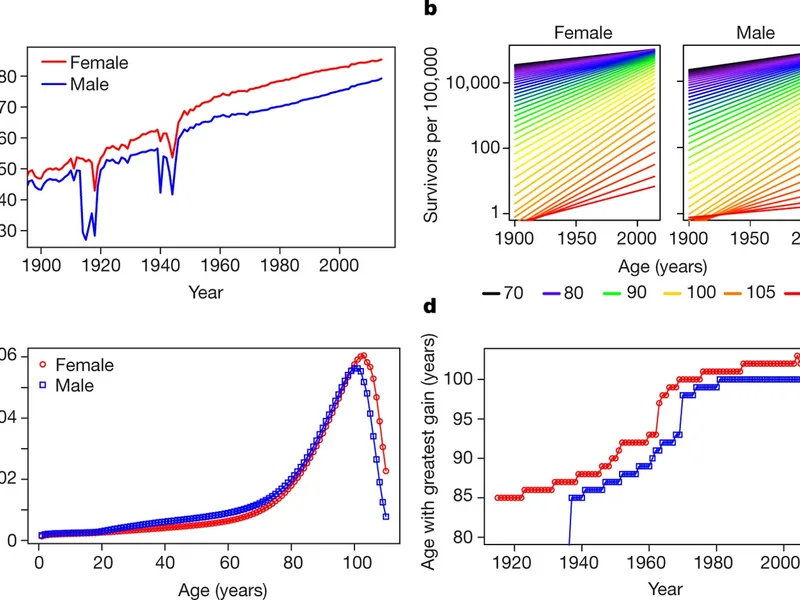
Researchers at the Skolkovo Institute of Science and Technology built a mathematical model asking a specific question: if you could switch off nearly every reversible cause of aging, what would still eventually limit how long a person lives? Their model pointed to somatic mutations, small DNA copying errors that build up in cells over a lifetime and can't currently be reversed.
The headline number that spread everywhere was 146 to 194 years, with 156 years sitting in the middle as the median estimate. That's the age at which half a hypothetical, disease-free population would still be expected to have died from mutation-related tissue failure. It's a model output, not a measured outcome, and the researchers have been fairly upfront about that distinction, even if a lot of the coverage skipped it.
This is where a lot of confusion creeps in, and it's worth slowing down here. Life expectancy is the average number of years people in a population actually live, and it's shaped heavily by things like infant mortality, disease, accidents, and access to healthcare. It's currently in the 70s to low 80s in most countries.
Maximum lifespan is a different concept entirely. It's the theoretical upper boundary for how long the human body could function under close to ideal conditions. The gap between the two is enormous, and it's exactly what this study was trying to measure using somatic mutations as the yardstick.
Interestingly, the same model, when pushed to its outer limits, produced maximum lifespan estimates as high as 210 to 557 years for exceptional individual cases, not just the median. That's a wide range, and it says more about the uncertainty in modeling this kind of thing than it does about any real prediction for how long a specific person might live.
Not everyone in the aging research field is convinced this settles anything. Some scientists studying cellular reprogramming argue that aging might be less about accumulated damage like DNA mutations and more about a loss of cellular information, the instructions cells use to know what type of cell they're supposed to be. If that view holds up, the ceiling this study describes might not be a hard limit at all.
I find this part of the debate genuinely useful, not just academic hair-splitting. It's a reminder that a single well-designed model, however careful, is describing one plausible mechanism among several competing theories. Somatic mutations are probably real contributors to aging. Whether they're the final word is still very much up for argument.
The longest verified human lifespan remains Jeanne Calment, who lived to 122. Nobody has come close since, and that gap between 122 and even the low end of this study's 146-year estimate is worth sitting with. Whatever the theoretical ceiling turns out to be, we're clearly nowhere near testing it in practice.
Research into real long-lived populations, often called blue zones, tells a very different and more grounded story. Places with unusually high numbers of people reaching their 90s and 100s tend to share fairly ordinary features: a mostly plant-based diet, regular low-intensity movement, strong social connection, and a sense of purpose. None of that requires solving somatic mutations. It's about reducing the everyday factors that push people toward earlier disease and decline.
This is where Doctar's more grounded content is genuinely more useful day to day than any headline about a 194-year ceiling. Guides on walking an hour a day, building a consistent morning walking habit, and understanding what happens when you walk after eating all map onto exactly the kind of low-intensity, consistent activity that blue zone research keeps flagging as protective.
In clinical practice, this is often the part that gets missed when a study like this goes viral: a model is only as good as its assumptions, and this one made a lot of them. It assumed certain mutation rates, certain tissue behaviors, and treated brain and heart cells as fixed bottlenecks based on current understanding of how little they regenerate. Future discoveries about cellular repair could shift those assumptions considerably.
That's not a criticism of the researchers, it's just how early-stage science works. The value of a study like this isn't that it hands us a final number. It's that it gives other scientists a clearer, testable framework to argue with, refine, or eventually disprove. Doctar's coverage of memory and cognitive aging and how resting heart rate reflects cardiovascular health both touch on the same non-renewing tissues this study leans on, and both fields are moving faster than most people realize.
None of this changes what actually works right now, and that's arguably the most important takeaway. Doctar's guide to staying active in older adulthood and its practical tips on everyday eating and movement reflect the same protective habits blue zone research keeps circling back to. Pacing your training matters too, and how often you should really do cardio alongside gentler approaches like low heart rate training helps avoid burning yourself out chasing a longevity trend.
Chronic conditions deserve real attention rather than being sidelined by longevity hype. Doctar's guide on managing diabetes without breaking the bank and its content on keeping joints strong both matter more for your actual quality of life over the next twenty years than anything a 156-year model predicts. Gut health plays a quieter role too, and gentle movement for digestive issues is worth reading if that's been nagging at you.
Cognitive and sensory health deserve the same attention. Reviewing medications that can affect dementia symptoms, understanding how multitasking affects memory, and staying on top of age-related vision changes are all more actionable than waiting on future breakthroughs. Persistent symptoms like unexplained fatigue are worth getting checked properly rather than dismissed.
For hands-on support, a registered dietitian, a nutritionist, or a nutrition and wellness centre can help translate general advice into a plan suited to your bloodwork. A cardiologist, a joint and bone care specialist, or an osteopath are reasonable next steps for specific concerns, and older adults juggling several health goals may find nutritional support programs for seniors genuinely useful. A structured weight management centre or an honest review of health-tracking apps can help keep any of this consistent, which matters far more than any single number from a headline.
Visit Hospital
Near You