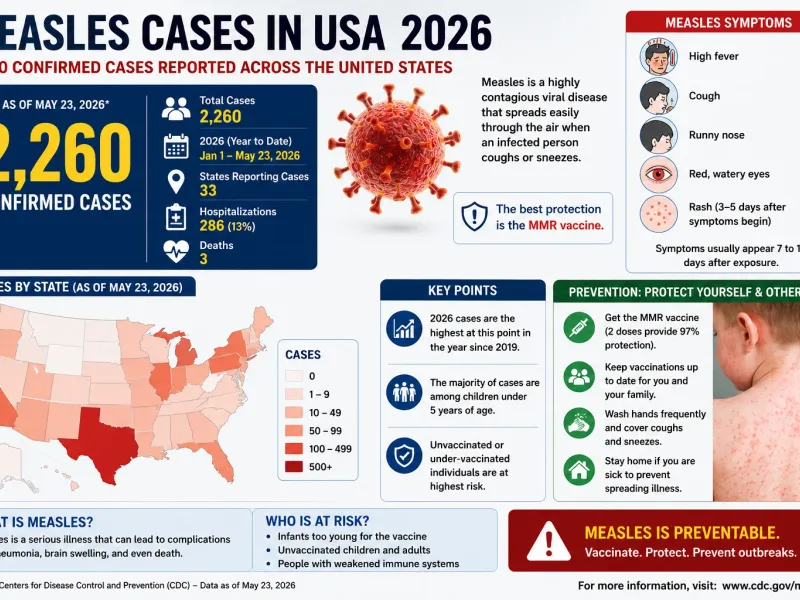
The United States has confirmed 2,260 measles cases in 2026 as of July 16, according to the CDC — already surpassing the 2,289 cases reported for all of 2025, the highest annual total since 1991. Cases have been reported in 44 states and Washington, D.C. Ninety-three percent of confirmed 2026 cases involve people who were unvaccinated or had unknown vaccination status.
To understand the scale, consider the baseline. In 2024 — just two years ago — the US recorded 285 measles cases and 16 outbreaks for the full year. By mid-July 2026, the country has already confirmed 2,260 cases and 34 outbreaks with half the year still ahead. That is an eightfold increase in two years.
This is not a single outbreak in one location. Cases in 2026 are spread across 44 jurisdictions, and 93% of them — more than 2,100 — are linked to active outbreaks, according to the CDC. The agency has warned state health departments that summer travel and large events are expected to push case counts higher in the coming months.
Three states have driven the majority of 2026 cases.
South Carolina became the epicenter of the outbreak wave that began in October 2025, with more than 670 confirmed cases concentrated in Spartanburg County. That outbreak — the largest in the US since measles was declared eliminated in 2000 — was officially declared over in April 2026 after 42 consecutive days without a new outbreak-related case.
Utah became the new center of active transmission after the South Carolina outbreak ended. The Utah outbreak, which started in summer 2025, spread to 22 of the state's 29 counties by mid-2026 and recorded more than 514 cases, according to the Utah Department of Health and Human Services. It remains ongoing.
Texas contributed more than 182 confirmed 2026 cases and had the largest single 2025 outbreak — the West Texas cluster that began in January 2025, drove hundreds of cases across Texas and New Mexico, and was declared over in August 2025.
Combined, South Carolina, Utah, and Texas account for the largest share of cases in the ongoing surge. The remaining cases are distributed across 41 other jurisdictions, from Alaska to Florida.
Deaths and Hospitalizations
Three deaths have been confirmed since the combined 2025–2026 outbreak began: two unvaccinated children in Texas and one unvaccinated adult in New Mexico, according to Medical Daily's tracking. These were the first measles deaths in the United States since 2015.
In 2025, 243 people were hospitalized with measles, according to Healthline's reporting on CDC data. In 2026, approximately 6% of confirmed cases — about 138 people as of early July — required hospitalization. Children under five face elevated risk: 10% of infected children in that age group were hospitalized, according to Global Biodefense's analysis of CDC case data.
No deaths have been confirmed in 2026 as of the most recent data.
[REVIEWER: add clinical insight here — e.g., what measles complications look like clinically, particularly subacute sclerosing panencephalitis (SSPE), the rare but fatal brain disease that can develop years after measles infection, and how clinicians should counsel unvaccinated families about these risks]
What Are Measles Symptoms?
Measles is caused by a virus, and symptoms typically appear 7 to 14 days after exposure. The CDC describes the progression in two stages.
The first stage — lasting 2 to 4 days — resembles a severe cold: high fever (often above 104°F), persistent cough, runny nose, and red, watery eyes (conjunctivitis). Small white spots called Koplik's spots may appear inside the mouth; these are a distinctive early sign, though they are easy to miss.
The second stage is the rash. A flat red rash typically starts at the hairline and spreads downward over the body over three or four days. By the time the rash appears, the infected person has usually been contagious for several days already.
Measles is one of the most contagious infectious diseases known. According to the CDC, if one person has measles, up to 9 out of 10 nearby people who are not protected will become infected. The virus can linger in the air and on surfaces for up to two hours after an infected person has left a room.
Complications: Who Is Most at Risk?
Most healthy adults recover from measles. But complications are common and can be severe, particularly in young children, pregnant women, and people with weakened immune systems.
The CDC lists the most serious complications as:
Pneumonia — the leading cause of measles-related death in children
Encephalitis (swelling of the brain) — occurs in roughly 1 in 1,000 measles cases and can cause permanent brain damage
Subacute sclerosing panencephalitis (SSPE) — a rare, fatal brain disease that develops years after measles infection, occurring in approximately 7 to 11 per 100,000 measles cases, according to the CDC
Blindness — a leading complication in malnourished children globally
Severe diarrhea and dehydration
Children under five and adults over 20 are at greatest risk for complications. Pregnant women who contract measles face increased risk of premature labor and low birth weight.
The Vaccination Rate Problem
The driver of the current crisis is not a mystery. National MMR vaccination coverage among incoming kindergartners has fallen from 95.2% in the 2019–2020 school year to 92.5% in 2024–2025, according to CDC data — below the 95% threshold required to achieve community immunity (herd immunity) and prevent sustained outbreaks.
That 2.7 percentage-point drop left approximately 286,000 kindergartners unprotected during the most recent school year, according to Global Biodefense's analysis of CDC data.
The consequences are measurable. A Common Health Coalition report, cited by U.S. News, estimates that a 1% decrease in the childhood MMR vaccination rate could cause 17,000 additional measles cases, 4,000 hospitalizations, and 36 preventable deaths annually.
The MMR vaccine — which protects against measles, mumps, and rubella — is one of the most effective vaccines ever developed. One dose is 93% effective at preventing measles infection; two doses are 97% effective, according to the CDC.
[REVIEWER: add clinical insight here — e.g., the recommended vaccination schedule for children and adults who may have missed doses, including guidance for healthcare providers on how to assess and address vaccine hesitancy in the clinical encounter]
America's Elimination Status Is at Risk
Measles was declared eliminated in the United States in 2000, meaning no chain of domestic transmission had lasted more than 12 consecutive months. That status has held for 26 years.
The Pan American Health Organization (PAHO) is scheduled to formally evaluate the US measles status in November 2026. For elimination status to be maintained, there must be no endemic transmission for 12 consecutive months. Given that multiple interconnected outbreaks have been running since early 2025, public health experts widely expect the US to lose that status.
Canada offers a preview of what that looks like. PAHO declared Canada no longer held measles elimination status in November 2025, after the country recorded 5,463 measles cases in a single year. The Americas region as a whole reported 14,975 measles cases in 2025, with the overwhelming majority in North America, according to KFF's analysis of PAHO data.
"Measles cases were high in 2025 due to declining vaccination in the US and high measles circulation globally," Dr. Nathan Lo told Healthline. Losing elimination status is not symbolic — it means measles is once again considered endemic to the US, which affects international travel health advisories, global public health partnerships, and domestic policy.
FAQ
How many measles cases are in the US in 2026? As of July 16, 2026, the CDC has confirmed 2,260 measles cases in the United States, spread across 44 states and Washington, D.C. This already exceeds the 2,289 confirmed cases for all of 2025, which was itself the highest annual total since 1991. Ninety-three percent of 2026 cases are linked to active outbreaks.
Who is at highest risk from measles in the US in 2026? Unvaccinated people of all ages face the greatest risk. Among those infected, children under five have the highest hospitalization rate — about 10% for that age group in 2026. Pregnant women and people with weakened immune systems also face higher risks of severe complications, including pneumonia and encephalitis.
Will the US lose its measles elimination status? PAHO is scheduled to formally assess US measles elimination status in November 2026. Measles elimination requires no endemic domestic transmission for 12 consecutive months. With continuous outbreaks running since early 2025 across dozens of states, public health experts widely expect the US to lose the status it has held since 2000. Canada lost its elimination status in November 2025.
Is the measles vaccine still effective against current strains? Yes. The MMR vaccine remains highly effective. One dose is 93% effective at preventing measles; two doses are 97% effective, according to the CDC. The vaccine targets the measles virus, which has not changed in the way influenza does — there is no need for annual reformulation. The problem is not vaccine effectiveness but declining vaccination coverage.
What should I do if I think I or my child has been exposed to measles? Contact your healthcare provider immediately and tell them about the potential exposure before going to a medical facility, so staff can take infection control precautions. If you or your child is unvaccinated or incompletely vaccinated, a provider may recommend post-exposure vaccination or immune globulin. Do not go to an emergency room or clinic without calling first.
Practical Takeaway
Check your vaccination status now. Adults born after 1957 who received only one dose of MMR may need a second dose, especially if they live in or plan to travel through an active outbreak area. Children should follow the standard two-dose schedule: one dose at 12 to 15 months, and a second at 4 to 6 years. If your child has missed doses or you are unsure of your own vaccine history, your doctor or local health department can advise on next steps. The MMR vaccine is 97% effective with two doses — but only if people get it.
This article must be reviewed and attributed to a named, qualified medical reviewer — such as a board-certified pediatrician, family medicine physician, or infectious disease specialist — before publishing. It is intended for general education only and does not constitute medical advice. Case counts are updated frequently; consult the CDC's Measles Cases and Outbreaks page for the most current data.
Sources
US Centers for Disease Control and Prevention (CDC). Measles Cases and Outbreaks, updated July 17, 2026
American Academy of Pediatrics. Red Book Online: Measles Outbreaks, updated July 9, 2026.
KFF. Measles Elimination Status: What It Is and How the U.S. Could Lose It, April 2026.
U.S. News & World Report. Tracking U.S. Measles 2026: 2,200 Cases Put Elimination Status at Risk, July 2026.
Medical Daily. CDC Confirms 2,104 Measles Cases as U.S. Elimination Status Faces Its Greatest Threat Since 2000, June 2026.
Global Biodefense. U.S. Measles Cases in 2026 Nearly Match Full-Year 2025 Toll, July 3, 2026.
Healthline. US Measles Cases in 2026 Surpass Total Number From Last Year, July 2026.
Association of State and Territorial Health Officials (ASTHO). Understanding Current U.S. Measles Outbreaks and Elimination Status, January 2026.
Common Health Coalition report on MMR vaccination rate modeling (cited in U.S. News, 2026).
Image Suggestion
An editorial photograph of a healthcare provider administering an MMR vaccination to a young child at a pediatric clinic — the child's arm visible, parent in the background. The image should feel warm and clinical rather than alarming, grounding the public health message in a concrete, actionable step. Avoid images of sick children with rashes, which can be distressing and stigmatizing.
Schema Suggestion
MedicalWebPage + FAQPage + NewsArticle MedicalWebPage signals E-E-A-T credibility for health content with named regulatory and peer-reviewed sources; FAQPage enables rich result display for the FAQ section in Google and AI Overviews; NewsArticle schema is appropriate given the active, evolving nature of the outbreak and helps the article surface in Google's Top Stories for measles-related search queries.