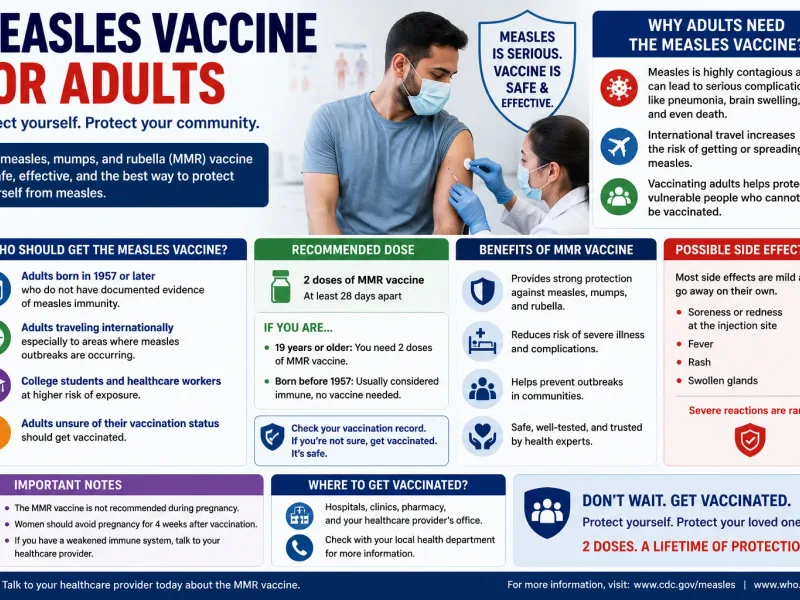
Most adults born after 1957 need at least one documented dose of the MMR vaccine — the combined measles, mumps, and rubella shot — to be considered protected against measles. Adults in higher-risk situations, including healthcare workers, college students, and international travelers, need two documented doses. Adults born before 1957 are generally considered immune because measles circulated widely enough that most people in that generation were exposed as children, according to the CDC.
The United States has recorded 2,260 confirmed measles cases in 2026 as of July 16 — already more than the full-year total for 2025, itself the worst year for measles in over three decades. Cases have been reported across 44 states, with large outbreaks in Utah, South Carolina, and Texas. The virus has caused three deaths and hundreds of hospitalizations since the combined 2025–2026 surge began.
The core problem is falling vaccination coverage. National MMR coverage among kindergartners dropped from 95.2% in the 2019–2020 school year to 92.5% in 2024–2025 — below the 95% threshold needed to prevent sustained outbreaks — according to CDC data. Many of those unvaccinated or incompletely vaccinated children are now in communities where measles is actively spreading. Adults who are unvaccinated or unsure of their status are at real risk.
"Everyone should be up to date on their measles, mumps, and rubella (MMR) vaccine," Dr. Scott Roberts, an infectious disease specialist at Yale Medicine, said in a Yale Medicine interview. "The vaccine is the most important tool for preventing a measles infection."
The CDC's Advisory Committee on Immunization Practices (ACIP) bases its recommendations on birth year, vaccination history, and risk factors.
Born before 1957
Adults born before 1957 are presumed immune based on childhood exposure during an era when measles was endemic, and generally do not need the vaccine. An exception applies to healthcare workers in this age group — they should still be evaluated individually by their employer or healthcare provider, according to the Wisconsin Department of Health Services guidance for providers.
Born between 1957 and 1968
Some adults vaccinated between 1957 and 1968 received an early killed (inactivated) version of the measles vaccine, which did not provide lasting protection. ACIP recommends re-vaccination for anyone who received this killed vaccine or whose vaccine type is unknown. Adults in this group with no evidence of immunity or only one documented dose should receive two MMR doses at least 28 days apart, per the South Carolina DPH outbreak vaccination guidance.
Born after 1968
Adults born after 1968 who have no documented evidence of immunity need the vaccine. Most adults in this group fall into one of these three situations:
No documented MMR doses: Should receive one dose now; two doses (at least 28 days apart) if in a high-risk category
One documented dose: Generally considered adequately vaccinated for most settings; two doses recommended for higher-risk adults (see below)
Two documented doses: Considered fully vaccinated; no additional doses recommended
Who Needs Two Doses Instead of One?
The CDC recommends two documented MMR doses — separated by at least 28 days — for adults who are in higher-risk situations. These include, according to ACIP and CDC guidance:
Healthcare workers — all settings with potential patient or specimen exposure
College and university students — post-secondary educational institutions
International travelers — anyone traveling outside the United States
Close contacts of immunocompromised people — those who live with or provide care to someone with a weakened immune system
People in active outbreak areas — public health authorities may recommend a second dose during outbreaks even for adults with one prior documented dose
Adults in any of the above categories who have only one documented dose should get a second dose now, regardless of when they received the first one.
[REVIEWER: add clinical insight here — e.g., whether providers should offer blood antibody (serologic) testing before giving a second dose to adults who believe they were vaccinated but lack records, and what the practical guidance is for clinical encounters during the current outbreak]
What Counts as Proof of Immunity?
You do not need a blood test to prove immunity if you have any of the following, which the CDC and ACIP define as "presumptive evidence of immunity":
Written documentation of one or two doses of a live measles-containing vaccine (given on or after the first birthday)
Laboratory confirmation of measles immunity (antibody test showing positive results)
Birth before 1957 (for most non-healthcare settings)
Prior diagnosis of measles confirmed by a laboratory test
Note: A doctor's verbal statement, family recollection, or the belief that you "had all your shots" does not count as documented evidence. You need a written record or a blood test. If your records are lost, the safest and simplest approach is to get vaccinated — receiving an extra dose of MMR when you may already be immune is not harmful, according to the Wisconsin DHS provider guide.
Who Should NOT Get the MMR Vaccine?
The MMR vaccine is a live attenuated vaccine — meaning it contains a weakened form of the measles, mumps, and rubella viruses. Certain people should not receive it.
Contraindications (do not vaccinate) include:
Pregnancy — MMR should not be given during pregnancy. Women should avoid becoming pregnant for at least 28 days after receiving MMR, according to CDC guidelines and ACOG's clinical guidance. The vaccine is safe postpartum, including while breastfeeding.
Severe immunosuppression — including people on high-dose corticosteroids, cancer chemotherapy, or certain biologic medications; and people with HIV who have severely low CD4 counts (below 200 cells/mcL or below 15%), according to the Merck Manual.
Severe allergy to any vaccine component — including a history of anaphylaxis to a prior dose of MMR.
HIV-positive adults with CD4 counts above these thresholds may safely receive MMR and should discuss their specific situation with their healthcare provider.
Adults who are mildly ill (a minor cold, low-grade fever) can still receive the vaccine. They do not need to wait to recover.
What to Expect from the MMR Vaccine
The MMR shot is given as a single injection, typically in the upper arm. Common, mild side effects can include soreness at the injection site, a low-grade fever, or a brief rash 1 to 2 weeks after vaccination, according to CDC fact sheets. These reactions resolve on their own.
Serious adverse events are rare. The most clinically significant include temporary low platelet count (which can cause unusual bruising or bleeding) and, very rarely, joint pain or swelling in adult women.
Two doses of MMR are 97% effective at preventing measles. One dose is 93% effective, according to the CDC. For most adults who received two correctly-timed childhood doses, protection is expected to last for life.
A note on boosters: unlike the flu shot, the MMR vaccine does not require routine annual boosters. Additional doses are only recommended if you are at heightened risk for exposure or if you lack documentation of two prior doses and are in a high-risk group.
[REVIEWER: add clinical insight here — e.g., practical guidance for adults presenting to primary care or urgent care during an active outbreak who are uncertain about their vaccination history, including how to counsel patients who express hesitancy about the MMR vaccine]
Measles After Vaccination: Can It Still Happen?
Yes, though it is uncommon. No vaccine is 100% effective in every individual, and two documented doses of MMR do not guarantee complete protection in all cases. However, vaccinated people who do develop measles typically experience a milder course of illness than those who are completely unvaccinated, according to the CDC.
"Breakthrough" measles in a vaccinated person is generally less contagious to others as well. The core message is that vaccination substantially reduces both individual risk and the risk of community spread.
FAQ
Do adults need a measles booster shot in 2026? Most fully vaccinated adults with two documented MMR doses do not need a booster. However, adults with only one documented dose who are healthcare workers, college students, international travelers, or in an active outbreak area should get a second dose now. If you are unsure of your history, talk to your doctor or simply get vaccinated — an extra dose is not harmful.
How do I know if I was vaccinated against measles as a child? The most reliable proof is a written vaccination record, such as an immunization card, school health record, or a note in your medical file. A blood test (IgG antibody test) can also confirm immunity. Family memory alone is not sufficient documentation according to CDC and ACIP guidelines. If records are unavailable, getting one MMR dose is safe and effective.
Can adults born before 1957 skip the measles vaccine? For most settings, yes. Adults born before 1957 are presumed immune based on widespread natural exposure before the vaccine was introduced. However, healthcare workers born before 1957 should discuss their individual situation with their employer or provider, as some facilities may require documented evidence of immunity even for this age group.
Is the MMR vaccine safe for adults with weakened immune systems? It depends on the degree of immunosuppression. MMR is a live vaccine and is contraindicated for people with severe immune compromise, including those with very low CD4 counts from HIV or those on high-dose immunosuppressive medications. People with milder immune conditions may receive MMR safely. Always discuss with a healthcare provider before getting any live vaccine if you have an immune condition.
Can I get vaccinated if I'm pregnant or trying to get pregnant? No. MMR is contraindicated during pregnancy. Women trying to conceive should receive MMR at least 28 days before becoming pregnant. Pregnant people without evidence of immunity should be vaccinated immediately after delivery, ideally before hospital discharge, according to ACOG guidelines. MMR is safe postpartum and while breastfeeding.
Practical Takeaway
Start by finding your vaccine records. If you have two documented MMR doses, you are likely protected for life and do not need to act unless your provider recommends otherwise. If you have one dose — or no records at all — talk to your doctor now, especially if you are in a high-risk category, live near an active outbreak, or plan to travel. Getting vaccinated when you may already be immune carries no meaningful risk and takes less than 10 minutes. With measles spreading across 44 US states and climbing, that 10 minutes is well spent.
This article must be reviewed and attributed to a named, qualified medical reviewer — such as a board-certified internal medicine physician, family medicine physician, or infectious disease specialist — before publishing. It is intended for general education only and does not constitute medical advice. Vaccination recommendations can vary; consult your healthcare provider or local health department for guidance specific to your situation.
Sources
US Centers for Disease Control and Prevention (CDC). Measles Vaccination, updated April 29, 2026.
CDC. Measles Vaccine Recommendations (ACIP), updated March 3, 2026.
CDC. Adult MMR Vaccination Algorithm.
American College of Obstetricians and Gynecologists (ACOG). MMR Vaccination and Management of Obstetric-Gynecologic Patients During a Measles Outbreak, March 2024.
Merck Manual (Professional Edition). Measles, Mumps, and Rubella (MMR) Vaccine.
Wisconsin Department of Health Services. Adult MMR Vaccination: What Providers Need to Know.
Colorado Department of Public Health and Environment (CDPHE). Measles Vaccination Recommendations, June 2025.
South Carolina Department of Public Health (DPH). Measles Outbreak Vaccine Recommendations, October 2025.
Yale Medicine / Dr. Scott Roberts, MD. Commentary on MMR vaccination during 2026 outbreak.
Image Suggestion
A close-up editorial photograph of an adult's upper arm receiving an injection from a gloved healthcare provider's hand, with a blurred clinical background — no face visible, conveying the routine, low-key nature of vaccination. Avoid children or baby imagery, which misrepresents the adult-focused angle of this article.
Schema Suggestion
MedicalWebPage + FAQPage MedicalWebPage signals E-E-A-T credibility for a YMYL health topic with named clinical and regulatory sources (CDC, ACIP, ACOG, Merck Manual); FAQPage enables rich result display for all five FAQ entries in Google Search and AI Overviews, including the high-traffic "do adults need a booster" query.