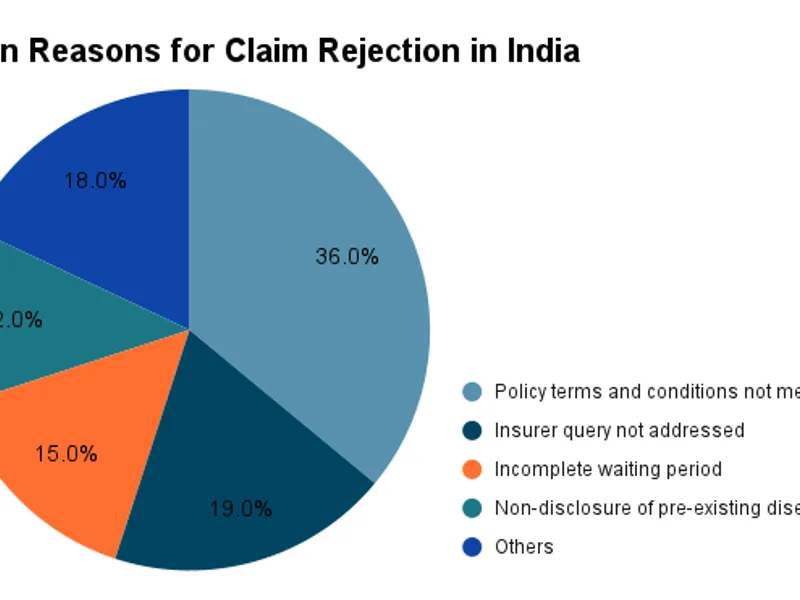
Why do medical insurance claims get rejected?
The most common problems are often administrative rather than dramatic. Missing documents, incorrect information, a waiting period, an exclusion or a treatment that falls outside the policy can all affect a claim.
For example, a policy may have specific conditions for pre-existing diseases, room-rent limits, co-payments, deductibles or network-hospital treatment. Doctar's guide to health insurance options in India explains why these details can substantially change what a policyholder actually pays.
Pre-existing disease clauses deserve particular attention. Doctar's health insurance guide for people with diabetes discusses waiting periods, network hospitals, co-payments and exclusions that can influence coverage.
A similar issue arises with chronic conditions such as hypertension. Doctar's health insurance guide for high blood pressure explains why policyholders should check coverage for pre-existing conditions and understand whether treatment is cashless or reimbursement-based.
Read the rejection reason carefully
Do not start an appeal until you know exactly what the insurer has rejected. A telephone explanation from a customer-care representative is not a substitute for the formal claim decision and supporting reason.
Look for the claim number, date of treatment, amount rejected and the specific clause or reason cited. If the insurer says the treatment was excluded, compare that statement with the actual policy wording.
Doctar has a detailed guide on appealing a health insurance claim denial, including the importance of collecting medical records, policy documents, correspondence and evidence supporting the claim.
This is where a little paperwork discipline pays off. Keep the admission papers, discharge summary, prescriptions, investigation reports, bills, payment receipts and correspondence in one place.
Cashless does not mean automatic approval
A cashless facility reduces upfront payment, but it does not guarantee that every hospital expense will be covered. Cashless treatment generally works through a network hospital and requires the insurer or its claims administrator to process the request under the policy terms.
Doctar's health insurance access guide explains the difference between cashless treatment and the broader issue of policy coverage. It also discusses network hospitals, waiting periods and the importance of understanding policy conditions.
For another explanation, see Doctar's guide to health insurance claims for hypertension, which covers cashless and reimbursement claims.
A similar principle applies to diagnostic tests. Doctar's guide to insurance coverage for blood tests notes that prescriptions, network facilities and pre-authorisation requirements may matter depending on the policy.
What if the insurer says the condition was pre-existing?
A pre-existing disease should not be treated as a vague label. The policy definition, disclosure made when the policy was purchased and applicable waiting-period terms all matter.
A policyholder should disclose known medical conditions honestly when buying insurance. Concealing a diagnosis or previous treatment can create serious problems later, particularly if the rejected claim is connected to that condition.
Doctar's guide to health insurance for multiple sclerosis discusses the importance of understanding waiting periods and disclosing pre-existing conditions.
The same issue appears in cancer insurance coverage, where policy type, waiting periods, exclusions, network hospitals and co-payments can all affect a claim.
Build the appeal around evidence
A strong appeal answers the insurer's stated reason instead of simply saying, "Please approve my claim."
If the insurer cites missing documents, provide the missing documents. If the problem is a coding or administrative error, ask the hospital to correct it. If the dispute concerns medical necessity, ask the treating doctor whether a clinical explanation or supporting medical record can clarify why the treatment was required.
Doctar's article on dual health insurance coverage is also useful for people who have more than one source of health coverage and need to understand how claims may be coordinated.
For serious illnesses, financial planning can become part of the treatment journey. Doctar's resources on cancer treatment financial assistance, cancer treatment costs, and financial assistance for cancer care offer related reading for families facing large medical expenses.
Escalate the complaint if needed
If your insurer does not resolve the matter, there are formal grievance channels in India. Start with the insurer's own grievance-redressal mechanism and keep proof of the complaint, including the complaint number and dates.
IRDAI's consumer guidance says that policyholders can escalate unresolved complaints, while the Bima Bharosa portal provides a mechanism for registering and tracking complaints. The portal also warns users that it does not ask complainants for payments.
IRDAI Bima Bharosa complaint portal
The Insurance Ombudsman is another route for eligible individual policyholders. IRDAI says a complainant generally needs to approach the insurer first and can approach the Ombudsman when the complaint is rejected, not resolved satisfactorily or not answered within the specified period. The Ombudsman scheme covers disputes including partial or total repudiation of health insurance claims.
IRDAI Insurance Ombudsman information
Prevention starts before hospital admission
The easiest claim problem to solve is often the one identified before treatment begins. For planned hospitalisation, check whether the hospital is in the insurer's network and whether pre-authorisation is required.
Also check your sum insured, room-rent restrictions, co-payment, deductibles, disease-specific waiting periods and exclusions. Doctar's guide to health insurance for heart disease discusses these policy factors in the context of cardiac treatment.
For senior citizens, Doctar's guide to health insurance plans for seniors covers government schemes, private policies, waiting periods and other factors older adults should consider.
For people considering additional protection, Doctar also discusses Medicare and Blue Cross Blue Shield concepts in India, while its health insurance access article looks at broader changes in India's insurance landscape.
Medical bills are not the only expense
Insurance disputes can expose gaps between what a family expects to be covered and what the policy actually pays. Even when a claim is accepted, co-payments, deductibles, exclusions and non-covered items may leave the patient with a substantial bill.
Doctar's guide to doctor consultation fees in India discusses the wider issue of planning for healthcare expenses.
For families without adequate insurance, Doctar's guide to affordable healthcare without insurance outlines public hospitals, community services and other options.
Government schemes can also be relevant for eligible households. Doctar's overview of India's healthcare policies and access explains the broad role of Ayushman Bharat and other public-health initiatives.
Other coverage questions families commonly face
Insurance questions do not stop at hospitalisation. People may also need to understand whether medicines, maternity care, preventive check-ups, transplants or advanced treatments are covered.
Doctar's guide to prescription drug coverage explains why outpatient medicines can fall under different policy arrangements.
For pregnancy-related costs, its maternity coverage guide and affordable prenatal-care guide provide related information.
For major procedures, readers can review Doctar's information on organ transplant insurance coverage and immunotherapy coverage.
For older adults, Doctar also has information on health check-up coverage and mental-health treatment coverage.
For people dealing with serious blood disorders, its article on managing CLL treatment costs discusses government assistance and patient-support options.
What should you do after a rejection?
Start with the paperwork, not an argument. Ask for the written reason for rejection, compare it with the policy clause, collect the relevant medical and billing records, and submit a clear grievance to the insurer.
If the insurer does not resolve the dispute, consider the appropriate escalation route through IRDAI and, where eligible, the Insurance Ombudsman. Because insurance disputes can depend heavily on the exact policy wording and facts, complex cases may warrant advice from a qualified insurance professional or lawyer.