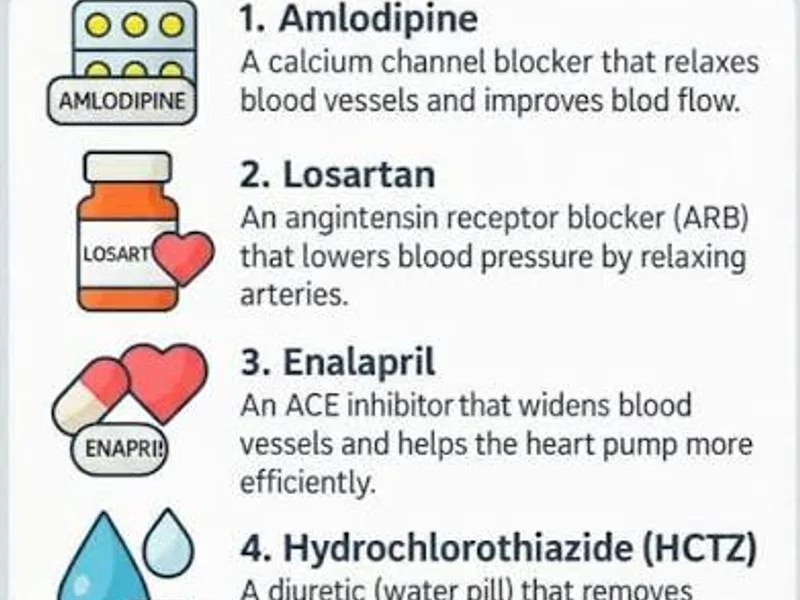
Medication for hypertension generally starts with one of four main drug classes recommended as first-line therapy: thiazide diuretics, ACE inhibitors, ARBs (angiotensin receptor blockers), and calcium channel blockers, all of which have been shown to reduce cardiovascular events, according to American Heart Association and American College of Cardiology guidelines. More than 70% of adults treated for primary hypertension eventually need at least two medications from different classes, either from the start or added over time.
[REVIEWER: add clinical insight here — e.g., how you decide which first-line class to start with for a given patient]
Thiazide diuretics
Diuretics, sometimes called water pills, help the body eliminate excess salt and water, according to the American Heart Association. Reducing that extra fluid volume in the bloodstream lowers the pressure placed on blood vessel walls. Thiazide diuretics are frequently used as a starting medication and are often combined with other drug classes rather than used alone.
ACE inhibitors
ACE inhibitors work by reducing the body's production of angiotensin, a chemical that causes arteries throughout the body to narrow. With less angiotensin being produced, blood vessels can relax and open up, which lowers blood pressure. Beyond blood pressure control, ACE inhibitors are noted for helping protect the kidneys, which makes them a common choice for people with diabetes or kidney disease alongside hypertension.
One important note: Mayo Clinic is explicit that ACE inhibitors should not be taken during pregnancy, since they've been linked to birth defects. Anyone who is pregnant or planning to become pregnant should discuss alternative blood pressure treatment options with their healthcare provider.
ARBs (angiotensin receptor blockers)
ARBs lower blood pressure through a related but distinct mechanism — rather than reducing how much angiotensin the body produces, they block the receptors in blood vessels that angiotensin attaches to, which diminishes its vessel-narrowing effect. A large observational study covered by the American Heart Association, examining nearly 3 million patients starting treatment for the first time, found ARBs worked about as well as ACE inhibitors at preventing cardiovascular events, while being associated with fewer side effects such as tissue swelling, cough, and digestive tract bleeding.
Like ACE inhibitors, ARBs carry a pregnancy-related caution, and combining an ACE inhibitor with an ARB is specifically avoided, since research summarized via NCBI's StatPearls notes the combination raises the risk of high potassium levels, low blood pressure, and kidney problems without added benefit.
Calcium channel blockers
Calcium channel blockers work by limiting how much calcium enters the muscle cells of the heart and blood vessel walls, which relaxes blood vessels and can also slow the heart rate depending on the specific drug. They're commonly used as both a standalone first-line treatment and as part of combination therapy alongside an ACE inhibitor or ARB.
Beta-blockers and other medication classes
Beta-blockers lower blood pressure primarily by reducing heart rate, and some also have a vessel-relaxing effect that adds to their blood-pressure-lowering benefit, according to the American Heart Association. While beta-blockers aren't usually first-line therapy for uncomplicated hypertension the way the four classes above are, they're commonly used when someone has an additional condition — like certain heart rhythm issues — where a beta-blocker offers benefit beyond blood pressure control alone.
Other medication classes, including alpha blockers, central agonists, and direct vasodilators, are typically reserved for cases where first-line medications aren't sufficient on their own or aren't well tolerated.
[REVIEWER: add clinical insight here — e.g., when you reach for a beta-blocker or other second-line class instead of starting with the four primary classes]
Current guidance often favors starting with two medications together rather than pushing a single drug to its maximum dose. Research covered by American Family Physician notes that more than 70% of adults treated for primary hypertension eventually require at least two antihypertensive agents. Combining medications from different classes — for example, a calcium channel blocker with an ARB — can control blood pressure more effectively than maximizing a single drug, and some combinations are available as a single combined pill to simplify the daily routine.
For people with Stage 2 hypertension specifically, current guidelines recommend starting with combination therapy from the outset rather than waiting to see if a single medication is enough.
How personal factors shape the choice
Doctors weigh several individual factors when selecting a starting medication, beyond just which class is generally first-line. Race is one documented factor — research has found that Black patients tend to respond particularly well to starting with a thiazide diuretic or a calcium channel blocker. Other health conditions matter too: someone with diabetes may be steered toward an ACE inhibitor or ARB for its kidney-protective effect, while someone with chronic kidney disease and protein in their urine is often treated with an ACE inhibitor or ARB combined with a diuretic or calcium channel blocker.
These are general patterns from research and guidelines, not universal rules — the right medication for any individual depends on their full health picture and should be determined with their own doctor.
What "resistant hypertension" means
When blood pressure stays above target despite optimal doses of three different medication classes, including a diuretic — or requires four or more medications to control — it's classified as resistant hypertension. Current guidelines recommend a systematic evaluation at that point for secondary causes of hypertension, whether medication is being taken consistently, and whether "white coat" effect might be influencing readings, before simply adding more medication.
A practical takeaway
If you're starting blood pressure medication for the first time, ask your doctor which class they're recommending and why it fits your specific health picture — your other conditions, your race, and any other medications you take all reasonably factor into that choice. If you're already on medication and your blood pressure still isn't at target, ask specifically whether combination therapy or a different class might work better, rather than assuming the current medication just needs a stronger dose.
FAQ
What is the most commonly prescribed medication for high blood pressure? There isn't one single most-common drug — thiazide diuretics, ACE inhibitors, ARBs, and calcium channel blockers are all considered first-line options under AHA/ACC guidelines, and the choice depends on individual factors like other health conditions and race.
Do I need more than one blood pressure medication? Possibly. More than 70% of adults treated for primary hypertension eventually need at least two medications from different classes, either starting together or added over time, according to research covered in American Family Physician.
What's the difference between ACE inhibitors and ARBs? Both reduce the blood-vessel-narrowing effects of angiotensin, but through different mechanisms — ACE inhibitors reduce how much angiotensin the body makes, while ARBs block the receptors angiotensin attaches to. Research suggests they work similarly well, with ARBs linked to somewhat fewer side effects.
Can blood pressure medication be taken during pregnancy? Some cannot. ACE inhibitors and ARBs are specifically not recommended during pregnancy due to a risk of birth defects. Anyone who is pregnant or planning to become pregnant should discuss safe blood pressure treatment options with their doctor.
What is resistant hypertension? It's blood pressure that remains above target despite optimal doses of three different medication classes, including a diuretic, or that requires four or more medications to control. Current guidelines recommend evaluating for secondary causes and medication adherence before adding further treatment.