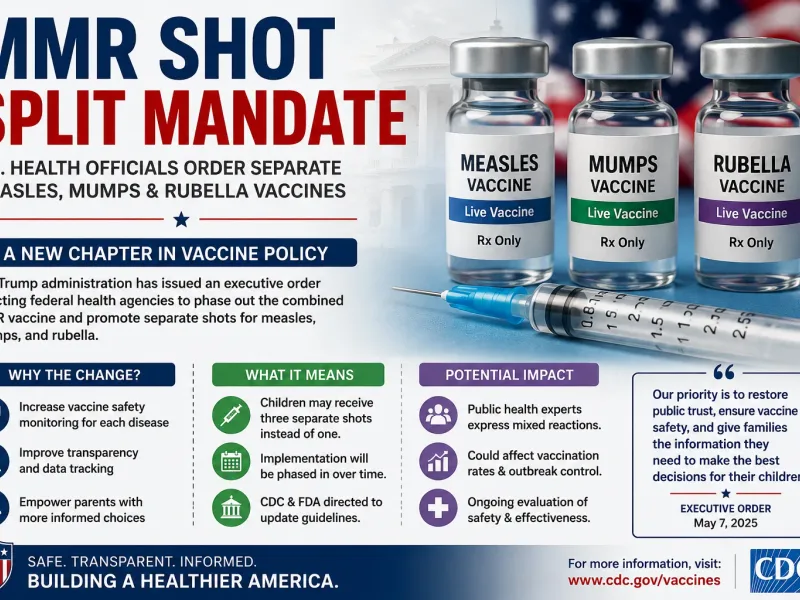
A vaccine policy story broke out of the US this week, and it's the kind that spreads faster than the facts behind it. On August 10, 2026, President Trump signed an executive order calling for the combined measles-mumps-rubella (MMR) vaccine to be split into three separate shots, each given at its own doctor's visit, according to
If you're a parent, the first question is obvious. Does this change what my child needs right now? For most families, the honest answer is no, not yet, and understanding why matters more than the headline itself.
What the Executive Order Actually Says
The order directs federal health agencies to recommend that the MMR vaccine be split into three single-disease shots once such products exist, and that childhood immunizations generally be spread across separate visits rather than combined. It also narrows the list of universally recommended childhood vaccines from 18 down to 11, and directs the Department of Justice to look into how states handle vaccine exemptions, per and
It's worth being precise about what this is. It's a federal recommendation, not a nationwide legal mandate. States still set their own school vaccination requirements, and as of this writing there's no change to those requirements, according to coverage of the order.
Why the Shots Don't Exist Yet
Here's the detail that got buried under the politics: there are currently no separate, single-antigen measles, mumps, or rubella vaccines licensed for use in the United States. The order itself reportedly acknowledges this, specifying that the split should happen "once such products are domestically available," per Manufacturing and licensing separate shots would require fresh clinical trials and regulatory approval, a process that takes years, not months.
So the practical, near-term reality is this: the childhood vaccine schedule most pediatricians follow hasn't actually changed. What has changed is the federal government's stated intent, and that's a meaningfully different thing from an available product sitting in a clinic fridge.
What Doctors and Health Bodies Are Saying
The pushback from pediatric and public health groups has been fast and largely unified. Major organizations including the American Academy of Pediatrics have said the changes aren't backed by scientific evidence and could raise infectious disease risk, according to
The core scientific concern isn't really about safety of the combined shot itself, it's about logistics. Splitting one visit into three means three chances for a missed appointment, a forgotten follow-up, a family that can't take another day off work. A 2017 analysis of national immunization data found that children who received at least one combination vaccine were roughly two and a half times more likely to complete their full vaccination series than those given single-antigen shots only, according to reporting from citing that data.
In clinical practice, this is often missed because "more visits" sounds like more thoroughness, when in practice it usually just means more opportunities to fall behind schedule, particularly for families juggling work and childcare.
On the specific claim linking combined vaccines to autism, the scientific position hasn't shifted. Public health researchers have found no evidence that the existing childhood vaccine schedule raises autism risk, and there's no published research showing a benefit to splitting the MMR into separate shots, according to review of a still-published CDC explainer on the topic.
The Timing Is Awkward, to Put It Mildly
This order lands at a genuinely inconvenient moment. US measles cases in 2026 have already outpaced any year since 1991, and kindergarten MMR vaccination rates have slipped to around 92.5%, below the roughly 95% threshold generally considered necessary for herd immunity, per Introducing more friction into the vaccination process during a measles resurgence is exactly the kind of timing that makes public health experts uneasy, whatever your view of the broader policy debate.
What This Means If You're a Parent in India
If you're reading this from Kolkata or anywhere else in India, the direct answer is simpler: this is a US federal policy shift, and it doesn't change your child's national immunization schedule. India's vaccination recommendations are set independently, and the combined MMR shot remains standard practice here, generally given as two doses per current guidance.
That said, global vaccine policy conversations do tend to spill over into parental anxiety everywhere, and it's fair to have questions. If you're weighing measles risk more broadly, this comparison of measles versus chickenpox symptoms is a useful, India-specific starting point.
What to Actually Do Right Now
Don't change your child's vaccination schedule based on a headline. Whether you're in the US or India, the vaccines currently in use haven't changed, and the combined MMR shot remains the standard, well-studied option.
If you have specific concerns, take them to your child's own doctor rather than a news article, this one included. A few experienced pediatricians in Kolkata worth consulting for a straightforward conversation about your child's vaccination schedule include Dr. Ritajyoti Sengupta, Dr. Bhaswati Chakrabarti Acharyya, and Dr. Atanu Kumar Jana, who between them cover decades of pediatric practice across the city.