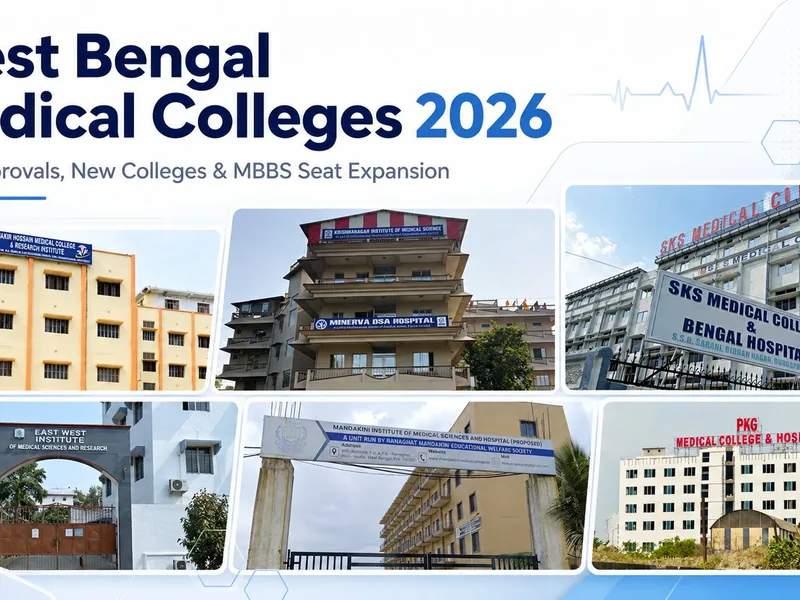
State budgets tend to bury healthcare announcements somewhere in the middle, one line among dozens. This year's West Bengal budget didn't do that. Alongside the usual allocations, the state government announced four new medical colleges, a second All India Institute of Medical Sciences (AIIMS), and a specialised cancer treatment hospital, all concentrated in and around North Bengal.
That's a meaningful cluster of announcements to make in one sitting. West Bengal already runs a large medical education network, with AIIMS Kalyani serving as its flagship federal institution alongside more than two dozen state government medical colleges. Adding this much capacity in one push signals the state sees a genuine gap, not just a routine expansion.
Where the New Colleges Are Coming Up
The four new medical colleges are planned for Alipurduar, Kalimpong, Paschim Bardhaman and Dakshin Dinajpur. Look at that list for a second and a pattern jumps out: three of the four are in North Bengal or its immediate periphery, districts that have historically had to send patients south to Kolkata or Siliguri for anything beyond routine care.
Anyone who has tried arranging specialist treatment for a relative in Alipurduar or Kalimpong knows exactly what that gap looks like in practice. It usually means a full day's travel each way, arranging a place to stay near the hospital, and hoping the appointment doesn't get pushed. A district-level medical college doesn't eliminate that overnight, but it does eventually mean a teaching hospital, and the specialists that come with one, closer to home.
Why a Second AIIMS Matters Beyond the Name
AIIMS carries weight as a brand in Indian healthcare, and understandably so, given the quality of care and research these institutions are generally associated with. West Bengal's existing AIIMS Kalyani sits in Nadia district, reasonably well placed for Kolkata and its surrounding districts, but a long way from North Bengal.
A second AIIMS specifically anchored in the north would do two things at once. It gives the region a tertiary care institution capable of handling complex cases that currently get referred out of the region entirely, and it creates a training pipeline for doctors who are more likely to actually stay and practise locally after graduating, since a meaningful share of medical graduates tend to settle near where they trained.
The Cancer Hospital Fills a Specific, Painful Gap
A dedicated cancer treatment hospital for North Bengal addresses something that doesn't get talked about enough. Oncology care, chemotherapy schedules especially, punishes patients who have to travel long distances repeatedly over months. Missing a cycle because the journey was too much, or delaying treatment because a family couldn't manage repeated trips to Kolkata, has real consequences for outcomes.
In clinical practice, this is often what gets missed in policy conversations about new hospitals: it's not just about having a facility exist somewhere in the state, it's about whether a patient can realistically get to it often enough for the treatment to work as intended. A cancer centre based in North Bengal changes that math meaningfully for families in the region, assuming staffing and equipment keep pace with the building itself.
What a New Medical College Actually Changes, and What It Doesn't
It's worth being honest about timelines here. Announcing a medical college in a budget speech and having it fully functional, accredited, and producing doctors are very different milestones, often separated by several years. Land acquisition, faculty recruitment, National Medical Commission approval, and building out an attached teaching hospital all take time, and delays at any one of these stages are common across India, not unique to West Bengal.
What does change relatively early, though, is the signal it sends to doctors already working in these districts. A planned medical college often brings incremental infrastructure investment well before the first admission batch, since the attached hospital typically needs to be functional ahead of teaching starting. That can mean better equipment and more specialist postings at the existing district hospital years before the medical college itself admits its first students.
What This Means If You Live in These Districts Right Now
If you're in Alipurduar, Kalimpong, Paschim Bardhaman or Dakshin Dinajpur today, none of this changes your immediate options. You're still working with what's currently available, and it's worth knowing exactly what that is rather than waiting years for an announcement to materialise. Check hospitals near you for current facilities, and if a specific specialist visit means travelling to Kolkata or Siliguri anyway, plan around it deliberately rather than as an emergency scramble each time.
For routine and semi-urgent care, it's worth having a general physician near you already identified locally, someone who can manage ongoing conditions and only refer you onward when it's genuinely necessary. That single relationship often saves more travel than any single new hospital will, at least in the near term.