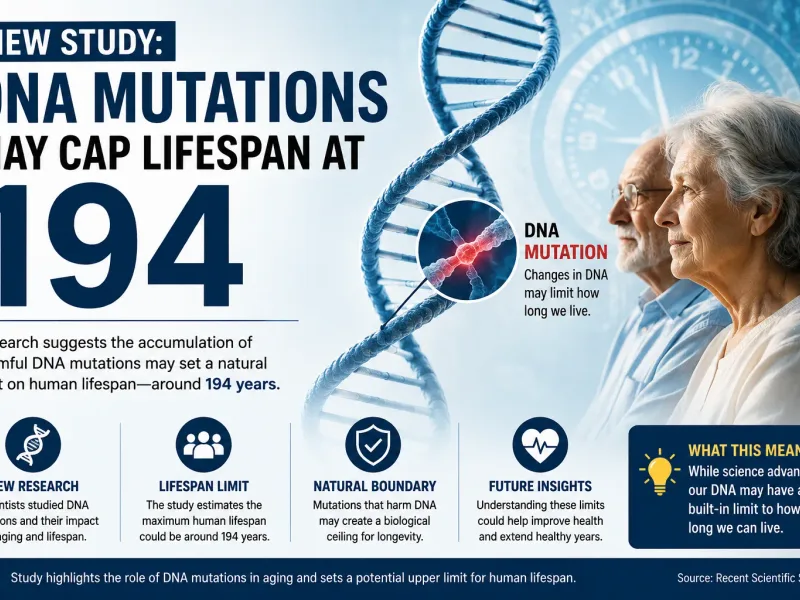
The Study That's Getting Everyone's Attention
A team at the Skolkovo Institute of Science and Technology in Russia asked a strange but useful question. If you could cure every disease and reverse every known cause of aging, how long would a person actually live? Their answer, published in the journal npj Aging, points to random DNA mutations as the thing that would still eventually kill us.
These are called somatic mutations, tiny copying errors that build up in the DNA of ordinary body cells (not the reproductive ones) from birth onward. A somatic mutation is a DNA change that arises in any non-reproductive cell after conception, so it affects the body's tissues but can't be passed on to children. Most of these errors are harmless. A few aren't.
Why the Number Isn't Just One Figure
You'll see headlines throwing around "194 years" like it's a fixed date on a calendar. It isn't. When the researchers combined four critical organ systems into a single model, they landed on a median lifespan of around 156 years, with a range of 146 to 194 years. Using a different version of the same modeling approach, they estimated a maximum possible lifespan of somewhere between 210 and 557 years.
That's a wide spread, and the researchers know it. One of the study's authors was careful to call this a mathematical estimate, not experimental data. No mice, no humans, no clinical trial. Just equations built on how fast mutations accumulate in different tissues.
The Body Parts That Set the Limit
Here's the part that actually matters for how we think about aging. Some organs, like the liver, constantly replace worn-out cells, which dilutes the damage over time. Others don't have that luxury. The brain and heart are particularly vulnerable because some of their critical cells are irreplaceable and rarely divide or get replaced after birth.
In clinical practice, this tracks with something doctors see constantly and rarely say out loud: heart and brain health tend to age on their own schedule, separate from the rest of the body. You can have the muscle tone of a 40-year-old and still be dealing with cardiac or cognitive changes that don't match. This study gives that observation a biological explanation. If you want a baseline check on where you stand, a cardiologist consultation is a reasonable starting point, especially past your 40s.
The Gap Between Theory and Reality
The theoretical ceiling looks almost absurd next to real life. If you strip out every hallmark of aging, including somatic mutations, the model predicts a median lifespan of 1,759 years. Add mutations back in and that collapses to around 156. Meanwhile, the longest verified human lifespan on record is 122 years — Jeanne Calment, still the outlier nobody has matched.
So mutations account for roughly half the gap between theoretical immortality and what we actually experience. Something else — disease, hormonal decline, cellular wear and tear — is responsible for the rest. That's arguably the real finding here, more than the eye-catching number. The study's authors themselves said the takeaway isn't that people might live to 190; it's that researchers now have a data-driven way to prioritize which aging mechanisms are worth targeting first.
Should You Actually Expect to Live to 150?
No. And if anyone tries to sell you a supplement on the back of this study, that's your cue to walk away. This is a ceiling under conditions that don't exist yet, not a forecast for your own lifespan. Current average life expectancy is nowhere near this range, and closing that gap depends on things we already know work: managing blood pressure, catching metabolic issues early, staying active, sleeping enough.
If you're the type who reads studies like this and gets curious about your own numbers, a general check-in is a decent place to start. Routine screening through a general physician or blood work via a diagnostic center tells you more about your actual aging trajectory than any headline will. For hormone-related aging markers, an endocrinologist is the right specialist, and if metabolic health or weight is part of your longevity plan, a dietitian consult tends to be more useful than most online advice.
For readers who want to go deeper on the genetics side, Doctar's editorial team has also covered related genomic research — including a piece on how cancer cells break their own DNA and one on CRISPR-based immunotherapy for prostate cancer, both of which touch on how DNA damage and repair shape long-term health. You can browse more research summaries on the Doctar health blog.
If something in your family history makes longevity or hereditary risk a live concern, that's a conversation worth having directly with a doctor rather than working it out from headlines. You can search doctors by specialty or find someone offering home-visit consultations if getting to a clinic is the barrier. Hospitals with broader diagnostic capacity are listed under hospitals near you, and if you need medication or supplements reviewed rather than guessed at, check them against a pharmacy near you instead of an online seller. For heart-specific concerns that come up alongside aging research like this, cardiology-related surgical options are also listed with typical costs if that's ever relevant. Skin changes tied to aging are common too, and a dermatologist can address those separately from the internal biology this study focuses on. Gut and metabolic symptoms that sometimes get lumped in with "aging" are worth ruling out with a gastroenterologist rather than assumed.