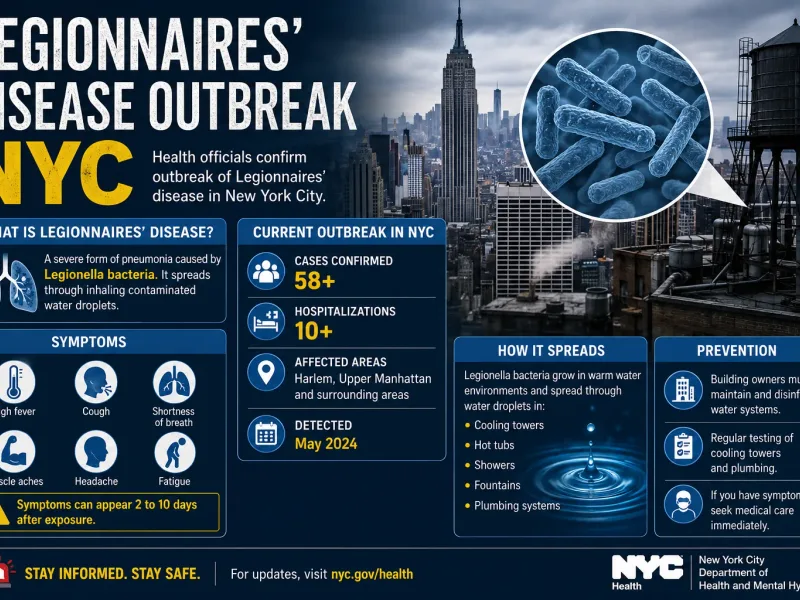
As of July 21, 2026, the New York City Health Department has confirmed 82 cases of Legionnaires' disease and five deaths tied to a community cluster in the Carnegie Hill and Yorkville neighborhoods of Manhattan's Upper East Side. Eight people remain hospitalized, 56 have been discharged, and 13 were never hospitalized. Officials say no new cases had been diagnosed in the six days prior to that update, a sign the outbreak may be slowing.
The NYC Health Department first announced the cluster on July 2, 2026, when it had identified just two confirmed cases in the affected ZIP codes — 10028, 10128, and 10075. Health Commissioner Dr. Alister Martin issued a health alert to providers at that point, urging them to consider Legionnaires' disease in anyone presenting with compatible symptoms in the area.
The case count climbed quickly after that. By July 6, the total had reached 23 confirmed cases with 17 hospitalizations. Just a day or two later, on July 7, the cluster had grown to 54 confirmed infections. By July 9, the city reported 46 diagnosed cases with 22 people still hospitalized — reflecting the lag between diagnosis dates and when case totals are publicly confirmed. The outbreak continued to grow through mid-July before beginning to plateau around the 74–82 case range by July 19–21.
City officials have said the likely source is a cooling tower or towers in the affected area — rooftop water systems used to regulate temperature in large buildings, which can spray a fine mist containing Legionella bacteria into the surrounding air. The NYC Health Department reported testing 183 cooling towers across 160 buildings in the investigation area. Of those, 77 towers at 75 buildings tested positive for Legionella in initial screening, and 34 towers at 33 buildings tested positive on confirmatory culture testing, meaning live bacteria were present. Every building on that list was ordered to clean and disinfect its cooling tower immediately.
As of the most recent city update, officials say testing and remediation have likely eliminated the exposure source, though no single building or tower has been publicly named as the definitive origin point.
[REVIEWER: add clinical insight here — e.g., how cooling-tower-linked Legionella outbreaks are typically identified and traced in your experience, and what building owners and residents should realistically expect during a remediation investigation like this one]
Symptoms to Watch For
Legionnaires' disease is a type of pneumonia caused by Legionella bacteria. Symptoms typically appear between two days and two weeks after exposure and can include cough, fever, chills, muscle aches, headache, and shortness of breath. Because these symptoms overlap heavily with the flu and other respiratory illnesses, the NYC Health Department has specifically urged anyone who lives, works, or has visited the Carnegie Hill or Yorkville area — including the east side of Central Park between East 76th and East 97th Streets — since late June to contact a health care provider if flu-like symptoms develop.
People are only at risk from breathing in contaminated water vapor; the disease does not spread from person to person, and it is not linked to drinking water, showering, or using air conditioners in the home, according to city health officials.
Dr. Toni Eyssallenne, the city's Deputy Chief Medical Officer, has said Legionnaires' disease can be effectively treated if diagnosed early, and specifically flagged that people 50 and older, smokers, and those with chronic lung conditions should be especially attentive to symptoms. About 1 in 10 people who develop Legionnaires' disease die from complications, according to the CDC, a rate that rises to roughly 1 in 4 among cases acquired during a healthcare facility stay.
[REVIEWER: add clinical insight here — e.g., what you look for clinically to distinguish Legionnaires' disease pneumonia from more common respiratory illnesses, and how quickly antibiotic treatment needs to start to meaningfully change outcomes]
How This Compares to Past NYC Outbreaks
This isn't the first time a New York City neighborhood has dealt with a Legionella cluster tied to cooling towers. A Central Harlem outbreak that began in July of the prior year ultimately sickened more than 100 people and killed seven, after Legionella bacteria were found in a dozen cooling towers across ten buildings, including a city-run hospital and a sexual health clinic. That outbreak drew scrutiny over whether city staffing shortages in cooling tower inspection programs contributed to the spread.
By case count, the 2026 Upper East Side cluster has so far been somewhat smaller than that prior Harlem outbreak, but its case total climbed faster in its first two weeks, and its death toll of five is already substantial. Both outbreaks point to the same underlying vulnerability: aging cooling tower infrastructure in dense urban buildings that requires regular testing and maintenance to prevent Legionella growth.
What the City Is Doing Now
Beyond testing and disinfecting cooling towers, the city has published a preliminary list of buildings with positive test results, distributed multilingual fact sheets and health alerts to the affected neighborhoods, and advised residents on general Legionella prevention steps for home water systems — including draining garden hoses, replacing water filters according to manufacturer instructions, checking chlorine levels in pools and hot tubs, and flushing hot water heaters twice a year.
The Health Department has emphasized that a "community cluster" designation means multiple people developed the disease within a connected time and place — not that everyone who enters the neighborhood is at risk. Most people exposed to Legionella do not become sick.
FAQ
How many people have gotten sick in the 2026 NYC Legionnaires' outbreak? As of the July 21, 2026 NYC Health Department update, 82 people have been diagnosed with Legionnaires' disease in the Carnegie Hill and Yorkville cluster, with five deaths, eight people still hospitalized, and 56 discharged.
What caused the NYC Legionnaires' outbreak? Officials believe one or more contaminated cooling towers in the Carnegie Hill and Yorkville area are the likely source. The city tested 183 cooling towers and found Legionella bacteria in dozens of them, all of which have since been disinfected, though no single definitive source has been publicly confirmed.
Is Legionnaires' disease contagious? No. Legionnaires' disease spreads only when someone breathes in water vapor containing Legionella bacteria — not from person to person. It is also not linked to a building's plumbing, drinking water, or air conditioning units, according to NYC health officials.
Is it safe to live in Carnegie Hill or Yorkville right now? City officials say it remains safe to drink tap water, shower, cook, and use air conditioners in the affected area. The main precaution is to monitor for flu-like symptoms — fever, cough, chills, muscle aches, or shortness of breath — and contact a health care provider promptly if they appear.
Who is most at risk from Legionnaires' disease? People aged 50 and older, current or former smokers, and those with chronic lung conditions or weakened immune systems face a higher risk of severe illness. The CDC estimates that about 1 in 10 people who contract Legionnaires' disease die from complications.
Practical Takeaway
The 2026 Upper East Side Legionnaires' outbreak has slowed since its peak, with no new cases reported in the most recent update and remediation completed on the cooling towers identified as likely sources. Anyone who lives, works, or has spent time in Carnegie Hill or Yorkville since late June and develops fever, cough, chills, or shortness of breath should contact a health care provider promptly and mention the potential exposure, since early treatment significantly improves outcomes.
This article must be reviewed and attributed to a named, qualified medical reviewer — such as a board-certified infectious disease physician or pulmonologist — before publishing. Case counts are updated regularly by the NYC Health Department; consult nyc.gov/health for the most current figures. This article is intended for general education only and does not constitute medical advice.
Sources
NYC Health Department. Legionnaires' Disease — investigation updates, case counts, and cooling tower testing results. nyc.gov/health
NYC Health Department. NYC Health Dept. Releases Preliminary List of Buildings Ordered To Clean and Disinfect Their Cooling Towers, July 10, 2026. nyc.gov
NYC Health Department. NYC Health Department Investigating Community Cluster of Legionnaires' Disease on the Upper East Side, July 2, 2026. nyc.gov
Associated Press (via U.S. News & World Report). What to Know About Legionnaires' Disease Making People Sick on New York's Upper East Side, July 7, 2026.
NY1 (Spectrum News). Legionnaires' outbreak slows as NYC continues cleaning cooling towers, July 15, 2026; Legionnaires' cluster grows to 54 cases on Upper East Side, July 10, 2026.
US Centers for Disease Control and Prevention (CDC) — mortality and risk-factor statistics for Legionnaires' disease.
Category
Infectious Disease / Public Health / Local Health Alerts
Image Suggestion
A realistic photograph of a rooftop cooling tower on a Manhattan apartment building against the Upper East Side skyline, ideally showing a city health inspector or maintenance worker conducting testing — conveying the actual investigation rather than a generic bacteria or hospital stock image.
Schema Suggestion
MedicalWebPage + FAQPage + NewsArticle — MedicalWebPage supports YMYL/E-E-A-T credibility for outbreak health content; FAQPage enables rich-result and AI Overview eligibility for the direct case-count and safety questions; NewsArticle reflects the actively evolving nature of the story and supports Top Stories eligibility for local search.