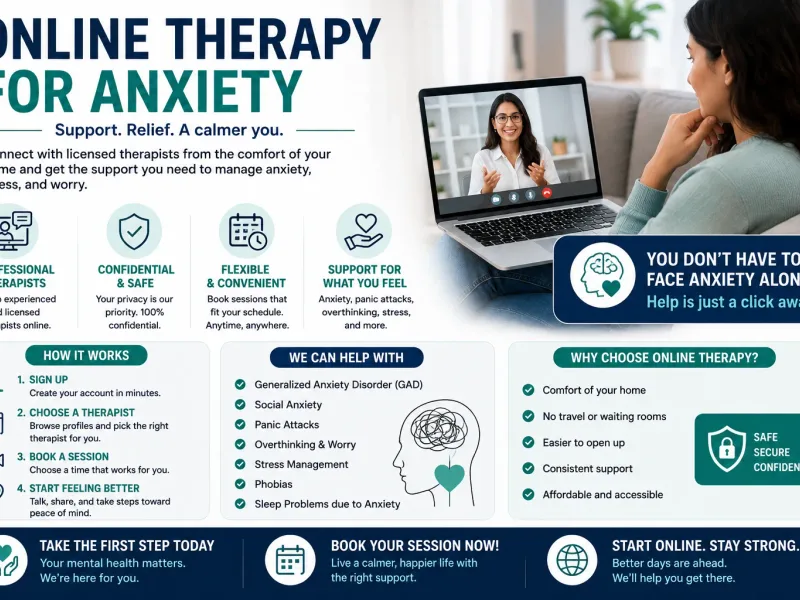
What "Online Therapy" Actually Means
The term gets used loosely, so let's be specific. Online therapy — also called teletherapy or e-therapy — is a structured, one-on-one consultation with a licensed mental health professional conducted via video call, phone, or in some formats, asynchronous chat. It is not a wellness app. It is not a chatbot. A real therapist with real credentials, conducting real sessions.
In India, you can access this through platforms that list verified psychiatrists and psychologists, or by booking directly with a mental health specialist. At Doctar, for instance, you can search for verified doctors across specialties, including mental health professionals, and book appointments online. The process is the same whether you're in a metro city or a smaller town.
The Type of Therapy That Works Best for Anxiety
Not all therapy is the same, and this distinction matters more than most people realise.
Cognitive Behavioural Therapy (CBT) is currently the most well-researched approach for anxiety disorders. It works by helping patients identify distorted thought patterns — the kind of catastrophic thinking that tells you the worst-case scenario is the only scenario — and replace them with more grounded responses. In clinical practice, this is often missed because patients expect medication as the first-line response, when structured psychotherapy alone can produce durable results for mild-to-moderate anxiety.
CBT translates well to video sessions. The structured nature of the approach — worksheets, thought records, behavioural assignments — doesn't require physical presence. Several well-designed studies have found that internet-delivered CBT achieves outcomes comparable to face-to-face CBT for anxiety, particularly when sessions are therapist-guided rather than fully self-directed.
Other approaches that work online include Acceptance and Commitment Therapy (ACT) and mindfulness-based interventions, though these tend to be used as adjuncts rather than standalone treatments for clinical anxiety.
Who Is Online Therapy Best Suited For?
Online therapy works particularly well for people with mild to moderate anxiety who:
Live in cities or towns with limited access to mental health specialists
Work irregular hours or have caregiving responsibilities that make in-person visits difficult
Feel more comfortable opening up from their own environment
Are beginning therapy for the first time and want a lower-pressure entry point
It's also a practical option for people managing chronic conditions that co-occur with anxiety — like thyroid disorders, heart disease, or diabetes — where mental health support is often needed alongside medical treatment. You can find specialists near you on Doctar who manage these conditions and refer to mental health care when needed.
That said, online therapy has limits. People with severe anxiety, active suicidal ideation, or complex psychiatric conditions generally need in-person assessment. A psychiatrist near you — or a specialist reached through platforms like Doctar's doctor search — can assess which format is appropriate.
What Happens in an Online Anxiety Session?
Most people don't know what to expect, and that uncertainty itself can fuel anxiety about starting. Here's a realistic picture.
Your first session is typically an assessment. The therapist asks about your symptoms, how long you've had them, your sleep patterns, work stress, relationships, and medical history. They're building a picture, not judging you. By session two or three, you'll usually be working on something specific — a thought pattern, a situation you've been avoiding, or a physical symptom like chest tightness or shallow breathing.
Sessions are typically 45 to 60 minutes. Video is generally more effective than text-based formats for anxiety, because the therapist can observe body language and tone — signals that matter clinically. If you're accessing care through a home visit doctor or a teleconsultation via Doctar, you can discuss whether a mental health referral is appropriate as part of a broader health review.
The Role of Medication: Is It Always Needed?
Many people ask their doctor about medication the moment anxiety is mentioned. It's a reasonable question. Medication — usually SSRIs (Selective Serotonin Reuptake Inhibitors), a class of antidepressants that also treat anxiety — can be genuinely helpful, especially for moderate-to-severe presentations. But not everyone with anxiety needs medication, and a good online therapist will be clear about what's within their scope.
Psychiatrists can prescribe; psychologists generally cannot. If after a few therapy sessions your symptoms aren't improving, or if your anxiety is significantly affecting your daily functioning, discussing medication with a psychiatrist becomes important. This is a conversation to have with a qualified professional, not a decision to make based on a blog post or self-diagnosis.
How to Find a Qualified Online Therapist in India
Quality varies enormously. The credentials to look for are: an RCI-licensed clinical psychologist (Rehabilitation Council of India) or a psychiatrist registered with the Medical Council of India. Some platforms list counsellors without clinical training — useful for general support, but not appropriate for clinical anxiety disorders.
Doctar lists verified doctors across India including in major cities like Delhi, Mumbai, Kolkata, Bangalore, and Chennai — with transparent consultation fees and full professional profiles. You can read patient reviews before booking, which matters when choosing someone for ongoing mental health care.
For those who prefer a preliminary general health assessment before seeking specialist care, a general physician can be a useful starting point. Many GPs are now comfortable with basic anxiety screening and can refer you onward if needed.
What About Cost?
Cost is a real barrier. In India, private mental health consultations can range from a few hundred to several thousand rupees per session depending on the city and the practitioner's experience. Online sessions are typically more affordable than in-person visits, partly because there's no overhead for clinic space.
Doctar shows transparent consultation fees upfront, so there's no ambiguity. Some hospitals near you also offer outpatient psychiatry departments at lower rates if cost is a significant concern. If you're managing anxiety alongside another condition — diabetes, for example — checking whether your diagnostics or specialist visits can be combined saves both money and travel time.
When Online Isn't Enough
Online therapy is a legitimate and effective option. But it's not a replacement for emergency care. If anxiety is accompanied by panic attacks that feel like heart attacks, severe chest pain, or thoughts of self-harm, that requires urgent attention. India's national emergency number is 112; for a medical emergency, call 108 for an ambulance. Doctar also lists emergency services near you if you need to locate urgent care quickly.
For general mental wellness support that falls short of clinical anxiety — stress management, relationship difficulties, work burnout — wellness and lifestyle resources can complement professional care.