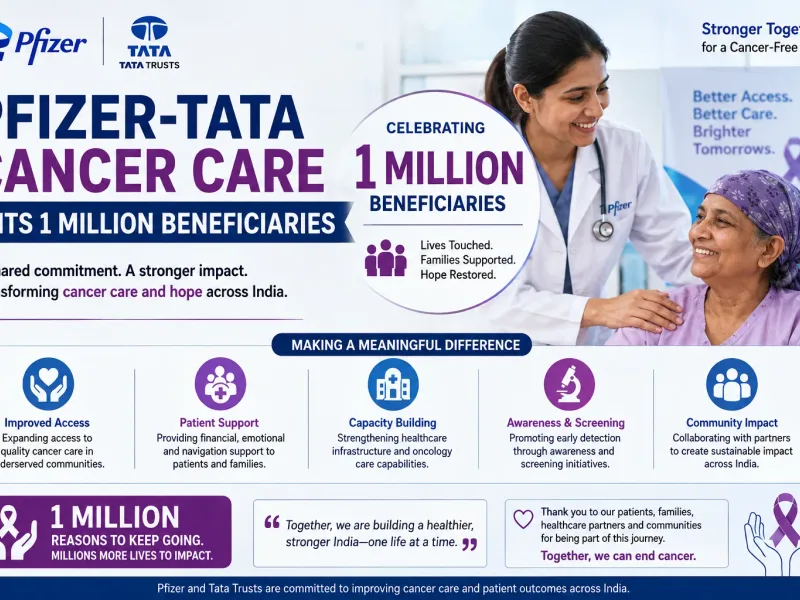
Pfizer-Tata Cancer Care Foundation Partnership Crosses 1 Million Beneficiaries
A public health number crossed a big round figure this week, and it's worth pausing on it for a moment. Pfizer India and the Tata Cancer Care Foundation (TCCF) announced their joint cancer awareness and early-detection programme has now reached more than one million people. That's not a projection or a target. It's a cumulative count, built up over several years of screenings, training camps and community outreach across five states — Assam, Jharkhand, Andhra Pradesh, Maharashtra and Odisha.
To mark it, the two organisations held a stakeholder conference in Guwahati, bringing together government officials, healthcare workers and development-sector partners to talk about what's worked and what still needs fixing. It wasn't a flashy event. But then, this isn't really a flashy kind of programme. It's slow, unglamorous, door-to-door work — the kind that doesn't make headlines until someone adds up seven figures.
What the Programme Actually Does
At its core, this is a cervical cancer, oral cancer and breast cancer screening initiative built around community health workers rather than hospitals. The partnership has supported over 993,000 screenings for these three cancers and trained nearly 25,000 healthcare providers, mostly frontline workers who go into villages, schools and local health centres.
Why these three cancers specifically? Because oral, breast and cervical cancers together account for a large share of India's cancer burden, and — this is the important part — all three can often be caught early through relatively simple checks. A visual mouth exam. A clinical breast exam. A Pap smear or HPV test. None of these require a big hospital or an oncologist sitting in the room. That's what makes community-level screening realistic at scale, instead of just aspirational.
Meenakshi Nevatia, Country President of Pfizer India, framed the collaboration as an attempt to weave awareness, screening, workforce training and referral pathways directly into the public health system rather than building a separate parallel structure. Dr. Kailash Sharma of TCCF and the Assam Cancer Care Foundation described it as proof that community-led, collaborative models can genuinely expand access to cancer care.
Why the Model Matters More Than the Number
In clinical practice, this is often what gets missed in conversations about cancer outcomes in India: the biggest gap usually isn't treatment technology, it's timing. A large share of cancers here are still diagnosed at stage three or four, when treatment options narrow and outcomes worsen considerably. By the time a patient walks into an oncologist's clinic with symptoms, the disease has often had months or years to progress quietly.
Programmes like this one try to shift that timeline leftward — catching abnormalities before they turn into symptoms a person would notice on their own. That's genuinely difficult to do in a country where the nearest general physician might be a bus ride away, and where cancer still carries enough stigma that people avoid getting checked. Building trust at the community level, through workers people already know, tends to work better than asking villagers to travel to an unfamiliar hospital for a test they don't fully understand.
Is one million beneficiaries a lot? In absolute terms, yes. Against India's population and cancer burden, it's a meaningful start rather than a solved problem. Worth remembering that context before treating any single milestone as the finish line.
What This Doesn't Solve
A screening programme identifies suspected cases. It doesn't automatically guarantee that every flagged person gets timely, affordable treatment afterward — that's where referral pathways come in, and where public-private models tend to get tested the hardest. The strength of this particular initiative is that it's tried to build those referral links into the existing government system, not bypass it. Whether that holds up at scale, across five very different states, is something worth watching over the next few years rather than assuming from a press release.
There's also a quieter point buried in this milestone: nearly 25,000 healthcare providers have now been trained through this programme. That's arguably the more durable outcome. Screening events end. Trained community health workers stay in their villages and keep doing the work long after the programme's formal cycle wraps up.
For Patients: What to Actually Do With This News
If you're reading this because a family member has been flagged during one of these screening camps, or because it made you think about your own risk, here's the practical part. Don't wait for symptoms to show up before getting checked, especially if you're over 40 or have a family history of any of these cancers.
Ask your local health worker or primary care provider whether a screening camp is active in your area.
If you notice a persistent mouth ulcer, an unusual breast lump, or abnormal bleeding, get it evaluated rather than monitoring it yourself for months.
A positive screening result is not a diagnosis. It's a signal to get further evaluation from a qualified doctor, not a reason to panic.
Screening programmes are not a substitute for regular checkups if you're in a higher-risk group — talk to a gynecologist or general physician about what frequency makes sense for you.
The Practical Takeaway
A milestone like this is a decent proxy for effort, not proof of outcome. The real test of the Pfizer-TCCF partnership will show up years from now, in whether cancer stage-at-diagnosis actually shifts earlier across these five states, and whether the referral system holds up for the people who get flagged. For now, what's clear is that nearly a million people who might otherwise never have been screened, have been. That's worth something on its own — but it's a step, not a solution.