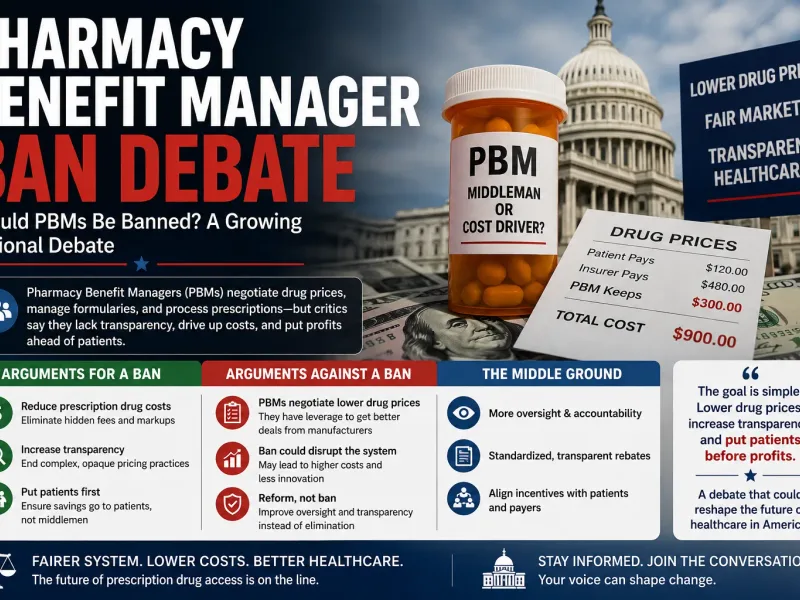
If you've never heard of a pharmacy benefit manager, you're not alone. Most people interact with one every time they fill a prescription and have no idea it happened.
A pharmacy benefit manager, PBM for short, is the company that sits between your insurance plan, the drug manufacturer, and the pharmacy counter. It negotiates rebates with drug makers, decides which drugs your insurance actually covers (the formulary), and sets how much your pharmacy gets paid for filling your prescription. Three companies, tied to the country's largest health insurers, control most of this market.
That concentration is exactly why the ban debate exists.
What PBMs Actually Do
On paper, the job sounds useful. PBMs negotiate bulk discounts with drug manufacturers, similar to how any large buyer might negotiate a better price, and pass at least some of that savings back to insurance plans.
In clinical practice, this is often missed because patients only ever see the sticker price at the pharmacy counter, not the rebate negotiations happening behind it. Whether the savings PBMs negotiate actually reach the patient, or get absorbed somewhere upstream, is a big part of what this whole debate is about.
Why Some Want PBMs Banned or Broken Up
The core complaint is a conflict of interest. The three largest PBMs are each owned by, or tied to, a major health insurer, and increasingly own mail-order and specialty pharmacies too. Critics argue that lets a PBM steer patients toward its own pharmacy, set reimbursement rates that squeeze independent competitors, and keep a share of rebates rather than passing them fully to patients.
Independent pharmacists have been especially vocal. Many say PBM-set reimbursement rates sometimes fall below what it costs them to dispense a drug, a business model that isn't sustainable long-term for a small pharmacy competing against a PBM's own mail-order arm.
There's also the transparency problem. Rebate agreements between PBMs and drug manufacturers are typically confidential, which makes it hard for regulators, employers, or patients to verify whether the negotiated savings are real or where they actually end up.
Why Others Argue Against a Full Ban
The counterargument isn't that PBMs are flawless. It's that removing them, or breaking up their negotiating power entirely, could remove one of the only forces currently pushing back against drug manufacturer pricing.
Some health economists argue that without PBM-negotiated rebates, list prices for many drugs would likely be even higher, not lower, since manufacturers would have less incentive to offer volume discounts to a fragmented buyer base. Employer groups have raised similar concerns, worried that dismantling PBMs quickly could disrupt existing health plan pricing without a ready replacement system in place.
There's also a fair question about which problem is actually being solved. A ban addresses PBM structure. It doesn't necessarily address the underlying reason U.S. drug prices are high in the first place, which involves manufacturer pricing decisions, patent protections, and a health system with far more players than PBMs alone.
What Actually Changed in 2026
The debate didn't end in an outright ban. Instead, Congress passed the Consolidated Appropriations Act, 2026, which enacted meaningful PBM reform without dismantling the model entirely, covering Medicare Part D and Medicare Advantage prescription drug plans.
Separately, the Federal Trade Commission settled with one of the three major PBMs in February 2026, requiring specific changes to its service offerings, while litigation against the other two major players continues. On top of the federal changes, every state has now passed some form of PBM regulation, though the specifics vary considerably from state to state, and several states are weighing further action in their 2026 legislative sessions.
None of this fully resolves the underlying ban-versus-reform argument. Reform advocates see 2026 as real progress on transparency. Advocates for a more fundamental structural break-up see it as a meaningful but incomplete step, since the largest PBMs remain vertically integrated with insurers and pharmacies even after the new rules take effect.
What This Means If You're Just Trying to Afford Your Prescriptions
Regardless of how the policy debate ultimately resolves, there are practical steps that help right now. Understanding your plan's formulary, and where a specific drug sits on it, affects your copay directly, something covered well in guides like this one on managing Dilantin (phenytoin) costs or this breakdown of Gemfibrozil pricing and insurance factors.
If a medication requires prior authorization, something PBMs frequently require before approving coverage, working closely with your prescriber's office matters, as explained in this guide to navigating Amitiza costs and coverage requirements.
Discount cards and manufacturer coupons, tools like GoodRx or manufacturer-run patient assistance programs, exist largely because PBM-negotiated insurance pricing doesn't always beat the cash price. Guides like this one on Eplerenone cost-saving strategies, this Seroquel affordability guide, and this breakdown of Rocklatan glaucoma medication costs walk through exactly when that's worth checking.
Generic substitution remains one of the most reliable ways to reduce out-of-pocket costs regardless of how PBM policy shakes out, something this guide to Arava (leflunomide) generic savings, this Dexilant pricing guide, and this Pristiq (desvenlafaxine) cost comparison all cover in more detail.