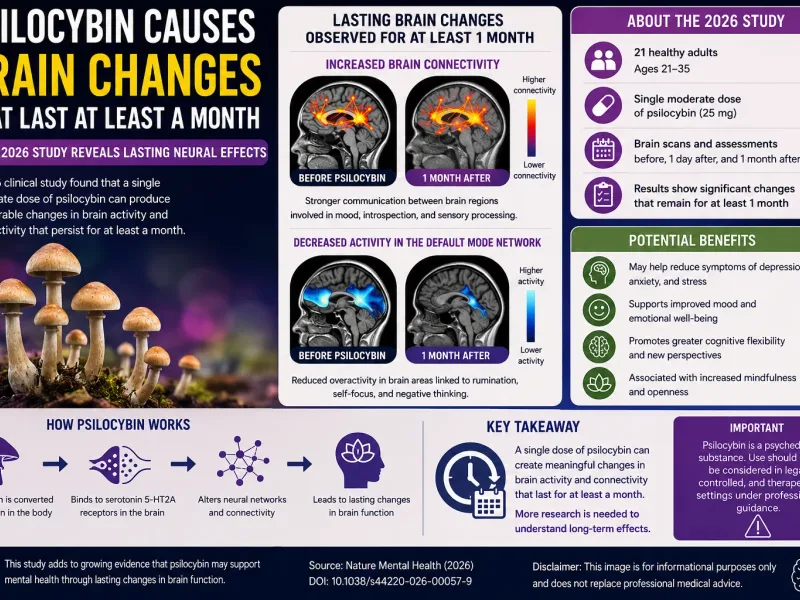
A single high dose of psilocybin produces measurable changes in brain activity and brain structure that remain detectable up to one month later, according to a placebo-controlled study published in Nature Communications in May 2026 by researchers at UC San Francisco and Imperial College London. The study used three distinct brain imaging and recording methods in 28 healthy adults who had never previously used a psychedelic, making it among the most methodologically rigorous human neuroimaging studies of psilocybin's lasting effects. The findings may help explain why psilocybin's therapeutic effects on depression and anxiety often outlast the drug experience itself by weeks to months.
The paper — titled "Human brain changes after first psilocybin use" — was led by Dr. T. Lyons and colleagues, with senior authorship by Professor Robin Carhart-Harris, a neurology professor at UCSF's Psychedelics Division and former director of Imperial College London's Centre for Psychedelic Research. The study was published May 5, 2026, in Nature Communications (DOI: 10.1038/s41467-026-71962-3).
<cite index="48-1">The study used a within-subjects design in 28 entirely psychedelic-naive healthy adults, meaning each participant served as their own comparison across both a placebo condition and a high-dose psilocybin condition.</cite> This design is considered stronger than using separate control and treatment groups because each person's brain serves as its own baseline.
<cite index="51-1">Electroencephalography (EEG), functional MRI, and diffusion tensor imaging (DTI) recordings were done in healthy human volunteers during the session (EEG), as well as before and one month after (fMRI, DTI) they received their first-ever high dose of psilocybin — 25 milligrams.</cite> EEG measures electrical brain activity in real time; fMRI detects changes in blood flow that reflect brain activity; and DTI is a specialized imaging technique that maps the physical structure of white matter tracts — the bundles of nerve fibers connecting different brain regions.
<cite index="54-1">In the first session, all participants were given 1 milligram of psilocybin — low enough to be considered a placebo. A month later, participants were given 25 milligrams in a second session.</cite> The same neurological tests were conducted in both sessions to establish baselines and allow direct comparison.
The study documented changes at two levels: functional (how the brain is working) and structural (how the brain is physically organized).
During the Experience: Increased Brain Entropy
During the psilocybin session itself, EEG recordings showed a significant increase in brain entropy — a measure of how diverse and unpredictable neural activity is. Lower entropy corresponds to more rigid, predictable patterns of brain activity. Higher entropy means the brain is generating a wider variety of signal patterns.
<cite index="49-1">Participants who experienced the greatest increase in flexible, varied brain activity also reported more personal insight and later improvements in well-being.</cite>
This finding connects to an influential theoretical framework in psychedelic research developed by Prof. Carhart-Harris called the REBUS model — Relaxed Beliefs Under pSychedelics. The REBUS model proposes that psilocybin temporarily reduces the brain's tendency to enforce its established patterns of prediction and belief, creating a window of unusual cognitive flexibility. <cite index="55-1">Psychedelics reliably enhance brain entropy (understood as neural signal diversity), and this effect has been associated with both acute and long-term psychological outcomes, such as personality changes,</cite> according to Carhart-Harris's research profile.
One Month Later: Functional and Structural Changes
The more striking findings came from the brain scans taken a full month after the psilocybin session.
<cite index="50-1">Researchers found that a single dose of psilocybin increased brain entropy, strengthened neural connections, and improved well-being for weeks.</cite> Functional MRI showed lasting changes in how brain regions communicated with each other. The DTI scans — which track the physical white matter architecture of the brain — showed what the researchers described as "likely anatomical changes," meaning the physical structure of some neural pathways appeared different one month after psilocybin compared to baseline.
<cite index="47-1">Researchers at UC San Francisco and Imperial College London showed that a single dose of psilocybin causes likely anatomical brain changes that last for up to a month after the experience. The study may help explain psilocybin's therapeutic effects on conditions like depression, anxiety, and addiction.</cite>
<cite index="59-1">"It will therefore be relevant to people with depression and anxiety who will typically be low in well-being," senior author Prof. Carhart-Harris said in an interview with Medical News Today.</cite>
[REVIEWER: add clinical insight here — e.g., from a psychiatrist's perspective, how these neuroimaging findings compare to what is seen in clinical trial participants with depression who respond to psilocybin-assisted therapy, and whether the anatomical changes identified in healthy volunteers are consistent with what would be therapeutically meaningful in patients]
Why Would Brain Changes Last So Long?
This is the central question the study raises — and partially answers.
Psilocybin is cleared from the body within hours of ingestion. The subjective experience — the "trip" — typically lasts 4 to 6 hours. So how does a molecule that is no longer present in the body one month later leave detectable marks on the brain's structure and function?
The answer involves neuroplasticity: the brain's capacity to physically reorganize itself in response to experience. Psilocybin acts primarily as an agonist of the serotonin 2A receptor (5-HT2AR) — it binds to and activates this receptor, which is heavily expressed in the prefrontal cortex, a region governing thinking, decision-making, and emotional regulation. Activation of this receptor triggers a cascade of changes in gene expression and synaptic signaling that can physically alter the connections between neurons.
<cite index="60-1">Increased 5-HT2AR signaling may serve to enhance neural and psychological plasticity,</cite> according to theoretical work from Carhart-Harris and Nutt, published in peer-reviewed neuropsychopharmacology literature.
A July 2026 paper in Neuropsychopharmacology by researchers at McLean Hospital and Harvard Medical School added a complementary finding: <cite index="53-1">Christopher W. Thomas and colleagues reported persistent improvements in reward responsiveness following a single psilocybin treatment, providing a potential explanation for the reversal of anhedonia</cite> — the loss of the ability to feel pleasure, which is a core feature of depression.
The convergence of these findings suggests a two-phase model: an acute phase during which psilocybin dramatically loosens the brain's patterns, followed by a consolidation phase in which a new, more flexible organization takes hold — at least temporarily.
What This Means for Psilocybin as Therapy
The clinical significance is substantial, though the study itself did not involve patients. <cite index="48-1">Psilocybin-assisted therapy is already being studied in clinical trials for depression, addiction, post-traumatic stress disorder, and end-of-life distress.</cite>
The broader clinical evidence base is already strong. A 2021 NEJM trial by Carhart-Harris and colleagues found psilocybin was as effective as escitalopram (Lexapro) in reducing depressive symptoms over six weeks in patients with non-refractory depression. A 2022 NEJM phase II randomized controlled trial found that a single 25 mg dose of psilocybin led to significant reductions in depression scores for at least six weeks compared to a 1 mg active placebo, according to findings reported in the peer-reviewed clinical trial document. A long-term follow-up study found response and remission rates of 75% and 58%, respectively, at 12 months post-treatment, according to a study in the Journal of Psychopharmacology cited in peer-reviewed literature.
The 2026 Nature Communications study adds neuroimaging evidence — for the first time, in completely psilocybin-naive healthy adults — that the drug's effects on brain structure and function are not purely functional and transient. The changes appear to involve the physical organization of neural pathways, persisting well beyond the acute experience.
Critical Limits of This Study
Responsible interpretation requires acknowledging what this study does not prove.
<cite index="48-1">The study is exploratory rather than confirmatory, and the small sample of 28 participants means the findings should be treated as hypothesis-generating rather than definitive. Whether the anatomical changes are permanent or require periodic repeat dosing is also unknown.</cite>
The within-subjects design — while methodologically sound — creates one unavoidable problem: <cite index="54-1">it was obvious to many participants which session had included the drug, which somewhat limits the findings.</cite> When participants know they received the active drug, their expectations and interpretations of the experience may shape reported psychological outcomes.
The participants were healthy adults with no mental health diagnoses. How these brain changes translate to people with depression, addiction, or PTSD — the populations in whom psilocybin is being tested therapeutically — requires separate investigation.
Psilocybin remains a Schedule I controlled substance in the United States at the federal level, meaning it is not available outside of clinical trial or research settings. Several US states, including Oregon and Colorado, have moved toward regulated therapeutic access, but a federally approved therapeutic product does not yet exist. Anyone considering psilocybin for a mental health condition should consult a qualified healthcare provider and pursue only regulated clinical pathways.
[REVIEWER: add clinical insight here — e.g., how a psychiatrist advises patients who are curious about psilocybin therapy but are not eligible for or near an active clinical trial, and what the current status of FDA Breakthrough Therapy Designation for psilocybin means for accessibility]
FAQ
What brain changes does psilocybin cause that last a month? A 2026 Nature Communications study found that a single 25 mg dose of psilocybin produced changes in brain activity patterns and in the physical structure of neural connections that were still detectable one month later in healthy adult volunteers. The changes included increased brain entropy (more diverse neural activity) during the experience and altered functional connectivity between brain regions at follow-up.
How does psilocybin change the brain if it leaves the body within hours? Psilocybin activates the serotonin 2A receptor (5-HT2AR), which triggers a cascade of gene expression and synaptic signaling changes that can physically alter neural connections — a process called neuroplasticity. The drug initiates these changes during the acute experience; the physical reorganization of neural pathways can persist long after the drug is cleared. This is similar in principle to how a single intense learning experience can change the brain structurally.
Could psilocybin brain changes help with depression? Multiple peer-reviewed clinical trials — including randomized controlled trials published in the New England Journal of Medicine — have found psilocybin-assisted therapy effective for depression, with some patients reporting sustained improvements for six months to a year after a single treatment session. The 2026 neuroimaging study adds biological evidence for why: lasting changes in brain structure and function may underlie the sustained therapeutic effects.
Is psilocybin legal or available for mental health treatment? Psilocybin remains a Schedule I controlled substance at the US federal level and is not available as a licensed prescription medication. It can only be legally administered in federally regulated clinical trials or in states with specific regulatory frameworks, such as Oregon and Colorado. Patients interested in psilocybin therapy should consult a psychiatrist or clinical psychologist familiar with psychedelic medicine.
How large was the psilocybin brain study and how reliable are its findings? The study included 28 healthy adults who had never used a psychedelic. Researchers describe it as exploratory and hypothesis-generating, not confirmatory. The small sample size and the fact that most participants could identify which session included the active drug are acknowledged limitations. The study's value lies in being the first to use three neuroimaging methods in psychedelic-naive humans to document both functional and structural brain changes one month after a single dose.
Practical Takeaway
The 2026 Nature Communications study is a significant step in explaining one of the central puzzles of psilocybin research: why a drug that is metabolized within hours can produce benefits that last months. Brain entropy, altered connectivity, and what appear to be anatomical changes in neural pathways are now documented in peer-reviewed literature in healthy humans — not just in animals or in depressed patients where other factors complicate interpretation. The research does not recommend psilocybin for self-treatment. It does, however, move the scientific conversation about psilocybin-assisted therapy from "this appears to work in trials" to "here is a credible neurological reason why it might."
This article must be reviewed and attributed to a named, qualified medical reviewer — such as a board-certified psychiatrist, neurologist, or clinical psychopharmacologist — before publishing. It is intended for general education only and does not constitute medical advice or a treatment recommendation. Psilocybin is a controlled substance; its use outside of authorized research or regulated therapeutic settings is illegal in most jurisdictions.
Sources
Lyons T, Spriggs M, Kerkelä L, et al. Human brain changes after first psilocybin use. Nature Communications. 2026;17:3977. DOI: 10.1038/s41467-026-71962-3.
UC San Francisco News Release. One dose of psilocybin changes the human brain. May 5, 2026.
Carhart-Harris RL, et al. Trial of psilocybin versus escitalopram for depression. New England Journal of Medicine. 2021;384:1402–1411.
Goodwin GM, et al. Single-dose psilocybin for a treatment-resistant episode of major depression. New England Journal of Medicine. 2022;387:1637–1648.
Thomas CW, LaMalfa KS, Whelan TP, et al. Psychedelics produce enduring enhancement of reward responsiveness in male rats. Neuropsychopharmacology. Published online July 10, 2026. DOI: 10.1038/s41386-026-02475-2.
Carhart-Harris R, et al. From relaxed beliefs under psychedelics (REBUS) to revised beliefs after psychedelics (REBAS). Scientific Reports. 2025;15:3651.
Siegel JS, et al. Increased global integration in the brain after psilocybin therapy for depression. Nature Medicine. 2022. DOI: 10.1038/s41591-022-01744-z.
Medical News Today / Erika Watts. Psilocybin: One dose may provide weeks of relief by reshaping brain. May 21, 2026.
Psychology Today / Addiction Outlook. How Can a Drug Lasting Hours Change the Brain for Months? July 2026.
Category
Mental Health / Neuroscience / Psychedelic Research
Image Suggestion
A pair of editorial brain scan images (fMRI or EEG visualization) presented side by side — one labeled "before psilocybin" and one labeled "one month after" — with visibly different activity patterns, ideally sourced from or styled after the UCSF/Imperial College research team's published figures. If a licensed image from the study is not available, a high-quality rendering of a human brain with highlighted neural pathways — clearly presented as illustrative rather than actual scan data — would convey the core concept without being misleading.
Schema Suggestion
MedicalWebPage + FAQPage MedicalWebPage signals E-E-A-T credibility for a YMYL health and neuroscience topic grounded in primary peer-reviewed literature from Nature Communications and NEJM; FAQPage enables rich result display for all five FAQ entries in Google Search and AI Overviews, including the high-traffic "how does psilocybin change the brain" query that has surged since the May 2026 paper publication.