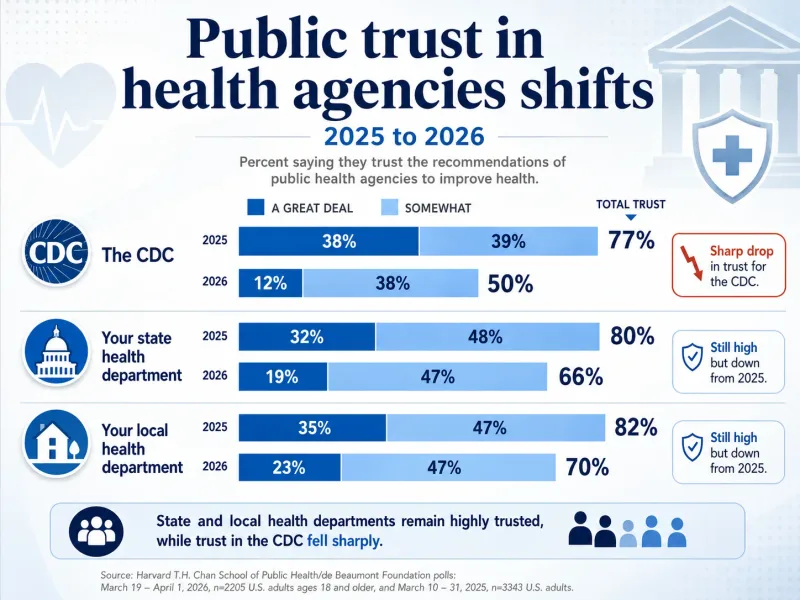
Trust in America's top health agencies just fell again, and it's the second year in a row this has happened. A February 2026 survey from the Annenberg Public Policy Center (APPC) at the University of Pennsylvania found that confidence in the CDC, FDA, and NIH dropped 5 to 7 percentage points compared to a year earlier. That's not a small statistical wobble. It's part of a pattern.
The Numbers, Plainly
Here's what the trend line actually looks like. In February 2024, 74% to 76% of Americans said they trusted the CDC, FDA, and NIH to provide trustworthy public health information. By February 2025, that had dropped to 67% across all three agencies. This year, it fell again to somewhere between 60% and 62%.
So over two years, trust in these agencies has slid roughly 14 to 16 points. That's a meaningful shift for institutions that, for decades, most Americans simply didn't think much about one way or the other.
The survey polled 1,650 U.S. adults between February 3 and 17, 2026, with a margin of error of about ±3.5 percentage points, so this isn't a fringe poll with a handful of respondents. It's a serious, methodologically sound national sample.
The Part That Actually Surprised Me
Here's the detail that's easy to miss if you only read the headline. The drop in trust isn't evenly spread. Americans still trust the career scientists working inside these agencies quite a bit — 67% expressed confidence in them. But confidence in the political leadership running those same agencies sits at just 43%.
That's a 24-point gap between the scientists doing the work and the officials overseeing it. Confidence in HHS Secretary Robert F. Kennedy Jr. specifically was even lower, at 38% to 39%.
In healthcare-adjacent reporting, this distinction gets flattened way too often. "Trust in CDC is falling" makes for a cleaner headline than "trust in CDC's leadership is falling while trust in its scientists holds relatively steady," but the second version is closer to what the data actually shows.
Where the Distrust Shows Up in Real Decisions
This isn't just an abstract opinion poll. The survey asked people what they'd actually do if health authorities disagreed with each other.
On infant hepatitis B vaccination, if the American Academy of Pediatrics and the CDC gave different advice, 42% of respondents said they'd follow the AAP, compared to just 11% who'd follow the CDC. On general vaccine safety questions, if the American Medical Association and CDC disagreed, people favored the AMA over the CDC by more than two to one — 34% versus 15%.
Only 59% of respondents said they're confident the CDC is providing trustworthy information specifically about vaccine safety and effectiveness. That's the kind of number that should concern anyone working in public health communication, regardless of politics.
One Thing That Hasn't Moved
Amid all this decline, one number stayed remarkably stable: trust in personal doctors. Roughly 46% of respondents said they have high confidence in their own primary care provider, a figure that's held steady even as institutional trust has fallen.
Having watched how patients bring up news headlines during regular visits over the past year, this tracks with what a lot of primary care doctors report anecdotally: people are increasingly treating their own doctor as the trusted filter for national health guidance, rather than taking agency statements at face value. That's arguably a healthy adaptation, and arguably also a sign that the agencies have some rebuilding to do.
Why This Matters If You're Not a Policy Person
You might be wondering why any of this should change what you do on a Tuesday afternoon. Here's the honest answer: it probably shouldn't change your medical decisions directly, but it's useful context for understanding why health guidance sometimes feels less settled than it used to.
If you're unsure whether a piece of health advice you saw online reflects current, credible guidance, running it past your own general physician is a reasonable move, especially for anything involving vaccines or your children's care. A pediatrician can walk you through current vaccine recommendations directly rather than leaving you to interpret conflicting agency statements on your own.