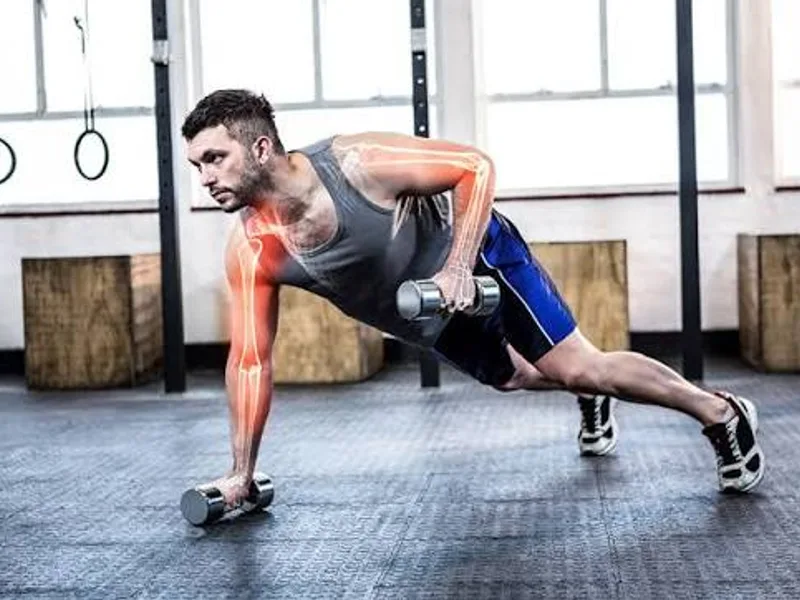
Why Resistance Training Can Strengthen Bones
Muscles and bones work as a unit. When a muscle contracts against resistance, it creates forces that are transmitted through the skeleton. Over time, repeated mechanical loading can encourage the body to maintain or build bone tissue.
Research supports this relationship. A 2025 systematic review and meta-analysis of 17 randomized controlled trials involving 690 postmenopausal women found that resistance training improved bone mineral density at the lumbar spine, femoral neck and total hip, although the researchers also noted substantial variation between studies.
That does not mean every weight-training routine will increase bone density. Exercise response depends on factors such as age, training history, health status, skeletal site and the way the program is designed.
For a useful explanation of bone-density measurement, see Doctar’s guide to [T-scores and Z-scores in bone density testing]Understanding T-scores and Z-scores in bone density testing.
Which Resistance Exercises Help Bone Health?
The best program usually involves movements that load several major muscle groups while allowing good control.
Squats and Sit-to-Stand Movements
Squats, supported squats and repeated chair rises load the hips and legs while also training muscles needed for everyday movement.
For beginners or older adults, a controlled sit-to-stand movement from a stable chair can be a practical starting point. Doctar’s [guide to strength training and the 1-rep max]Understanding the 1-rep max and strength training explains why strength should be progressed carefully rather than tested recklessly.
Resistance Bands and Weight Machines
Bands can provide resistance without requiring heavy free weights. Weight machines can also be useful because they provide a more controlled movement path.
For people who are new to strength training, a physiotherapist or qualified exercise professional can help with technique and progression. Doctar’s [physiotherapy guidance on strength training]Strength training guidance from Doctar is a useful related resource.
Upper-Body Strength Work
Pressing, pulling and rowing movements can load the arms, shoulders, upper back and spine. Resistance exercises are particularly useful because their effects are not limited to the legs.
The Bone Health & Osteoporosis Foundation also describes resistance exercise as muscle-strengthening activity that can benefit the bones of the arms, legs and back.
Doctar also covers [strength training with psoriatic arthritis]Strength training with psoriatic arthritis, which is relevant for readers who have joint or inflammatory conditions that may affect exercise choices.
How Often Should You Do Resistance Training?
Consistency matters more than an occasional hard workout.
Bone Health & Osteoporosis Foundation guidance recommends muscle-strengthening exercise on roughly two to three days each week, while the International Osteoporosis Foundation supports progressive resistance training for people with osteoporosis when appropriately adapted.
The exact program should depend on the person's starting strength, medical history and fracture risk. A 2025 meta-analysis in postmenopausal women found benefits across several training approaches, but also reported considerable differences between studies, so there is no single routine that should be presented as universally optimal.
Readers interested in related training methods can also explore Doctar’s [conjugate method for strength training]Conjugate method for strength training and its practical article on [pull-ups and training frequency]Can you do pull-ups every day?.
What If You Already Have Osteoporosis?
A diagnosis of osteoporosis does not automatically mean you must stop resistance training.
The International Osteoporosis Foundation says progressive resistance training can be safe for people with osteoporosis, with exercise intensity initially kept appropriate to the individual's ability and increased gradually. People at high fracture risk may need specific movement restrictions.
The bigger issue is technique. Exercises involving forceful twisting or repeated deep forward bending of the spine may be unsuitable for some people with osteoporosis, particularly those at increased risk of spinal fracture.
Doctar has a dedicated guide on [osteoporosis exercises to avoid]Osteoporosis exercises to avoid that discusses these precautions in more detail.
Doctar also covers [boosting bone density after 60]Boosting bone density after 60 and [preventing stooping and protecting the spine in older age]Preventing stooping and protecting the spine in older age.
In clinical practice, this is often missed because people hear "osteoporosis" and assume exercise is dangerous. In reality, the right exercise can be part of bone-health management, but the wrong movement, poor technique or inappropriate progression can increase injury risk.
Resistance Training Is Only One Part of Bone Health
Strong bones need more than resistance exercise.
Weight-bearing activities such as brisk walking, stair climbing and some forms of sport expose bones to forces that are different from those produced by resistance machines. The Bone Health & Osteoporosis Foundation recommends both weight-bearing and muscle-strengthening exercise as components of bone health.
Nutrition matters too. Calcium is a major mineral in bone, while vitamin D helps the body absorb calcium. Doctar’s [calcium-rich foods guide for Indian diets]Calcium-rich foods for Indian diets explains practical food sources, while its guide to [non-dairy calcium foods]Non-dairy calcium foods for Indian diets may be useful for people who avoid or cannot tolerate dairy.
Doctar also discusses [vitamins and supplements for Indian consumers]Vitamins and supplements guide for Indian consumers and [protein sources for healthy aging]Protein sources for healthy aging.
Supplements should not be treated as a substitute for a balanced diet or prescribed treatment. If you suspect a calcium or vitamin D deficiency, discuss testing and treatment with a healthcare professional rather than self-treating.
Bone Health After Menopause
Women can experience faster bone loss around and after menopause because falling estrogen levels affect bone remodeling.
That makes resistance training particularly relevant during this stage of life. Doctar’s [guide to exercise after menopause]Exercise for stronger bones after menopause discusses resistance training alongside weight-bearing and balance exercises.
Its related article on [vitamin D and menopause]Vitamin D and menopause explains why bone health deserves particular attention during this transition. The [perimenopause functional exercise guide]Functional exercise during perimenopause offers another perspective on maintaining strength and function.
For additional context, Doctar covers [healthy habits during menopause]Healthy habits during menopause and [menopause-related bone-density loss]Menopause and bone-density loss.
When Professional Guidance Makes Sense
People with a previous fragility fracture, diagnosed osteoporosis, significant bone loss, persistent pain, balance problems or other medical conditions should not copy an advanced gym program from the internet.
A doctor or physiotherapist can help determine which movements are appropriate and whether a bone-density assessment or other evaluation is needed.
For readers looking for orthopaedic care, Doctar lists specialists such as [Dr. Ronen Roy, orthopaedist in Kolkata]Dr. Ronen Roy, orthopaedist in Kolkata, [Dr. Kunal Kanti Pal]Dr. Kunal Kanti Pal, orthopaedist in Kolkata and [Dr. Arunangsu Bhattacharyya]Dr. Arunangsu Bhattacharyya, orthopaedist in Kolkata.
Other Doctar specialist profiles include [Dr. Rajendra Singh Gaheer]Dr. Rajendra Singh Gaheer, orthopaedist in Kolkata and [Dr. Partha Pratim Das]Dr. Partha Pratim Das, orthopaedist in Kolkata. Doctar also lists [Dr. Kamal Sinha, physiotherapist in Kolkata]Dr. Kamal Sinha, physiotherapist in Kolkata.