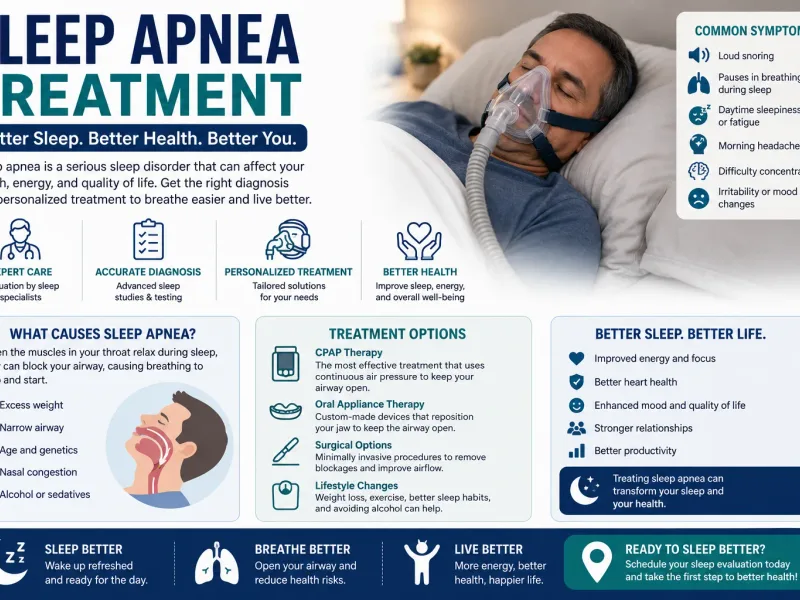
What are the signs of sleep apnea?
Loud snoring gets most of the attention, but it is only one clue. A partner may notice pauses in breathing, choking or gasping during sleep, while the person may experience morning headaches, dry mouth, poor concentration or excessive daytime sleepiness.
Some people sleep through the night and still wake up exhausted. Doctar's guide on [excessive daytime sleepiness] Excessive Daytime Sleepiness: When to Seek Medical Advice explains why persistent daytime sleepiness deserves medical attention rather than being dismissed as ordinary tiredness.
Other subtle clues can be easy to miss. Doctar has also examined [tongue-related signs of sleep apnea] What Your Tongue Can Tell You About Sleep Apnea, although a tongue appearance by itself cannot diagnose the disorder.
Diagnosis comes before treatment
A person should not choose a CPAP machine or another sleep device simply because they snore. Proper diagnosis helps establish whether the problem is obstructive sleep apnea, central sleep apnea or another sleep disorder.
A doctor may review symptoms, medical history, weight, airway anatomy and other health conditions. A sleep study can then measure breathing, oxygen levels, heart rate and other signals during sleep.
One commonly used test is polysomnography. Doctar's [guide to polysomnography] Understanding Polysomnography Testing explains how this overnight test records several body functions while a person sleeps.
For some people with suspected obstructive sleep apnea, a home sleep apnea test may be appropriate. It is simpler than a full sleep-lab study, but it does not provide the same amount of information and is not suitable for every patient.
CPAP remains a major treatment
Continuous positive airway pressure, commonly called CPAP, is one of the main treatments for obstructive sleep apnea. The machine sends a steady flow of air through a mask to help keep the airway open during sleep.
CPAP can work very well when it is correctly prescribed, fitted and used consistently. But the machine is not magic. Mask leaks, dryness, discomfort and difficulty adjusting to the equipment can affect whether someone continues using it.
Doctar also has a [guide to CPAP coverage and treatment considerations] Understanding CPAP Machines and Coverage, which discusses CPAP as a common treatment for obstructive sleep apnea.
What if CPAP is uncomfortable?
CPAP is not the only possible approach. Depending on the diagnosis, a doctor may consider a custom oral appliance, positional therapy, weight management, surgery or another form of positive-airway-pressure treatment.
Oral appliances are worn in the mouth during sleep and can reposition the jaw or tongue to help maintain airway space. They are generally considered for selected patients, particularly those with certain forms or severities of obstructive sleep apnea or those who cannot tolerate CPAP.
Doctar's main [sleep apnea treatment guide] What Is Sleep Apnea? Causes, Symptoms and Treatments covers CPAP, oral appliances, sleep studies and lifestyle measures.
Lifestyle changes can support treatment
Lifestyle changes can be useful, but they should not automatically replace prescribed treatment. For people who are overweight, medically appropriate weight management may improve obstructive sleep apnea. Regular physical activity and avoiding alcohol close to bedtime may also help some patients.
Sleeping position matters for some people. Obstructive events can be worse when a person sleeps on their back, so positional strategies may be recommended in selected cases.
Doctar discusses the relationship between [sleep apnea and weight gain] Sleep Apnea and Weight Gain: Understanding the Cycle, including why weight and sleep quality can influence each other.
In clinical practice, this is often missed because people expect a machine or procedure to solve everything. Treatment usually works better when the underlying risk factors and daily habits are addressed alongside the main therapy.
Surgery may help selected patients
Surgery is not the first answer for everyone with sleep apnea. It may be considered when the anatomy of the nose, throat, tonsils, jaw or another part of the upper airway contributes significantly to obstruction.
An ENT specialist can assess structural problems affecting breathing. Doctar's article on [ENT care for sleep apnea and snoring] Top ENT Specialist in Supaul explains that ENT doctors evaluate conditions involving the nose, throat and upper airway, including sleep apnea.
Nasal obstruction can also complicate breathing during sleep. Doctar's [septorhinoplasty guide] Septorhinoplasty and Nasal Breathing discusses how structural nasal problems may affect airflow, although nasal surgery is not a universal cure for sleep apnea.
Finding the right specialist
A pulmonologist, sleep-medicine specialist, ENT doctor or another appropriately trained physician may be involved depending on the suspected cause.
Doctar currently lists [pulmonologists in Bangalore] Pulmonologists in Bangalore and a location-based [pulmonologist-near-me search in Bangalore] Pulmonologists Near Me in Bangalore. These directories can help patients explore respiratory specialists by location.
Individual Doctar profiles can also help readers understand the range of respiratory specialists available. Examples include [Dr. Raja Dhar in Kolkata] Dr. Raja Dhar, Pulmonologist in Kolkata, [Dr. Sanghabrata Sur] Dr. Sanghabrata Sur, Pulmonologist in Kolkata, [Dr. Ranjan K. Das] Dr. Ranjan K. Das, Pulmonologist in Kolkata, and [Dr. Debraj Jash] Dr. Debraj Jash, Pulmonologist in Kolkata.
For Mumbai, Doctar lists respiratory specialists such as [Dr. Amit Panjwani] Dr. Amit Panjwani, Pulmonologist in Mumbai and [Dr. Nimish M. Shah] Dr. Nimish M. Shah, Pulmonologist in Mumbai. Dr. Shah's profile specifically describes experience in sleep disorders.
Delhi patients can explore [Dr. Amit Dhamija] Dr. Amit Dhamija, Pulmonologist in Delhi, whose Doctar profile includes sleep medicine, or [Dr. RS Chatterji] Dr. RS Chatterji, Pulmonologist in Delhi, whose profile also notes sleep-medicine expertise.
For patients with significant upper-airway or snoring concerns, ENT assessment may also be useful. Doctar's [ENT guide for Bettiah] ENT Specialists in Bettiah and [ENT guide for Madhepura] Find the Best ENT Doctor in Madhepura discuss the role of ENT specialists in evaluating conditions that can affect breathing and sleep.
Sleep apnea can affect the heart
Untreated sleep apnea is not only a sleep problem. Repeated breathing interruptions and changes in oxygen levels can place stress on the cardiovascular system.
Research has linked sleep apnea with several cardiovascular problems, including high blood pressure and abnormal heart rhythms. Doctar's article on [sleep apnea and heart arrhythmias] Sleep Apnea and Heart Arrhythmias explains this relationship in more detail.
That does not mean every person with snoring has heart disease. It does mean persistent symptoms deserve proper evaluation rather than being ignored for years.
Be careful with quick fixes
Online trends can make sleep apnea treatment sound surprisingly simple. Mouth taping, for example, is sometimes promoted as a solution for snoring or mouth breathing.
That is not a substitute for diagnosing sleep apnea. Doctar's [article on mouth taping] Mouth Taping for Snoring and Sleep Apnea discusses why the practice deserves caution, particularly when someone may already have a sleep-related breathing disorder.
Sleep medicines also should not be treated as a simple answer to breathing-related sleep problems. Doctar's [sleep medication guide] Understanding Sleep Medications explains that sleep medicines are intended for specific sleep problems and should be considered with professional guidance.
Children need a different approach
Sleep apnea can affect children too, but the causes and treatment decisions can differ from adults. Enlarged tonsils or adenoids, airway anatomy and other conditions may contribute.
For children, evaluation by an appropriately trained paediatrician, ENT specialist or sleep specialist may be necessary. Doctar lists [Dr. Sumaira Quazi in Bangalore] Dr. Sumaira Quazi, Pediatrician, whose profile includes paediatric sleep medicine.
A hospital with dedicated sleep services may also be appropriate in complex cases. For example, [Advanced Neuro and Maternity Hospital in Begusarai] Advanced Neuro and Maternity Hospital, Begusarai lists sleep medicine and sleep-disorder services.
When should you seek medical help?
Make an appointment if loud snoring is accompanied by witnessed breathing pauses, gasping during sleep, persistent daytime sleepiness, morning headaches or difficulty concentrating.
Do not wait for a routine appointment if someone has severe breathing difficulty, loss of consciousness, chest pain or another acute medical emergency. Emergency care is appropriate in those situations.
A sleep problem can look harmless from the outside. The person may simply appear to be sleeping loudly. But repeated breathing interruptions are worth taking seriously.