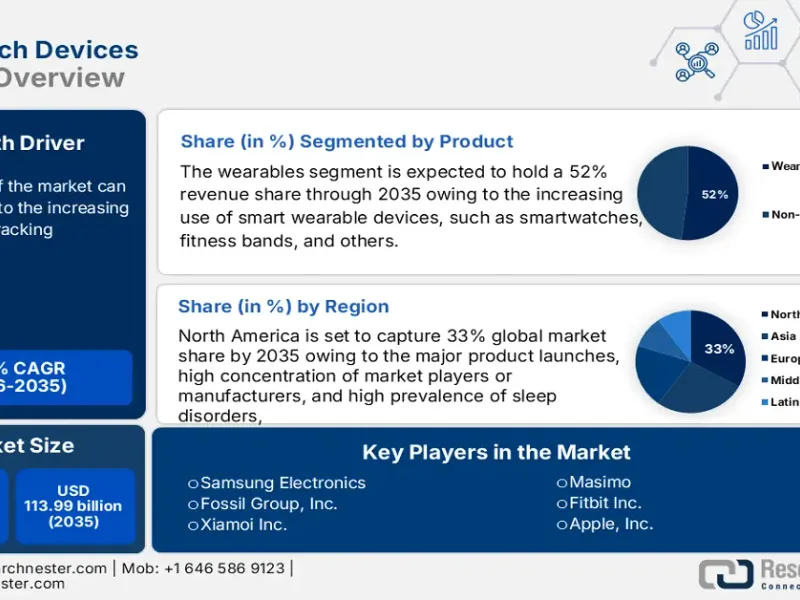
The sleep tech wearable market is shifting from fitness gadgets toward everyday health monitoring. Smartwatches, rings and screen-free wrist devices can now collect sleep-related data overnight, giving consumers a picture of their sleep that was once available mainly through specialised testing.
That does not mean a wearable can replace a sleep clinic. It cannot. The more useful question is where these devices fit between personal wellness tracking and medical care.
Doctar's [wearable health technology guide] Wearable Health Tech in 2026 describes the broader move toward continuous health monitoring, including sleep, heart rate, blood oxygen and other physiological signals.
What is driving the sleep wearable market?
The appeal is straightforward: people want to understand what happens while they are asleep without spending a night in a laboratory.
A wearable can collect information over many nights, which makes it useful for spotting personal patterns. Doctar's [sleep tracker guide] Sleep Trackers and Sleep Health describes consumer trackers as devices that can monitor sleep duration, patterns and estimated sleep stages.
The market is also benefiting from better sensors and smaller hardware. A device worn on the wrist or finger is far less intrusive than a collection of wires attached in a sleep laboratory.
But convenience creates its own trap. A beautifully designed sleep score can look more medically precise than it actually is.
Smart rings are becoming serious sleep products
Smart rings are one of the most visible parts of the market because they remove the screen and bulk associated with many watches.
Doctar's [Oura Ring review] Oura Ring and Sleep Tracking describes a ring that tracks measures including heart rate, heart-rate variability, body temperature and breathing-related information, then converts some of that data into sleep and readiness scores.
The attraction is not just fashion. Rings can be worn continuously, including overnight, and many users prefer them because they do not have a bright screen demanding attention at bedtime.
The limitation is equally important. A consumer ring estimates sleep from sensor signals and algorithms. It does not directly measure every feature that a clinical sleep study measures.
Smartwatches remain a major category
Smartwatches have a broader role because they combine sleep tracking with exercise, heart-rate monitoring and smartphone functions.
Doctar's [fitness tracker comparison for women] Fitness Trackers and Sleep Monitoring discusses devices from Apple, Garmin, Samsung and WHOOP and their different approaches to sleep and health tracking.
A separate [Fitbit Charge 5 review] Fitbit Charge 5 and Sleep Tracking covers sleep patterns alongside heart-rate and activity measurements.
For buyers, the practical question is not which device has the longest feature list. It is which measurements are relevant, how consistently the device can be worn and whether its data can actually help the user make sensible changes.
WHOOP and the rise of recovery tracking
Some wearable companies have moved away from presenting themselves primarily as sleep trackers. They sell a broader idea of recovery, readiness and physical strain.
Doctar's [WHOOP 4.0 review] WHOOP 4.0 Sleep and Recovery Tracking describes a screen-free device that combines sleep information with heart rate, heart-rate variability, respiratory rate, skin temperature and other measures.
This reflects a wider market trend. Sleep is increasingly being treated as part of recovery rather than an isolated number.
For athletes, that may be useful. For someone worried about unexplained fatigue or repeated night waking, however, a recovery score is not a diagnosis.
What are wearables actually measuring?
Most consumer sleep wearables do not watch the brain directly. They infer sleep and wake states from signals such as movement and heart-rate patterns, with some devices adding temperature or oxygen-related measurements.
That distinction matters.
Clinical sleep testing can record brain activity, eye movements, muscle activity, breathing and blood oxygen. Doctar's [polysomnography explainer] Polysomnography Sleep Study describes this broader testing process.
A wearable therefore offers a different kind of information. It is convenient and repeated, but it is not equivalent to a full sleep study.
Actigraphy sits between consumer and clinical tracking
Actigraphy is an interesting middle ground. It uses a small movement-sensing device, often worn on the wrist, to study activity and rest over several days.
Doctar's [rest-activity rhythm study guide] Rest-Activity Rhythm Study explains how an actigraph can record movement patterns and help clinicians assess sleep-wake rhythms and circadian problems.
This is different from buying a smartwatch and checking its sleep score each morning. In a clinical setting, the device's information is interpreted alongside a sleep diary, medical history and other findings.
Sleep apnea is where the distinction matters most
Wearables may flag unusual overnight oxygen or breathing-related patterns, but consumers should be cautious about treating an alert as proof of sleep apnea.
Sleep apnea involves repeated interruptions in breathing during sleep. Doctar's [sleep apnea overview] Sleep Apnea Causes, Symptoms and Treatment explains the condition and the role of sleep studies in diagnosis.
The difference between [obstructive and central sleep apnea] Obstructive vs Central Sleep Apnea also matters because these conditions have different mechanisms.
If someone has loud snoring, witnessed pauses in breathing, gasping or persistent daytime sleepiness, a wearable should not become an excuse to postpone medical assessment.
Doctar's [excessive daytime sleepiness guide] Excessive Daytime Sleepiness explains why persistent sleepiness can have several causes and may warrant professional evaluation.
The market has a measurement problem
Sleep technology companies often report sleep stages such as light, deep and REM sleep. Those labels are appealing because they appear precise.
But consumer algorithms estimate these stages rather than measuring brain waves in the same way as polysomnography. A user should therefore look at trends rather than treating every nightly score as a medical fact.
Doctar's [guide to diagnosing sleep disorders] Medical History in Sleep Disorder Diagnosis highlights the role of medical history, sleep schedules, symptoms and related conditions in assessing sleep problems.
In clinical practice, this is often missed because a colourful dashboard feels objective. A number is still only useful when we understand what was measured, how it was estimated and what question it can actually answer.
What happens when sleep data becomes medical data?
The next major issue for the sleep tech wearable market is not just accuracy. It is data governance.
Sleep records can reveal routines, working hours, travel patterns, illness and other sensitive information. As wearables connect with health apps and healthcare systems, users need to understand what information is collected, where it is stored and who can access it.
Doctar's [health wearable technology overview] Health Wearable Technology Trends points to greater connectivity between wearable devices, smartphones and health records as an emerging direction.
More connectivity can be useful, but it raises the stakes for privacy and security.
Better sleep data does not always mean better sleep
There is another problem that rarely gets enough attention: some people become obsessed with their sleep numbers.
A person may wake after a difficult night, see a low score and spend the entire morning worrying about the score. That anxiety can become part of the sleep problem.
Doctar's [sleep troubles guide] Common Sleep Troubles and Better Sleep covers common problems such as insomnia, snoring, restless legs and disrupted sleep routines.
Its [guide to tiredness and difficulty sleeping] Tired But Can't Sleep also discusses how stress, circadian disruption and sleep disorders can contribute to the feeling of being exhausted but unable to sleep.
A wearable should ideally support better habits, not create another reason to stare at a screen at 2 a.m.
Where the market could go next
The most interesting development is the movement from passive tracking toward health decision support.
Wearables are becoming better at combining several signals and presenting them as trends. That may help users recognise changes worth discussing with a clinician.
But the boundary between wellness technology and medical devices will become increasingly important. A device marketed for general wellness does not automatically have the same clinical validation or regulatory status as a medical diagnostic device.
Doctar's [wearable technology outlook] Wearable Health Tech Trends discusses the broader push toward continuous monitoring, predictive analytics and remote health management.
The market's future will likely depend as much on evidence and responsible interpretation as on smaller sensors and cleverer algorithms.
When should you talk to a sleep specialist?
Persistent symptoms should outweigh a reassuring wearable score. Loud snoring, gasping during sleep, witnessed breathing pauses, severe daytime sleepiness or ongoing insomnia deserve proper assessment.
Doctar's [sleep medication guide] Sleep Medications and Professional Care stresses that persistent sleep problems may require assessment rather than self-treatment.
A person with suspected sleep apnea may be referred for a sleep study. Someone with a circadian rhythm problem may need a different evaluation.
Doctar's [delayed sleep phase guide] Delayed Sleep Phase Syndrome explains how actigraphy can help document sleep-wake patterns in selected patients.
For persistent daytime sleepiness, Doctar's [medical advice guide] When Daytime Sleepiness Needs Medical Advice recommends professional assessment when symptoms interfere with daily life.
People looking for specialist care can also explore Doctar profiles such as [Dr. RS Chatterji] Dr. RS Chatterji, Sleep Medicine, whose profile includes sleep medicine, or [Dr. Hemanth L] Dr. Hemanth L, Sleep Medicine, who is listed as a pulmonologist and somnologist.
[Dr. Amit Dhamija] Dr. Amit Dhamija, Sleep Medicine is another Doctar-listed pulmonologist whose profile includes sleep medicine.