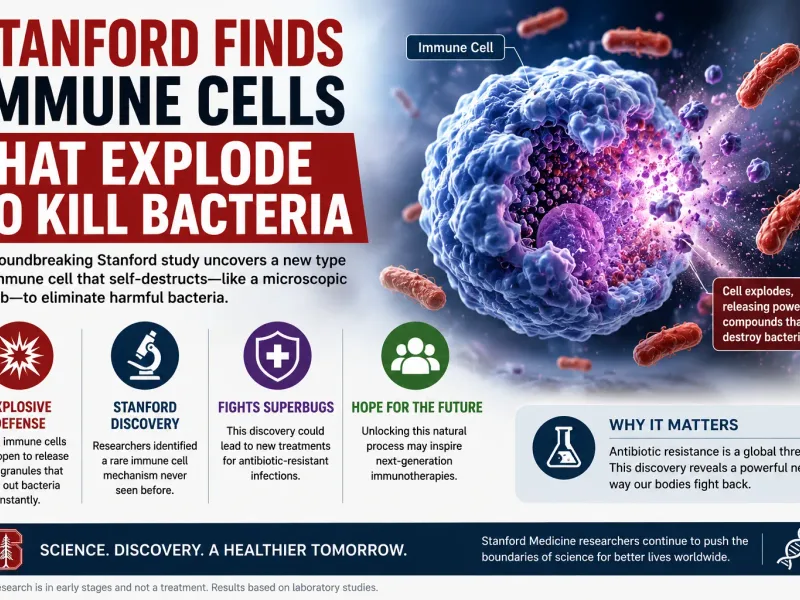
Stanford researchers have identified a new kind of immune cell that kills nearby threats by exploding. The whole event is over in minutes. The cell releases a burst of toxic substances, destroys anything close by, and then disappears so completely that it barely leaves a trace.
They found it in planarian flatworms — those small, flat, oddly indestructible aquatic worms famous for regenerating entire bodies from a single severed piece. The team, led by Stanford bioengineering professor Bo Wang, named the cells "ruptoblasts." The findings were published in the journal Cell in June 2026.
It's a strange image to sit with: a cell essentially detonating itself as a defense strategy. But that's more or less what's happening.
How Ruptoblasts Actually Work
The discovery started almost by accident. Postdoctoral researcher Chew Chai was investigating a different question entirely — whether flatworms can tell their own tissue apart from another worm's. While watching cells under the microscope, she noticed a group of them behaving oddly: bursting open, killing everything nearby, then vanishing within about five minutes.
That's the part that makes ruptoblasts unusual. Most immune cells fight in a way that takes hours and depends on direct contact with a target. Ruptoblasts skip all of that. They respond to a spike in activin, a hormone already known to regulate flatworm regeneration and reproduction. Once triggered, calcium floods out of the cell's internal structures, and the cell erupts, releasing broad-spectrum killing agents into the immediate area.
There's also a structural quirk worth mentioning. Ruptoblasts aren't blood cells, unlike T-cells or neutrophils in the human immune system. They're glandular cells — a completely different lineage doing a job usually reserved for blood-derived immune cells.
What the Cells Actually Destroy
In lab tests, researchers exposed ruptoblasts to E. coli bacteria, human kidney cells, and mouse blood cells. The explosive reaction killed all of them. When the flatworms were infected with harmful bacteria, nearby cells released the activin signal that set the ruptoblasts off, clearing the infection through localized, contained destruction rather than a body-wide immune response.
That containment is arguably the most interesting part. The damage stayed limited to the blast zone. No chain reaction, no lingering toxicity spreading to healthy tissue nearby.
Planarian flatworms are one of the most heavily studied animals in developmental biology — people have been slicing them up and watching them regrow for over a century. So how did something this dramatic go unnoticed?
Part of the answer is timing. The whole event resolves within minutes and destroys the very cell that produced it. Standard tissue preparation methods, which typically involve fixing and preserving samples before examining them, would likely miss a process this fast and self-erasing entirely. You'd need live-cell imaging to catch it in the act, which is exactly what this team used.
It's worth being upfront about what this study does and doesn't show. This is an invertebrate mechanism, observed in a flatworm. The researchers haven't established an equivalent process in humans, and there's no therapy on the horizon yet.
What it does offer is a genuinely new idea. Wang's team suggests this kind of rapid, self-contained, cell-sacrificing defense might represent an evolutionary branch that never made it into vertebrate immune systems — possibly because animals like us can't regenerate lost cells as efficiently as a flatworm can. If a human immune cell detonated itself the way a ruptoblast does, the surrounding tissue damage might not be so easily repaired.
Still, researchers are interested in the underlying logic: fast, hyper-localized destruction with minimal collateral damage is exactly the kind of behavior that's valuable in fighting drug-resistant bacteria or tumors, where current treatments often struggle to be both fast and precise.
The Bigger Picture on Immune Diversity
Wang has pointed out that most biomedical immunology research focuses on mammals, which means a lot of immune biology in the rest of the animal kingdom is still unmapped. Animals that have been surviving in bacteria-heavy, pathogen-dense environments for hundreds of millions of years may be running immune strategies nobody has thought to look for yet.
Ruptoblasts are one example. There are likely more out there, simply because so few non-mammal immune systems have been studied this closely.
What to Take From This
This isn't a treatment breakthrough yet, and it's not going to change how doctors manage infections anytime soon. What it does is open a new line of basic research into how immune cells can destroy threats quickly and locally without wide tissue damage — an idea that, if it can eventually translate to human biology, could matter for how we think about treating bacterial infections and cancer. For now, it's a reminder that even a widely studied lab animal can still surprise researchers who know where to look. If you're dealing with a persistent or unusual infection today, that's still a conversation for a doctor, not a lab finding in a flatworm.