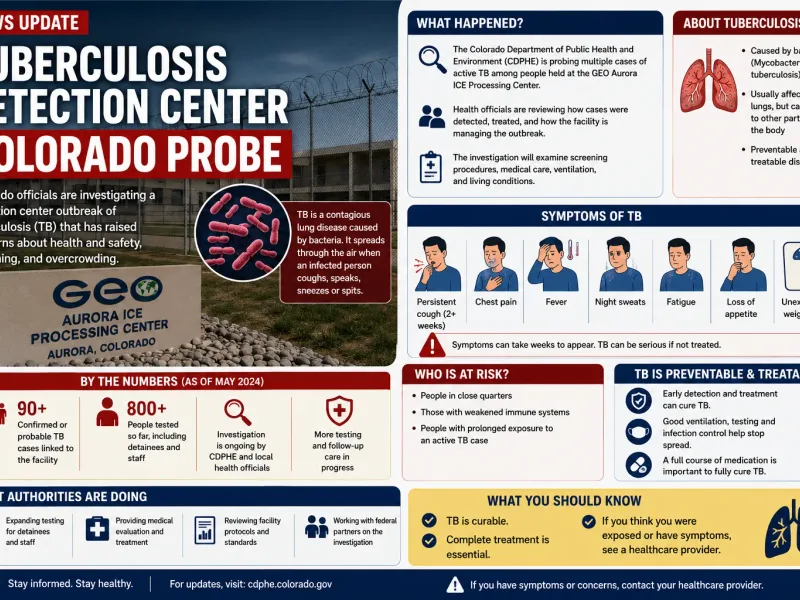
Colorado public health officials have been unable to complete an investigation into a confirmed case of active tuberculosis at the Aurora ICE Processing Center for more than a month, because GEO Group, the private company that operates the facility, has not provided the access and records required under state law. The Adams County Health Department (ACHD) confirmed the case in early June and issued a public health order on June 25 directing GEO to cooperate. As of a July 22 statement from the Colorado Department of Public Health and Environment (CDPHE), that access still hadn't been granted.
The Adams County Health Department learned of a laboratory-confirmed case of active tuberculosis in a detainee at the Aurora facility in early June 2026, according to CBS Colorado. Because Colorado law requires public health agencies to investigate confirmed TB cases, ACHD opened an investigation and issued a public health order roughly three weeks later directing GEO to provide access to medical records, help identify potential exposures, and allow investigators to interview the patient.
That access has not materialized. ACHD Executive Director Kelly Weidenbach said in a court filing that investigators have faced <cite index="18-1">a lack of cooperation from federal immigration authorities and the facility's representatives</cite>, and that they remain denied access to the infected patient, medical records, and information on detainee movement needed to determine who may have been exposed and how far the disease may have spread.
By late July, CDPHE spokesperson Hope Shuler said the situation was unresolved: <cite index="16-1">the department still had not received access to the facility or all of the information needed to determine who may have been exposed and ensure they receive appropriate testing and treatment</cite>, despite repeated attempts by the governor's office and CDPHE leadership to contact facility leadership directly.
GEO Group's position, according to Shuler, is that <cite index="17-1">its lawyers have stated there are no confirmed or suspected cases of tuberculosis at the site</cite>. Health officials say that claim can't be independently verified without the contact investigation the company is blocking — and that it also doesn't match the lab-confirmed case ACHD says it identified in June.
The core problem, according to CDPHE, is that a TB investigation depends on speed. Shuler put it directly: <cite index="17-1">a complete investigation remains necessary because people who were recently infected may initially test negative</cite>. Standard TB testing methods, including skin tests and blood tests, can take weeks after exposure to reliably detect infection, which is part of why public health law requires prompt contact tracing rather than a one-time check.
The Colorado Sun reported that the facility housed 1,249 detained people as of the most recent oversight report from Rep. Jason Crow's office, in a congregate setting where the CDC notes tuberculosis — a bacterial infection that spreads person to person through the air and primarily affects the lungs — can move efficiently if not identified and managed quickly.
[REVIEWER: add clinical insight here — e.g., how contact investigations for active TB are typically prioritized and sequenced in a congregate or detention setting, and why early testing windows can produce false negatives even in genuinely exposed individuals]
What Tuberculosis Investigations Normally Involve
When a case of active tuberculosis is confirmed, health departments are legally required to act quickly. CBS Colorado summarized the standard process: <cite index="20-1">when a case of active tuberculosis is identified, Colorado law requires public health officials to promptly investigate the case, determine whether others may have been exposed, and take appropriate steps</cite> to test and treat those contacts.
That typically means reviewing where the person spent time and who they were near, testing people identified as close contacts, and starting treatment for anyone found to have active or latent infection. In a detention facility, that process depends heavily on the facility's own records of housing assignments, shared spaces, and detainee movement — the exact information ACHD says it has not been given.
Common symptoms of active tuberculosis, per the CDC, include a persistent cough, chest pain, coughing up blood, fatigue or weakness, and fever. Left untreated, the disease can be fatal, though it is treatable with a multi-month course of antibiotics when caught and managed appropriately.
[REVIEWER: add clinical insight here — e.g., what a contact investigation timeline typically looks like from confirmed case to completed testing of contacts, and what factors can complicate that timeline in a facility with restricted access]
The Broader Context
This isn't happening in isolation. Colorado Public Radio has reported that state officials, including pressure directed at the Colorado Attorney General's office, are pushing for legal action to force compliance, given that state law gives public health departments authority to investigate confirmed infectious disease cases regardless of the facility type involved. The Denver Gazette also reported that concerns about tuberculosis risk have surfaced at public meetings related to a separate, previously closed Colorado detention facility slated to reopen, reflecting broader unease about infectious disease oversight in detention settings generally.
The Aurora facility itself has drawn scrutiny before on other grounds, including past reporting on detainee deaths and conditions, though those issues are separate from the current tuberculosis investigation.
What Happens Next
As of this writing, the standoff between GEO Group and Colorado health officials remains unresolved, and the scope of potential exposure at the Aurora facility is still unknown to state and county health authorities. CDPHE has said it remains ready to complete the investigation once given access. Whether that access comes through voluntary cooperation or legal action from the state may determine how long the exposure window stays open for anyone who has passed through the facility since the case was identified.
FAQ
What is happening with the tuberculosis case at the Aurora ICE facility? Adams County health officials confirmed a case of active tuberculosis in a detainee in early June 2026 and issued a public health order requiring GEO Group, which operates the facility, to provide records and access needed for a contact investigation. As of late July, officials say that access still has not been granted.
Why can't health officials confirm how many people were exposed? Investigators say they've been denied access to the infected patient, medical records, and detainee movement records that would let them identify who spent time near the person and needs testing. Without that information, the scope of potential exposure can't be determined.
What does GEO Group say about the case? According to a CDPHE spokesperson, GEO Group's lawyers have stated there are no confirmed or suspected tuberculosis cases at the facility. Health officials say that claim conflicts with the lab-confirmed case they identified in June and can't be verified without the investigation the company has not permitted.
How is tuberculosis normally investigated when a case is confirmed? Colorado law requires public health officials to promptly investigate confirmed active TB cases, identify people who may have been exposed, and arrange testing and treatment as needed. That process depends on access to the confirmed patient, their medical records, and information about where they spent time.
What are the symptoms of active tuberculosis? Common symptoms include a persistent cough, chest pain, coughing up blood, fatigue, and fever. Tuberculosis spreads through the air between people and primarily affects the lungs, though it can also affect other organs. It's treatable with antibiotics but can be fatal without treatment.
Practical Takeaway
This is an active, unresolved public health standoff, not a closed case — the scope of potential tuberculosis exposure at the Aurora ICE Processing Center remains unknown to Colorado health authorities more than a month after a confirmed case was identified. Anyone who has been detained at, worked in, or visited the facility recently and develops a persistent cough, unexplained fatigue, chest pain, or fever should contact a health care provider, mention the facility, and ask about TB testing directly rather than waiting for official notification.
This article must be reviewed and attributed to a named, qualified medical reviewer — such as a board-certified infectious disease physician or public health physician — before publishing. This article is intended for general education only and does not constitute medical advice. It reports on an active, evolving news situation; consult local news sources and CDPHE for the most current updates.
Sources
Colorado Department of Public Health and Environment (CDPHE) — statements via spokesperson Hope Shuler, reported by News From The States, July 22, 2026.
Adams County Health Department — statements by Executive Director Kelly Weidenbach, reported by The Colorado Sun, July 15, 2026.
CBS Colorado. Tuberculosis case confirmed at GEO Group Aurora ICE Processing Center, July 13, 2026.
The Denver Gazette. GEO impeding TB investigation at Aurora ICE detention center, Colorado officials say, July 21, 2026.
Colorado Public Radio (CPR News). Pressure on Colorado AG to force Aurora ICE detention center to allow a tuberculosis investigation, July 17, 2026.
US Centers for Disease Control and Prevention (CDC) — tuberculosis transmission, symptoms, and treatment information. cdc.gov
Category
Infectious Disease / Public Health / Health Policy
Image Suggestion
A realistic exterior photograph of the Aurora ICE Processing Center building, taken during daylight, showing the facility's entrance and perimeter fencing — grounding the story in the actual location rather than a generic detention-center stock image or an unrelated medical photo.
Schema Suggestion
MedicalWebPage + NewsArticle + FAQPage — MedicalWebPage supports YMYL/E-E-A-T credibility for the health-policy angle; NewsArticle reflects the actively unfolding nature of the story and supports Top Stories eligibility; FAQPage enables rich-result and AI Overview eligibility for the direct factual questions in the FAQ section.