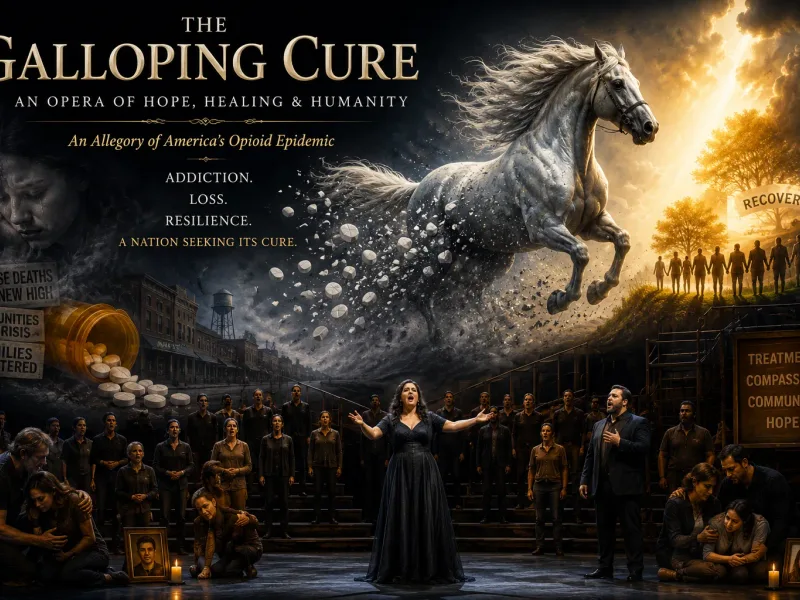
The Story Behind "The Galloping Cure"
The opera is called The Galloping Cure, composed by Missy Mazzoli with a libretto by Royce Vavrek. Mazzoli has said the project began with grief, not research. She lost two cousins to opioids — one in 2002, the other in 2009, both just 25 years old. One died after an OxyContin overdose. The other became addicted to heroin after first getting hooked on OxyContin, then died of a heroin overdose.
That's not a rare pattern. It's one of the most well-documented pathways of the opioid epidemic: a legal prescription opens the door, tolerance builds, the prescription runs out or gets harder to refill, and a cheaper, more available, far more dangerous substance fills the gap.
Mazzoli and Vavrek worked with novelist Karen Russell to shape the story, reportedly starting from Franz Kafka's unsettling short story "A Country Doctor" as a creative jumping-off point. What they landed on is a fable rather than a documentary — a choice Mazzoli has described as a way to bring compassion into a subject that's usually told through statistics or tragedy alone.
Why a Carnival Ride? Understanding the Allegory
The opera sets its story in a fictional, faded town and centers on a charismatic outsider — a con-man figure — who arrives promising relief. The central image is a carnival merry-go-round: something that looks joyful, feels good while you're on it, and keeps circling back to where you started without ever actually taking you anywhere.
That's not a bad description of opioid dependence. The initial relief is real. Pain goes away, or anxiety softens, or sleep finally comes. But the body adapts fast. What worked at first stops working at the same dose, so the dose creeps up — a process called tolerance. Eventually the person isn't riding for the good feeling anymore; they're riding because getting off makes them sick. That's dependence, and it's a different thing from simply "liking" a drug too much.
In clinical practice, this distinction is often missed because families (and sometimes patients themselves) assume addiction is about willpower or moral failure. It's more accurate to think of it as a hijacked survival circuit. The carousel doesn't stop because someone is weak-willed. It stops when the underlying physical dependence is treated properly, usually with medical support.
What the Opera Gets Right — and Where a Fable Has Limits
The merry-go-round image captures something textbooks often miss: the sense of motion without progress, the way each ride feels like it might finally be different. That's emotionally honest, and it's probably why audiences are responding to it.
Where any allegory has to simplify is the science. Real opioid use disorder involves the brain's opioid receptors adapting at a cellular level — this is well documented in addiction medicine — and untreated withdrawal can be dangerous, not just miserable. The opera isn't a clinical guide, and it was never meant to be one. It's meant to make people feel something they might otherwise scroll past in a headline.
It's also fair to ask: does turning a public health crisis into a "weird fairy tale," as Mazzoli herself called it, risk softening how serious this is? Maybe a little. But preachy, data-heavy messaging hasn't exactly turned the tide on opioid deaths either. There's a real argument that stories reach people statistics don't.
Where the Numbers Actually Stand
I won't invent a precise figure here, because the honest answer is that opioid mortality data varies by country, by year, and by which agency is counting — and pinning an exact number to this piece would go stale within months anyway. What's consistently true across health authorities is that prescription opioids remain a documented pathway into heroin or illicit fentanyl use for a meaningful share of people who develop opioid use disorder. If you want current figures, your country's health ministry or the WHO's substance use data pages are more reliable than a blog post trying to guess.
If You or Someone You Love Is Worried About This
You don't need to wait for a crisis to ask questions. If pain medication has been prescribed for weeks rather than days, it's worth discussing a taper plan with the prescribing doctor before dependence sets in — you can read more on non-narcotic pain relief options if you're trying to understand alternatives.
If a medication like gabapentin has been prescribed alongside or instead of opioids, this explainer on whether gabapentin is a controlled substance is a reasonable starting point — though it's education, not a substitute for talking to a pain management specialist.
If someone is already dependent, safety comes first. This guide on what to do in an overdose emergency is worth reading before you need it, not after. And if pregnancy or breastfeeding is part of the picture, this piece on Suboxone during pregnancy and breastfeeding addresses a question that comes up more than people expect.
None of this replaces an actual consultation. You can find a doctor near you or search hospitals nearby if you need an in-person evaluation, and pharmacy services if a taper plan requires medication changes. For anything urgent, emergency services near you shouldn't be a last resort — call sooner rather than later.