The Sweet Food Cravings Myth That Won't Die
You've heard it before, maybe from a wellness account, maybe from a well-meaning relative: craving sugar means your body is "missing something." Magnesium, chromium, a mystery vitamin, take your pick. It sounds plausible. It's also mostly not how this works.
Sugar cravings are real. The explanations circulating online for why they happen are, more often than not, oversimplified at best and made up at worst. Let's look at what the evidence actually says, because the gap between the popular story and the research is bigger than most people realize.
Where the "Nutrient Deficiency" Idea Comes From
The theory sounds tidy: your body is short on magnesium or B vitamins, so it sends you searching for chocolate. Some wellness content pages describe cravings as the body's way of flagging exactly which nutrient is missing, right down to matching specific foods to specific deficiencies.
The catch is that solid clinical evidence for this pairing is thin. A registered dietitian quoted in a 2026 industry piece put it plainly: sugar cravings do not typically signal a nutrient lacking in your diet. Blood sugar swings from your eating pattern are a much more consistent driver than an undiagnosed deficiency.
That doesn't mean nutrition never plays a role. Skipping meals, eating too little protein, or going too long without eating can absolutely trigger a crash-and-crave cycle. That's a real mechanism. It's just not the same as "your body specifically wants sugar because it's low on iron," which is the version that tends to spread.
The Bigger Myth: Cutting Sugar "Resets" Your Sweet Tooth
Here's where recent research gets genuinely useful. A 2026 randomized controlled trial, dubbed the Sweet Tooth Trial and published in the American Journal of Clinical Nutrition, tracked adults over six months on diets with high, low, or moderate levels of sweet taste exposure. The question: does eating less sweet food make you crave sweetness less, the way quitting smoking is supposed to reduce nicotine cravings?
The answer, based on this trial, was no. Cutting sweet foods didn't meaningfully reduce participants' preference for sweetness or improve markers like weight compared with the other groups. That's a real blow to a popular idea, the one behind countless "30-day sugar detox" programs that promise your cravings will fade if you just tough it out long enough.
So Why Do We Crave Sweet Foods?
A few mechanisms have decent evidence behind them, and none of them are mysterious or moralistic.
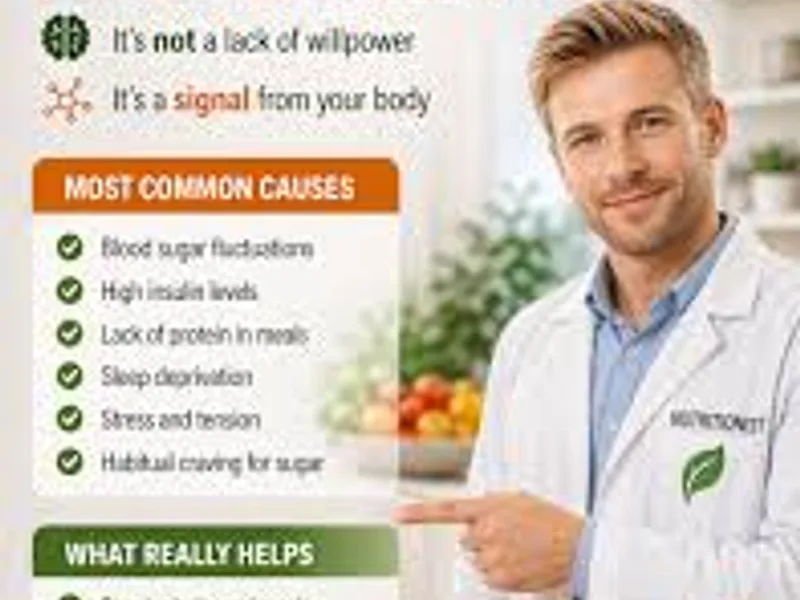
Blood sugar swings. Eating a lot of refined carbs or sugar causes a quick rise in blood glucose, followed by a drop. That drop can leave you tired and reaching for something sweet to feel better fast. It's less "addiction" and more a predictable physiological loop.
Brain reward chemistry. Sweet taste triggers dopamine release, the neurotransmitter tied to pleasure and reinforcement. This is a normal biological response, not evidence of addiction in the clinical sense. A widely cited 2016 review found little support for true "sugar addiction" in humans, describing craving-and-bingeing patterns as a response to easy access to highly palatable food rather than a substance dependency.
Evolutionary wiring. Humans are born preferring sweet tastes. That preference likely helped our ancestors seek out calorie-dense, safe food sources. It made sense when sweet food was rare. It's a mismatch now that it's everywhere.
Sleep and stress. Poor sleep disrupts hunger hormones and tends to push cravings toward sweet, energy-dense food specifically. Stress works through a different pathway but lands in a similar place, since sugar briefly nudges mood via that same dopamine response covered above.
Restriction itself. Telling yourself a food is completely off-limits can make you think about it more, not less, which is part of why the strictest "no sugar ever" approaches often backfire.
Where a Craving Becomes a Health Question, Not a Trivia Question
In clinical practice, this is often missed because both patients and clinicians can be quick to file sugar cravings under "willpower" and move on. Occasional cravings are normal and not something to overanalyze. But intense, frequent, or hard-to-control cravings paired with other symptoms deserve a proper look rather than another home remedy.
Watch for cravings that come with frequent urination, unusual thirst, unexplained weight change, or extreme fatigue. These can point toward blood sugar issues worth discussing with an endocrinologist or general physician, rather than something to manage with another wellness hack. If cravings are tangled up with binge eating or a broader difficult relationship with food, that's a conversation for a dietitian or a mental health professional, not a self-imposed detox.
People managing diabetes have extra reason to take a structured approach rather than guessing. Doctar's guide to blood sugar-friendly snacks and its piece on yogurt for Indian diabetics cover practical swaps that satisfy a sweet craving without the same glucose spike. Doctar's broader sugar myths piece is also worth a read if you want more of these popular claims checked against the evidence.
A More Honest Way to Handle a Sweet Tooth
Nobody needs to declare war on dessert. The research doesn't support the idea that a single square of chocolate sets off an unstoppable addiction cycle, and it also doesn't support the idea that white-knuckling your way through total sugar avoidance will eventually cure the craving. Both stories oversell certainty the science doesn't have.
What tends to help, based on the more grounded research, is steadier meals with enough protein and fiber, decent sleep, and not treating the occasional sweet craving as a moral failure. If oatmeal or a snack with staying power sounds more useful than a lecture, Doctar's oatmeal for diabetes guide and its piece on going to bed hungry both cover practical, low-drama ways to keep blood sugar steadier through the day.