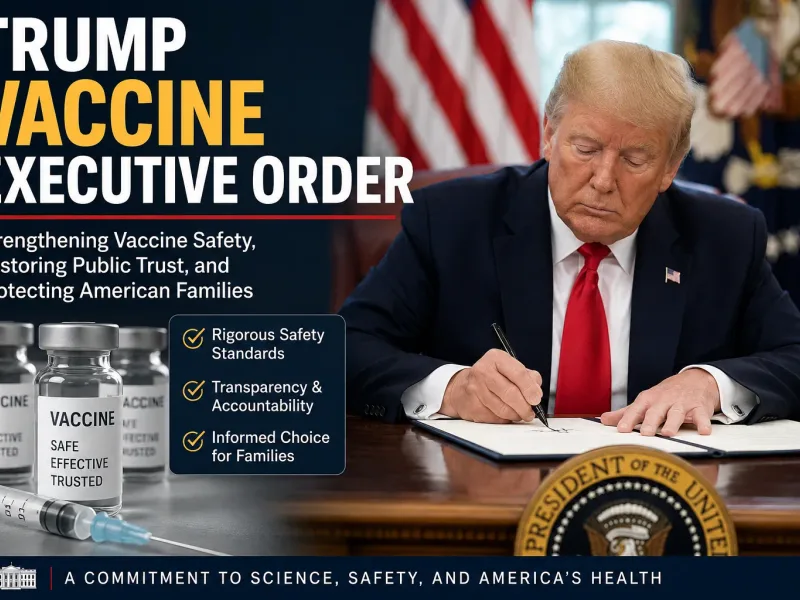
President Donald Trump signed an executive order on August 10, 2026, directing changes to how the US approaches childhood vaccination. Health Secretary Robert F. Kennedy Jr. stood beside him at the signing. Within hours, medical and public health groups were pushing back publicly, and the order was already being framed by legal experts as likely to face court challenges.
That's a lot happening in one news cycle. Here's what the order actually contains, separated from the noise around it.
What the Order Actually Does
The order calls for reducing the number of vaccines universally recommended for American children, reportedly cutting the list of diseases covered from 18 down to 11, according to a White House fact sheet cited by multiple outlets. Vaccines removed from the universal list would shift to what's described as "shared clinical decision-making" between parents and doctors, rather than a standard recommendation for everyone.
It also calls for splitting the combined measles, mumps and rubella (MMR) vaccine into three separate shots, a formulation that doesn't currently exist as an approved product in the same way. And it directs the Department of Justice to pursue legal action against states that don't allow religious or medical exemptions to vaccine mandates.
None of this takes effect simply because the order was signed. That distinction matters more than most headlines let on.
Why "Executive Order" Doesn't Mean "Done"
In the US, vaccine recommendations are legally the job of the CDC's Advisory Committee on Immunization Practices, not the president directly. A vaccine law scholar quoted across several outlets this week made the point plainly: a president can direct the CDC to convene that committee and consider changes, but an executive order itself isn't a substitute for that process.
This isn't a new fight, either. A related attempt earlier this year to overhaul the CDC's vaccine schedule without going through that committee was blocked by a federal judge in March, specifically because it bypassed the required process. This new order appears to be, in part, an attempt to reassert the same changes while that litigation continues.
In clinical practice, this is often missed because parents assume a presidential signature immediately changes what their pediatrician will recommend at the next visit. It doesn't, not automatically, and not yet. The gap between a policy announcement and an actual change in clinical guidelines can run for months, sometimes longer, especially when the change is being contested in court.
Where the Pushback Is Coming From
Physician groups and vaccine researchers responded quickly, and their objection isn't really about politics, it's about evidence. Major medical organizations have spent years reiterating that the current childhood schedule, including the combined MMR shot, is backed by decades of safety and efficacy data. Splitting a well-studied combination vaccine into three separate injections isn't something the current evidence base calls for, according to physicians quoted this week, several of whom noted it would mean more needles and more clinic visits for children without a clear clinical benefit.
One claim from the signing event also didn't hold up factually. A comparison Trump made about vaccine liquid volume was checked against reference data from Johns Hopkins and found to be substantially inaccurate, off by roughly a factor of ten. It's a small detail in the news cycle, but it's illustrative of a larger pattern this week: several specific claims made around the order's signing haven't matched the underlying data.
On the specific question of vaccines and autism, worth stating plainly since it keeps resurfacing in this debate: the scientific consensus, based on multiple large studies conducted over more than two decades, does not support a link between the MMR vaccine and autism. That isn't a matter of political opinion, it's the finding of a substantial and consistent body of research.
What This Means for Parents Right Now
For most families, the honest, current answer is: keep following your pediatrician's existing recommendations. The standard vaccine schedule hasn't legally changed as a result of this order, and it's tied up in the same kind of legal process that blocked a similar attempt earlier this year.
If you have specific questions about your child's vaccination schedule, particularly around the MMR vaccine, this remains a conversation for your pediatrician rather than a news article, however well sourced. Doctar's own explainer on how vaccines work is a reasonable starting point if you want the underlying biology rather than the policy fight, and if your child's schedule includes shots like the rotavirus vaccine or older recommendations like the BCG/TB vaccine, those pieces cover what's actually in each shot and what side effects are genuinely expected versus rare.
This is also, worth saying directly, a US federal policy story. India's immunization schedule is set through its own separate process, and nothing in this executive order changes vaccination requirements or recommendations here. If you're navigating vaccine questions for your child in India, that's still best done with your own general physician or pediatrician working from India's own schedule, not a US policy announcement.