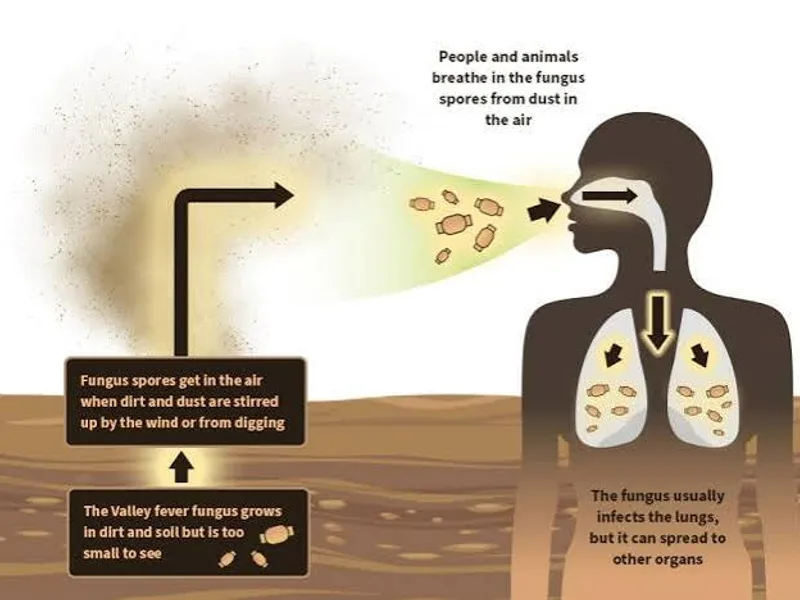
A Fungus in the Dirt, Not the Air You'd Expect
Valley fever doesn't spread person to person. It doesn't come from a virus at all.
It's caused by a fungus called Coccidioides, which lives in dry, dusty soil across parts of California, Arizona, and increasingly further afield. When that soil gets disturbed, by wind, construction, farming, or even a dust storm kicked up after a dry summer, the spores go airborne. Breathe them in, and you can end up with an infection that settles in the lungs.
Named after California's San Joaquin Valley, where it was first well documented, the disease has outgrown its old geographic boundaries. That's really the story here.
Why California Keeps Breaking Its Own Record
California logged nearly 12,500 confirmed cases in 2024, the highest annual total the state has ever recorded, well above the roughly 7,000 to 9,000 cases that had been typical most years between 2016 and 2023. Officials at the California Department of Public Health have been blunt about it: this isn't a one-off spike, it's a trend, and cases have kept climbing into 2025 and 2026.
What's driving it? Weather whiplash, mostly. Wet winters followed by hot, dry summers create ideal conditions for the fungus to grow in soil and then get thrown into the air once things dry out. California had exactly that pattern after a stretch of atmospheric river storms a few winters back, and the case numbers followed.
Geography is shifting too. Kern County has historically carried the heaviest burden, but health officials are now seeing meaningful case growth in Monterey, Santa Barbara, San Joaquin, Stanislaus, and even Sacramento counties, areas that weren't traditionally considered high risk.
Did You Know?
Valley fever is no longer just a California and Arizona story. Public health trackers are documenting rising case identification in Oregon and Washington, and some researchers project the fungus's range could keep expanding as regional climate patterns shift. Whether that reaches the scale some are predicting is still an open question, not a settled fact.
Symptoms That Mimic Everything Else
This is where Valley fever gets genuinely tricky. Most infections cause symptoms that look exactly like a bad flu or a lingering cold: cough, fever, chest pain, fatigue, sometimes headaches and body aches. Symptoms typically show up one to three weeks after exposure.
In most people, it resolves on its own without ever being correctly identified. That's honestly the more common outcome, and it's part of why the "true" number of infections is almost certainly higher than what gets officially logged.
In clinical practice, this is often missed because a patient with a persistent cough and fatigue rarely gets asked about recent time spent outdoors in dusty conditions — the question that would actually prompt the right test. A general cold doesn't linger past 7 to 10 days. Valley fever often does, and that's the practical signal worth paying attention to.
In a smaller share of cases, roughly 5 to 10 percent by some estimates, the infection can turn into pneumonia or cause lasting lung damage. Rarer still, it spreads beyond the lungs entirely, into the skin, bones, or even the brain and spinal cord, where it can cause a form of meningitis. That outcome is uncommon, but it's serious enough that it shouldn't be dismissed as a scare tactic.
Who's More Likely to Get Seriously Ill
Anyone breathing dusty air in an affected region can get infected, but a few groups face a higher chance of severe disease:
People with weakened immune systems, including those on chemotherapy, living with HIV, or post-transplant
Pregnant women, particularly in the third trimester
Outdoor workers in construction, farming, and landscaping, who disturb soil directly
Certain ethnic groups, including Black and Filipino individuals, who research has shown face higher rates of the disease spreading beyond the lungs
Is that last point fair to call out? It feels uncomfortable to say plainly, but public health data backs it, and glossing over it doesn't help anyone get diagnosed faster.
When to Actually See a Doctor
If you've had a cough, fever, chest pain, or persistent tiredness for more than seven to ten days, especially after spending time outdoors in a dusty environment in an affected region, it's worth bringing up Valley fever specifically with a doctor rather than waiting it out as "probably just a cold." A general physician is a reasonable starting point, and if breathing symptoms or chest involvement persist, a pulmonologist can take a closer look with proper imaging and testing. If you've traveled to California, Arizona, or the broader Southwest and developed lingering respiratory symptoms afterward, mention that travel history directly, since it changes what gets tested for. You can find and book verified doctors on Doctar if you need somewhere to start.