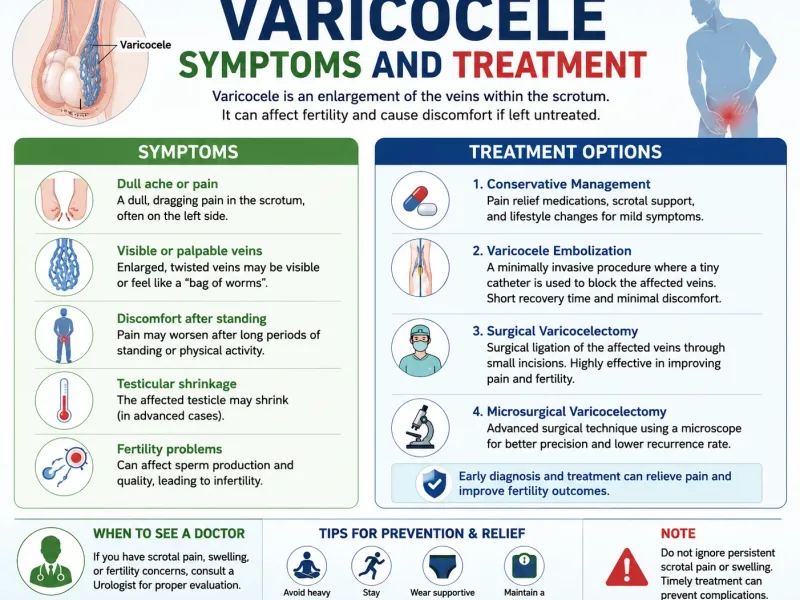
What is a varicocele?
A varicocele is an enlargement of the veins inside the scrotum, similar in some ways to varicose veins in the legs. It usually develops on the left side and may be discovered during a routine examination or a fertility evaluation.
Varicoceles are common and do not always cause problems. Some men never know they have one.
The concern arises when the enlarged veins are associated with testicular discomfort, reduced testicular growth, abnormal sperm production or infertility.
Men researching fertility can also read Doctar's guide to male infertility causes to understand the other conditions that may affect conception.
What are the symptoms of varicocele?
Many varicoceles cause no symptoms at all. When symptoms do occur, they can be quite subtle.
Dull or aching testicular pain
The typical pain is a dull ache or feeling of heaviness in the scrotum. It may become more noticeable after standing for a long time or later in the day and may improve when lying down.
Persistent testicular discomfort should not automatically be blamed on a varicocele. Other conditions can cause scrotal pain, so an examination is important.
Enlarged or visible veins
A larger varicocele may feel like a soft, twisted group of veins above the testicle, sometimes described as a “bag of worms.” Smaller varicoceles may only be detectable when a doctor examines the scrotum.
Doctar's guide to the scrotum and testicular anatomy can help readers understand what is normally found in this area.
One testicle appears smaller
In adolescents, a varicocele can interfere with normal testicular development. In adults, a significant varicocele may be associated with gradual reduction in testicular size.
A noticeable difference in testicle size deserves medical assessment rather than self-diagnosis.
Fertility problems
Some men discover a varicocele only after a semen analysis shows abnormal sperm parameters.
A varicocele can be associated with lower sperm production and poorer sperm quality, although having a varicocele does not automatically mean a man is infertile.
If sperm count is the concern, Doctar's information on low sperm count causes can provide additional background.
Why can a varicocele affect sperm?
The exact mechanism is not completely understood.
One explanation is that enlarged veins can interfere with temperature regulation around the testicles. The testicles need to remain slightly cooler than core body temperature for normal sperm production. Varicoceles may also contribute to oxidative stress and other changes in the testicular environment.
This is why a varicocele may affect sperm production in some men but have little or no noticeable effect in others.
How is a varicocele diagnosed?
A doctor can often diagnose a varicocele through a physical examination.
The scrotum may be examined while the man is standing and lying down. The clinician may also ask him to bear down briefly, known as the Valsalva manoeuvre, because this can make the enlarged veins easier to detect.
An ultrasound may be recommended when the diagnosis is uncertain, symptoms need further investigation or another condition needs to be ruled out.
For men being evaluated for fertility, a semen analysis may be particularly useful.
Doctar's semen and sperm guide explains the difference between sperm count, movement and morphology.
Does every varicocele need treatment?
No.
This is probably the most important point for someone who has just been diagnosed.
A varicocele that causes no symptoms and is not affecting testicular development or fertility may simply be monitored. Mayo Clinic notes that many varicoceles do not require treatment.
Treatment decisions depend on factors such as age, symptoms, testicular size, semen results and fertility plans.
In clinical practice, this is sometimes misunderstood because men hear the word “varicocele” and assume surgery is immediately necessary. It isn't. The reason for treatment matters.
When is varicocele treatment considered?
Treatment may be considered when a clinically palpable varicocele is associated with infertility and abnormal semen parameters.
The 2024 AUA/ASRM male infertility guideline recommends that clinicians consider surgical varicocelectomy for men attempting to conceive who have a palpable varicocele, infertility and abnormal semen parameters, with specific exceptions including azoospermia.
Treatment may also be considered in selected adolescents with delayed testicular development or in people with persistent pain that has not responded adequately to conservative measures.
Varicocele treatment options
1. Observation and monitoring
If the varicocele is small, painless and not affecting fertility or testicular development, observation may be appropriate.
A doctor may recommend follow-up examinations and, depending on the situation, semen testing or monitoring of testicular size.
2. Varicocelectomy
Varicocelectomy is a procedure in which the enlarged veins are sealed or tied off so blood can flow through healthier veins.
Microsurgical varicocelectomy is one approach used to repair a varicocele. Laparoscopic surgery is another option.
The AUA/ASRM guideline reports evidence that varicocele repair can improve semen parameters and may improve pregnancy rates in appropriately selected men, although the evidence has limitations and outcomes vary.
The aim is not simply to make the veins disappear. In fertility cases, the goal is to improve the conditions around the testicle and potentially improve sperm production.
3. Varicocele embolization
Embolization is a minimally invasive alternative to surgery.
A specialist places a thin catheter into a vein and uses imaging to reach the affected testicular veins. Small coils or another blocking material are then used to stop abnormal blood flow through those veins.
Recovery is generally shorter than with traditional surgery, but suitability depends on the individual case and local expertise.
Can varicocele treatment improve sperm quality?
It can in appropriately selected men.
The AUA/ASRM guideline reports improvements in semen parameters following varicocele repair, including sperm concentration and motility.
Mayo Clinic similarly notes that surgery may improve sperm count and correct some sperm abnormalities.
But treatment does not guarantee pregnancy. Fertility depends on both partners and on other factors affecting sperm and reproductive health.
Men trying to improve fertility can also review Doctar's sperm quality improvement tips.
Can a varicocele cause low testosterone?
There is a possible relationship between significant varicocele and testicular function, but the situation is not straightforward.
Some men with varicocele may have impaired testosterone production, while many have normal hormone levels.
If symptoms such as low libido, fatigue or sexual problems are present, testosterone should not be assumed to be the cause without proper evaluation. Doctar's guide to understanding testosterone levels explains why hormone results need to be interpreted alongside symptoms.
Men with erectile difficulties can also read about erectile dysfunction.
What can you do for mild varicocele pain?
For mild discomfort, a doctor may recommend conservative measures such as scrotal support and appropriate over-the-counter pain relief.
Do not rely on home remedies to treat an underlying fertility problem. If pain continues or becomes more severe, the diagnosis should be reassessed.
A new lump, sudden severe pain or rapidly developing swelling requires prompt medical attention because other conditions, including testicular torsion, can present with scrotal pain.
What are the risks of varicocele surgery?
Varicocele repair is generally considered a well-established procedure, but it is not risk-free.
Possible complications include:
recurrence of the varicocele
hydrocele, or fluid around the testicle
infection
bleeding or hematoma
injury to an artery
persistent or changed testicular pain
The potential benefits should therefore be weighed against the reason for treatment.
If surgery is being considered mainly for pain, doctors may be particularly cautious because the pain may have another cause and may not completely disappear after repair.
Does varicocele always cause infertility?
No.
A varicocele can be associated with infertility, but many men with varicoceles can father children without treatment.
This is why fertility decisions should be based on the complete clinical picture rather than the ultrasound report alone.
If conception is taking longer than expected, both partners should be evaluated. Doctar's male infertility guide discusses other male reproductive factors that can contribute to difficulty conceiving.
What about testosterone treatment and fertility?
Men with fertility concerns should be careful about starting testosterone without specialist advice.
External testosterone can suppress the hormonal signals that stimulate sperm production. A man may therefore have improved testosterone levels while his sperm production decreases.
This is particularly relevant when a man has both varicocele and suspected low testosterone. Treating the hormone number without considering fertility goals can create another problem.
Doctar's information on TRT side effects and risks explains why testosterone therapy needs medical supervision.
When should you see a urologist?
Make an appointment if you notice:
a new lump or swelling in the scrotum
persistent testicular aching or heaviness
visibly enlarged veins
one testicle becoming smaller
difficulty conceiving
abnormal semen-test results
fertility problems combined with suspected hormonal issues
A doctor consultation can help determine whether examination, ultrasound, semen analysis or hormone testing is appropriate.
Men whose main concern is sexual function can also consider a sexologist consultation, particularly when erectile or ejaculation problems are present alongside fertility concerns.