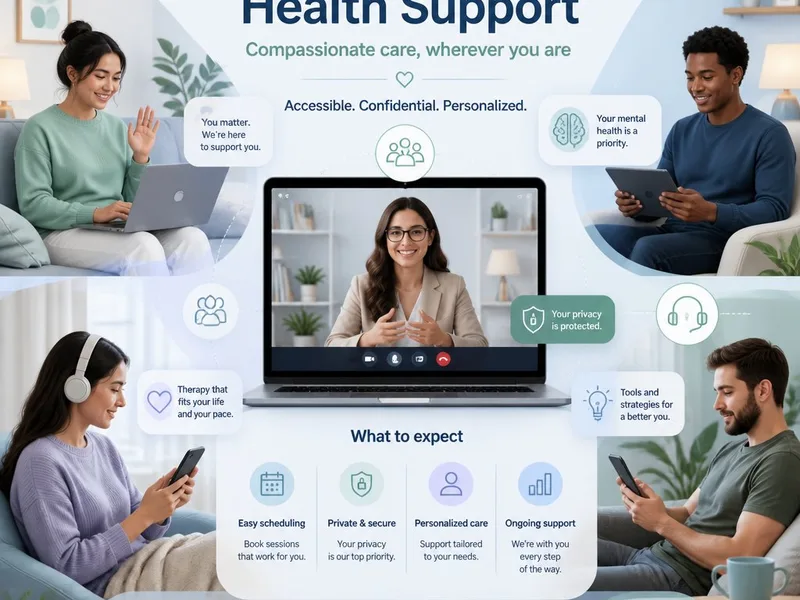
Virtual mental health counseling connects people with a licensed therapist, psychologist, psychiatrist, or clinical social worker remotely, through video calls, phone calls, or secure text-based platforms, rather than requiring an in-person office visit. NIMH refers to this broadly as telemental health, and notes it can include everything from a full mental health assessment and treatment plan to ongoing therapy and medication management.
This isn't a new concept, but its scale changed dramatically starting in 2020. What began as an emergency pandemic accommodation has, by most accounts, become a standard, permanent part of how mental health care gets delivered — not a stopgap people use only when in-person options aren't available.
Does virtual counseling actually work as well as in-person therapy?
According to NIMH, virtual care can be effective for treating mental illnesses including anxiety, ADHD, bipolar disorder, depression, and PTSD. The American Psychological Association goes further, stating that teletherapy delivered via phone or videoconferencing has been shown to produce similar outcomes to traditional in-person therapy, with efficacy demonstrated specifically for anxiety, depression, PTSD, and adjustment disorder.
This isn't a fringe or preliminary finding — it reflects a substantial and growing body of research built up over more than a decade, accelerated significantly by data gathered during the pandemic when telehealth use expanded rapidly. The consistent theme across this research: for many common mental health conditions, format matters less than the quality of the therapeutic relationship and the treatment methods being used.
Effectiveness isn't uniform across every situation, and it's worth being honest about where telehealth has documented limits rather than presenting it as a universal substitute for in-person care.
Research reviewing telepsychiatry for people with complex, long-term needs — multiple co-occurring conditions, for instance — suggests in-person care may be superior for that specific population. Reviews conducted during the pandemic also found that people with psychosis, autism, or intellectual disabilities in particular struggled to adapt to remote appointments compared with other groups. Complex case management, more broadly, is generally considered harder to deliver as effectively through a screen as it is in person.
Practical barriers matter too. A private, quiet space for a session isn't guaranteed for everyone, technology access and reliability vary widely, and some therapeutic techniques — certain exposure therapy approaches, for example — require more adaptation to work well remotely. None of this means virtual care can't work for these situations, but it does mean the fit should be evaluated individually rather than assumed.
What a typical virtual counseling session looks like
Most virtual mental health platforms offer a mix of formats — video calls are the most common, but phone-only and secure messaging options exist too, which can matter for people with limited internet access or a preference for voice-only interaction. Sessions are generally structured the same way an in-person appointment would be: an initial assessment, an ongoing treatment plan, and regular follow-up sessions.
The American Psychiatric Association recommends preparing for a telepsychiatry appointment much like you would an in-person one — having your relevant medical records, current prescriptions, and specific questions ready beforehand helps make the most of the time. NIMH suggests checking a few practical basics before booking with a telehealth provider, including confirming they're licensed in your state and that the platform they use is secure and appropriate for your needs.
Who tends to benefit most from virtual counseling
People in rural or underserved areas with limited access to in-person mental health providers are among the clearest beneficiaries, since telehealth removes the travel barrier entirely. The same applies to people with mobility limitations, demanding work schedules, or caregiving responsibilities that make a traditional in-office appointment difficult to fit in consistently.
Some people also find it genuinely easier to open up about sensitive topics from their own environment, compared with a traditional clinical office setting — a benefit noted across multiple studies on patient experience with virtual mental health care, even though the underlying reasons for this vary from person to person.
Insurance coverage and getting started
Insurance coverage for telemental health has expanded substantially and is now commonly included in many plans, though coverage specifics still vary by provider, plan, and location. If you're considering virtual counseling, a primary care provider is often a useful starting point — they can refer you to a psychologist, psychiatrist, or clinical social worker who offers virtual care, according to NIMH.
It's also important to know what virtual counseling isn't designed for. Telehealth can be a strong option for ongoing care, but it's not a substitute for emergency care. If you or someone you know is struggling or having thoughts of suicide, call or text 988 to reach the Suicide & Crisis Lifeline, available 24/7. In a life-threatening emergency, call 911.
Video, phone, or messaging: does the format matter?
Not all virtual counseling looks the same, and the format itself can affect the experience. Video sessions most closely resemble in-person therapy, preserving visual cues like facial expressions and body language that many therapists rely on. Phone-only sessions strip that away but can lower the barrier for people who feel more comfortable without a camera, or who don't have reliable video access.
Text-based or messaging platforms are a different model entirely — often asynchronous, meaning you send messages and a therapist responds within a set window rather than in real time. Research on these formats is less extensive than on video-based teletherapy, and they tend to suit ongoing, lower-acuity support better than they suit an initial diagnostic evaluation or a crisis situation. If you're unsure which format fits your needs, it's a reasonable question to ask a provider directly before your first session, rather than assuming one platform's default setup is the only option.
FAQ
Is virtual mental health counseling as effective as in-person therapy? For many common conditions — anxiety, depression, PTSD, ADHD, and bipolar disorder — research shows virtual counseling can be as effective as in-person care. The American Psychiatric Association considers telepsychiatry equivalent to in-person care on diagnostic accuracy and patient satisfaction.
Who might not be a good fit for virtual-only mental health care? People with complex, long-term needs involving multiple co-occurring conditions, or conditions like psychosis, autism, or intellectual disabilities, may be better served by in-person care or a hybrid approach, according to research reviewing telepsychiatry outcomes for these groups.
Does insurance cover virtual mental health counseling? Coverage has expanded significantly and is now common across many insurance plans, but specifics vary by provider, plan, and location. It's worth confirming coverage details directly with your insurer before starting virtual care.
Can virtual counseling handle a mental health emergency? No. Telehealth is designed for ongoing care, not emergencies. If you or someone you know is having thoughts of suicide, call or text 988 for the Suicide & Crisis Lifeline; in a life-threatening situation, call 911 directly.
How do I find a virtual mental health provider? A primary care provider is often a good first step — they can refer you to a psychologist, psychiatrist, or clinical social worker offering virtual care. NIMH also recommends confirming a provider is licensed in your state before booking.
Takeaway
For most common mental health concerns, the evidence genuinely supports virtual counseling as a legitimate option, not a lesser substitute for in-person care — the more useful question isn't whether telehealth works in general, but whether it's the right fit for your specific situation, which is worth raising directly with a provider during that first appointment.
5. Sources
National Institute of Mental Health (NIMH) — "Getting Mental Health Support Virtually" and "What Is Telemental Health?"
American Psychological Association (APA) — "Telehealth and telepsychology"
PMC/NCBI — "Telepsychiatry: what clinicians need to know about digital mental healthcare"