What the Study Actually Found
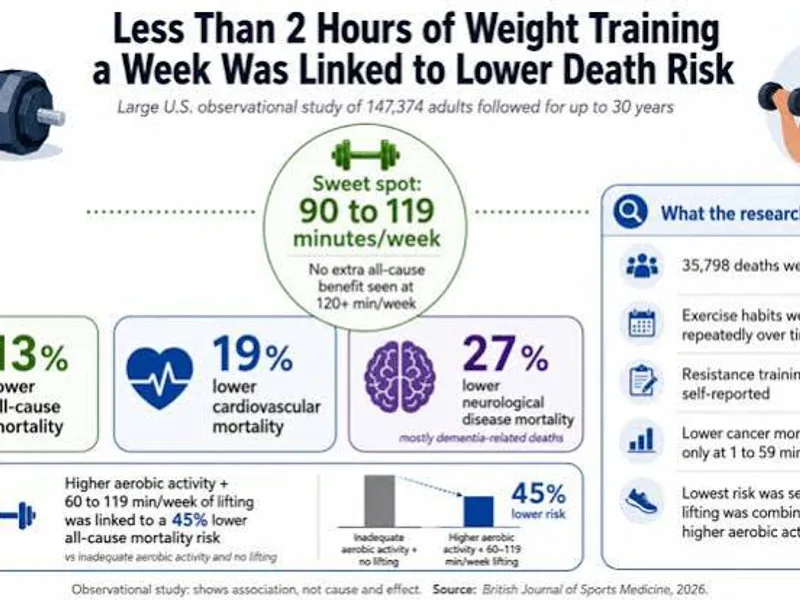
People who did roughly 90 to 119 minutes of resistance training per week were significantly less likely to die from any cause than those who did none. That's less than two hours a week — two sessions of 45 minutes each, or three sessions of 30 minutes. Most working adults can find that window.
The research followed 147,374 participants across three large, long-running American health cohorts. Over up to 30 years, researchers at Harvard T.H. Chan School of Public Health tracked how much time participants spent lifting weights and compared that against confirmed death records. More than 35,000 participants died during the follow-up period, giving the study substantial statistical power.
For heart disease deaths, those logging 90 to 119 minutes of weekly resistance training had a 19% lower risk compared to non-lifters — even after accounting for aerobic exercise. For neurological disease deaths, mostly dementia-related in this dataset, the association was a 27% lower risk. If you're concerned about your cardiovascular health, speaking with a cardiologist near you is a good first step before changing your exercise habits.
In clinical settings, this connection between strength training and heart risk reduction is often missed. Doctors routinely discuss diet and cardio with patients managing cardiovascular risk, but resistance training rarely enters that conversation with the same urgency. This study makes a strong case for changing that.
The Sweet Spot — And Why More Isn't Always Better
Here is what surprised many researchers: pushing past 120 minutes of resistance training per week produced no additional survival benefit. More lifting, beyond that ceiling, did not translate to a longer life.
That's counterintuitive if you assume harder or longer always means better health outcomes. It also removes pressure from people who feel they need to spend hours in the gym. You don't. The data suggest the protective window is surprisingly modest.
Cancer mortality followed a different pattern. Resistance training was linked to lower cancer deaths only at lower doses — specifically 1 to 59 minutes per week — with the association driven primarily by reduced deaths from colorectal, bladder, and breast cancers. Higher volumes showed no additional cancer protection, though case numbers in individual cancer categories were relatively small.
If you have a history of cancer or heart disease in the family, a conversation with a heart disease specialist or your regular doctor is worthwhile before starting a new programme. You can also explore diagnostic lab tests near you to understand your baseline health markers first.
Combine Cardio and Lifting for the Biggest Benefit
The study's most practical finding for everyday people: if you already do aerobic exercise, adding weights makes it even more powerful.
People who combined moderate-to-high aerobic activity with 60 to 119 minutes per week of resistance training saw their risk of dying from any cause drop by up to 45% compared to those who did little aerobic activity and no resistance training at all. That is a substantial figure. Aerobic exercise — walking, cycling, swimming — still offered stronger overall protection on its own, but for people who already run or walk regularly, adding resistance training continued to reduce mortality risk at nearly every level of aerobic activity.
Think of it this way: if you're already doing 30 minutes of daily walking, two short strength sessions a week could be the most impactful additional step you take for your long-term health. Not a fad diet. Not a supplement. Just lifting something heavy twice a week.
A physiotherapist near you can help design a safe programme combining aerobic and resistance work if you're starting from scratch or recovering from injury. For people with joint concerns, particularly knees or hips, an orthopedic specialist can advise on which exercises are appropriate before you load those joints.
The Brain Benefit Nobody Is Discussing Enough
Perhaps the most underreported finding in this study is the connection between weightlifting and neurological disease deaths.
Deaths from brain-related conditions — mostly attributed to dementia in this dataset — are rising sharply as the global population ages. Yet resistance training's potential role in reducing that risk has received far less research attention than its cardiovascular effects. The 27% lower risk associated with 90 to 119 minutes of weekly resistance training is striking, and worth taking seriously even though causation hasn't been proven.
To reduce the risk of reverse causation — the possibility that people simply stopped exercising because they were already becoming sick — researchers extended the gap between exercise measurements and death records to 8 and 12 years. The association held. That methodological step lends the findings considerably more credibility than most observational studies on the same topic.
If brain health or dementia risk is a concern for you or a family member, a neurologist in your city can offer guidance specific to your situation. You may also want to speak with a dietitian for nutrition advice, since diet and exercise together appear to have synergistic effects on cognitive health.
How Was the Study Designed?
Data came from three well-established American research cohorts: the Health Professionals Follow-up Study, which enrolled male health professionals; the Nurses' Health Study; and the Nurses' Health Study II. Together they included 31,540 men and 115,834 women, with a median age of 54.
Participants completed detailed questionnaires every two years covering health habits, diet, medical history, and physical activity. Deaths were confirmed through family reports, autopsy records, and national death registers, with a tracking rate exceeding 98%. Confounding factors — age, ethnicity, smoking history, body weight, diet quality, alcohol intake, and family history of heart disease and cancer — were all accounted for statistically.
Crucially, researchers used the cumulative average of all available exercise reports rather than a single snapshot. That approach more accurately reflects a person's long-term habits and significantly strengthens the study's methodology.
What This Study Cannot Tell Us
Being observational, the study cannot prove that lifting weights directly caused people to live longer. Correlation and causation remain different things, and it's worth saying that plainly.
The study population was predominantly white, middle-aged to older health professionals — which limits how broadly the findings generalise. Results may look different in younger adults, in people from different ethnic backgrounds, or in people with different baseline health status. The questionnaire also did not capture bodyweight-only exercise or Pilates, which may offer similar benefits but weren't measured here.
Resistance training was self-reported, introducing the possibility of measurement error. The researchers used repeated assessments and cumulative averages to reduce this error, but it can't be fully eliminated.
None of these limitations invalidate the findings. They simply mean we should treat this as strong, compelling evidence — not a closed case.
What Actually Counts as Resistance Training?
The study measured training in hours per week and did not require gym access or barbells. Resistance training broadly covers: free weights (dumbbells, barbells), weight machines, resistance bands, and weighted vests. The questionnaire in this study did not capture bodyweight exercises specifically, so push-ups, squats, and lunges may offer similar benefits but weren't separately quantified.
If you have access to a gym, you can search doctors by specialty to find a sports medicine professional who can design a programme for your fitness level. If you can't get to a gym, a pair of resistance bands at home can get you into the target time range with minimal investment.
For people who'd prefer supervised training but can't travel easily, book a home visit doctor or physiotherapist who can assess your mobility and suggest appropriate exercises in your own space. Sports physiotherapy services are also increasingly available as home visits in many cities.
Who Should Be Cautious Before Starting?
Strength training is generally safe for most adults, but some groups need medical clearance first.
If you have existing heart disease, have had a cardiac event, or are managing uncontrolled blood pressure, speak with a cardiologist before adding resistance training. Those managing breathing conditions should check with a pulmonologist if they're concerned about how exertion will affect their respiratory health. People with diabetes or metabolic conditions — where blood sugar responses to exercise can be unpredictable — may want input from an endocrinologist near you before significantly increasing physical activity.
For older adults or those with joint replacements, an orthopedic review matters. If you've had or are considering knee replacement surgery or bypass surgery, your surgical team will have specific guidance on when and how to resume exercise safely.
If you're in a city and want to explore your options, find hospitals near you that offer sports medicine or rehabilitation services, or look at top hospitals in Kolkata for cardiac and orthopedic rehabilitation programmes. You can also find surgeons near you if a structural issue needs attention before you begin training.