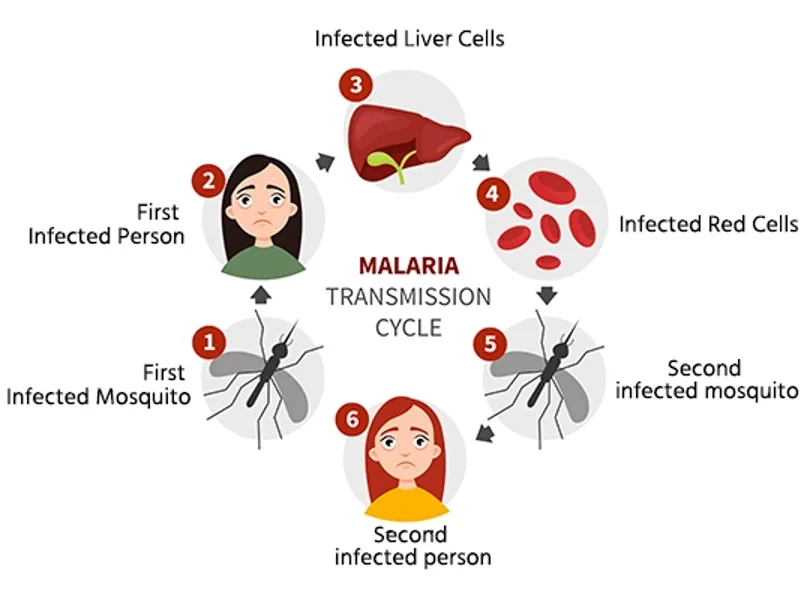
It's Not the Mosquito Bite Itself, It's What's Inside It
Malaria has one of those names that gives you the wrong idea. It comes from Italian, roughly "bad air," from centuries ago when people assumed swamp air made you sick. The actual cause is much smaller and much more specific: a parasite.
Malaria is caused by single-celled parasites in the genus Plasmodium. These parasites don't fly, crawl, or spread through the air on their own. They need a carrier, and that carrier is a specific type of mosquito, the female Anopheles mosquito. When an infected mosquito bites you, it doesn't just leave an itchy welt. It injects parasites directly into your bloodstream.
The Five Parasites That Actually Cause Human Malaria
Not all Plasmodium species affect humans the same way, and this is where a lot of general explanations get too vague to be useful. Five species are responsible for the vast majority of human malaria cases: Plasmodium falciparum, P. vivax, P. ovale, P. malariae, and P. knowlesi.
P. falciparum is the one to actually worry about. It's responsible for the large majority of malaria deaths worldwide and is the dominant species across sub-Saharan Africa. P. vivax is the most geographically widespread of the group and can still cause severe illness, even death, though it's generally considered less deadly than falciparum. P. ovale and P. malariae cause milder disease in most cases. P. knowlesi is a bit of an outlier, it's technically a monkey parasite that jumped to humans and shows up mainly in parts of Southeast Asia.
Here's a detail that surprises a lot of people: P. vivax and P. ovale can lie dormant in the liver for months, sometimes years, before causing a relapse. Someone can be treated, feel fine, and then get sick again later without a new mosquito bite. In clinical practice, this is often missed because patients assume a past "successful" treatment means the parasite is gone for good, when for these two species, that's not always true.
How the Infection Actually Progresses in the Body
After the mosquito bite, the parasites travel to the liver first. They multiply there quietly, without causing symptoms, for anywhere from about a week to several weeks depending on the species. This is called the liver stage, and it's part of why malaria symptoms don't show up immediately after exposure.
Eventually, the parasites leave the liver and invade red blood cells. This is when symptoms typically start: fever, chills, headache, muscle aches, nausea, and sometimes vomiting or diarrhea. The fever often comes in cycles, rising and falling as parasites break out of red blood cells in waves. If you've ever heard someone describe malaria fever as coming and going in a pattern, that's the biological reason why.
Why Some People Get Much Sicker Than Others
Malaria doesn't hit everyone equally, and the reasons matter for understanding who's actually at risk. Children under five bear a disproportionate share of malaria deaths globally, largely because their immune systems haven't built up any prior exposure to fight the infection off quickly.
Pregnant women face elevated risk too, partly due to changes in immune function during pregnancy and partly because placental tissue can become a site where the parasite concentrates. People with lower or no prior exposure to malaria, including travelers visiting endemic regions and migrant workers, are also considered higher risk, since repeated exposure over years can build up partial immunity in people who live in malaria-endemic areas long-term. That's not the same as full protection, but it does change how severely someone typically gets sick.
Where Malaria Actually Spreads, and Why That's Changing
Malaria transmission happens mainly in tropical and subtropical regions, large parts of Africa, South Asia, Southeast Asia, parts of Latin America, and areas around the Caribbean and South Pacific. Roughly 40% of the world's population lives somewhere with some level of malaria risk.
The map isn't fixed, though. Anopheles mosquitoes need specific temperature ranges to survive and transmit the parasite effectively, and researchers are increasingly documenting how rising temperatures are shifting malaria risk into new regions of Africa that weren't previously considered high-risk zones. Growing pesticide resistance among mosquito populations is complicating control efforts too, which is part of why global malaria deaths have crept back up toward pre-pandemic levels after years of steady decline.
The Bottom Line on Cause
Strip away everything else, and malaria's cause is straightforward: a Plasmodium parasite, delivered by an infected Anopheles mosquito bite, that multiplies first in the liver and then in red blood cells. Everything else, the fever patterns, the relapses, the severity, comes down to which of the five species is involved and how much prior immunity the infected person has.