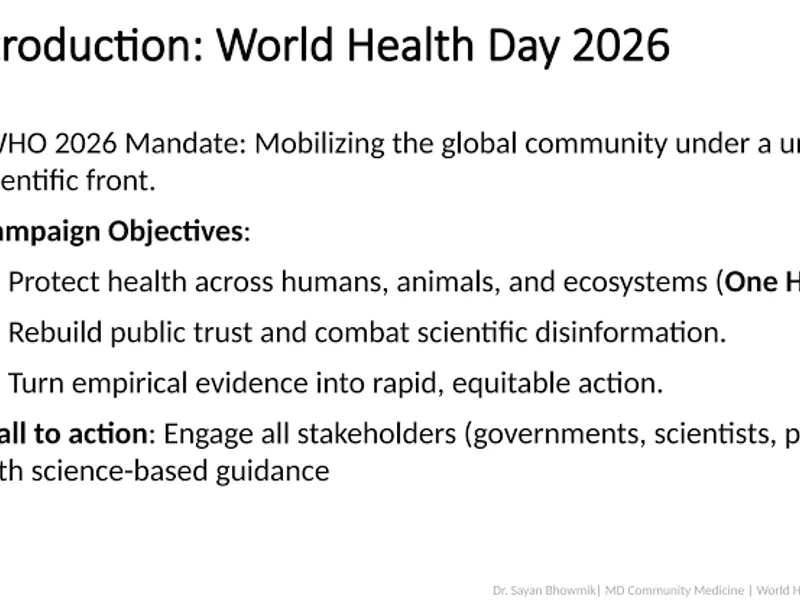
WHO global health mobilization is moving into a tougher phase
The latest WHO activity points to a simple reality: global health efforts are being asked to do more while resources and systems remain under pressure.
The World Health Organization's 2026 programme budget places health equity, resilience, primary healthcare, universal health coverage and emergency preparedness among its major priorities. At the same time, WHO acknowledges a difficult operating environment shaped by outbreaks, conflict, climate-related risks, economic instability and inequality.
This is not just about responding when a new disease appears. The bigger task is keeping everyday healthcare functioning while preparing for the next emergency.
For readers looking for related health information, DOCTAR's health blogs and medical insights cover areas including infections, chronic diseases, diagnostics, medicines, mental health and public health.
Emergency preparedness is getting renewed attention
WHO's emergency work remains one of the clearest parts of this mobilization. Its 2026 emergency programme includes outbreak surveillance, emergency appeals, technical guidance, training and support for countries dealing with major health crises.
The organisation has also been pushing countries to test their systems before emergencies happen. In July 2026, WHO reported expert agreement that simulation exercises should become part of health-system preparedness, rather than being treated as occasional exercises.
That approach matters because a response can fail long before a patient reaches a hospital. Shortages of trained staff, weak disease surveillance, disrupted supply chains and poor communication can all slow the response.
Readers interested in practical information about infection risks, disease warning signs, and when professional care may be needed can also explore DOCTAR's Health Today section, which includes an infections category.
Vaccination remains part of the global response
Vaccination continues to sit near the centre of WHO's health-security agenda.
At the 2026 World Health Assembly, global health leaders reaffirmed support for the Immunization Agenda 2030. The discussion focused not only on vaccine availability but also on primary healthcare, surveillance, regional manufacturing, supply chains and public trust.
That last issue may be the hardest one to solve.
Misinformation and declining confidence can undermine vaccination programmes even when vaccines are available. WHO said countries need stronger community engagement and evidence-based health communication to address these problems.
For everyday readers, the lesson is fairly straightforward: health protection depends on both medical tools and public confidence in using them.
DOCTAR also maintains a Health Tips of the Day section, including nutrition, seasonal health and wellness information.
Health workers are part of the mobilization story
A health system cannot respond effectively without enough trained people to run it.
One significant 2026 development came at the World Health Assembly, where WHO member states approved amendments to the Global Code of Practice on the International Recruitment of Health Personnel. The changes address international recruitment, emergency situations and the need for investment in health systems in countries that lose health workers.
The issue is more complicated than simply counting doctors and nurses.
When trained healthcare workers move between countries, destination systems may benefit while countries already facing workforce shortages can struggle. The updated WHO framework aims to make international recruitment more ethical and encourage co-investment in health systems.
In clinical practice, this is often missed because workforce problems appear first as waiting times, staff fatigue, reduced service capacity or difficulty maintaining essential care, rather than as a headline about global health policy.
People seeking individual medical care can use DOCTAR's doctor directory to explore healthcare professionals across India.
Financing could determine what happens next
Global health mobilization ultimately depends on money.
WHO's 2026–2027 programme budget was revised to US$4.2 billion from an earlier Executive Board version of US$5.3 billion, while retaining priorities around primary healthcare, emergency preparedness and universal health coverage.
WHO has also highlighted increasing pressure on health financing. In July 2026, its Civil Society Commission reported calls for stronger domestic financing, accountability and clearer evidence that health investments are actually improving services.
This is where global policy reaches ordinary households. Funding decisions can influence whether clinics have staff, whether medicines remain available, whether vaccination programmes reach communities and whether emergency services can expand during a crisis.
Better data may be one of the biggest priorities
Health authorities cannot manage what they cannot reliably measure.
WHO's World Health Statistics 2026 report warned that global health progress is uneven and, in some areas, reversing. It also identified major gaps in mortality and cause-of-death reporting, making it harder to understand health trends and plan effective responses.
The report found that only 18% of countries were reporting mortality data to WHO within one year as of the end of 2025. WHO said stronger data systems and digitalization are needed to support better health decisions.
This matters during outbreaks, but it also matters for routine healthcare. Reliable information helps governments identify where resources are needed and whether interventions are actually working.
DOCTAR's content also spans diagnostics and health conditions, while its doctors directory provides access to healthcare professionals across India.
Civil society is becoming harder to ignore
Global health decisions are not made by governments and international agencies alone.
WHO's Civil Society Commission has been working on a 2026–2028 plan covering governance, community participation, health financing and communication. More than 120 civil society representatives took part in its 2026 annual meeting.
That involvement matters because community organisations often see practical problems before international agencies do. They can identify barriers involving trust, language, access, affordability and local culture.
A global strategy may look strong on paper. Its real test is whether people can feel the difference at a clinic, pharmacy or community health centre.
What the latest WHO update really signals
The current WHO mobilization is less about one dramatic health announcement and more about rebuilding the machinery behind public health.
Emergency preparedness, vaccination, health-worker protection, financing, reliable data and community engagement are connected pieces of the same system. Weakness in one area can make the others harder to sustain.
The 2026 World Health Assembly captured that idea clearly: WHO's Director-General said international decisions only have value when they change what happens in clinics, communities and households.
That is perhaps the most useful way to read the current global health story. Mobilization is not simply about preparing for the next pandemic. It is about making health systems strong enough to keep working before, during and after the next crisis.