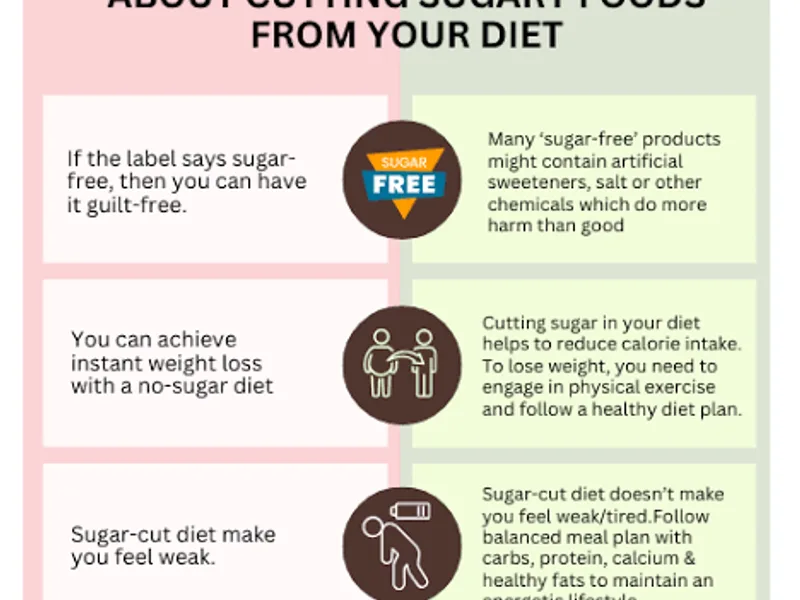
Cutting Sweets Doesn't Work the Way Most Advice Promises
"Just stop eating sugar and the cravings will go away." It's one of the most repeated pieces of diet advice out there, and for most people who try it, it doesn't hold up. That's not a failure of discipline. It's closer to a predictable outcome of how the brain responds to restriction.
Anyone who's white-knuckled their way through a "no sugar" month and then eaten half a cake at the first birthday party knows this pattern already. The interesting part is that researchers can now explain a good chunk of why it happens.
The Forbidden Fruit Problem
Telling your brain a food is completely off-limits doesn't make it less appealing. It tends to do the opposite. Cognitive research on thought suppression, the classic "don't think about a white bear" finding, shows that deliberately trying not to think about something makes it more mentally present, not less. Food restriction follows a similar pattern: a forbidden food becomes more cognitively loud, not quieter.
Add to that the habit loop itself. The cue that triggers a sweet craving, say, the 4pm slump or a stressful phone call, doesn't disappear because you've banned sugar. The craving still fires. Without a replacement routine, the urge just has nowhere to go, and it tends to build rather than fade. Eventually a strong enough trigger, stress, a bad day, a social event, breaks the restriction, and the rebound eating is often bigger than what would have happened without the ban in the first place.
What the Research Actually Shows
This isn't just armchair theory. A six-month randomized trial, the Sweet Tooth Trial, published in the American Journal of Clinical Nutrition in 2026, tested what happens when adults are assigned to high, low, or moderate sweetness diets. Cutting sweetness didn't lower participants' preference for sweet foods, and it didn't shift health markers tied to diabetes or heart disease compared with the other groups.
That's a direct hit against the "reset your palate by quitting sugar" theory that underlies a lot of detox programs. It doesn't mean sugar is harmless. It means the specific promise, that total avoidance recalibrates your cravings, isn't well supported by this kind of controlled testing.
Registered dietitians who work with this daily report a similar pattern anecdotally, separate from formal trials. Clients often arrive convinced that one cookie will trigger an unstoppable binge, a belief usually traced back to comparisons between sugar and addictive substances like cocaine. Those comparisons mostly come from rodent studies, and rodent behavior doesn't map cleanly onto human eating psychology.
Why All-or-Nothing Backfires More For Some People
In clinical practice, this is often missed because the all-or-nothing framing feels like the "serious" option, so people assume it must work better than moderation. For a modern food environment where added sugar shows up under dozens of different names on ingredient labels, expecting total avoidance is often just unrealistic, not a matter of trying harder.
The shame cycle makes it worse. Someone breaks a strict no-sugar rule, feels like they've failed completely, and the all-or-nothing mindset pushes them to abandon the effort entirely rather than just eating normally again the next meal. That collapse-and-restart pattern is a known weak point of rigid rules generally, not unique to sugar.
What Tends to Work Better
Gradual reduction, rather than a hard stop, lines up better with how taste preference and habits actually change. Taste sensitivity to sweetness shifts slowly, typically over several weeks of consistently lower exposure, not overnight. Trying to force an instant reset tends to just trigger the restriction backlash described above.
Addressing the trigger matters as much as the food itself. If cravings hit hardest during a stress spike or an energy dip, a swap that solves the actual problem, a real snack with protein and fiber, a short walk, better sleep the night before, tends to hold up better than a bare rule against dessert. Doctar's guide on blood sugar-friendly snacks and its piece on managing stress both cover practical versions of this.
Planned moderation, deciding in advance you'll have a small portion rather than pretending the food doesn't exist, also tends to reduce the psychological charge around a given food. It's a smaller ask than total elimination, and it's one people can actually sustain past a two-week burst of motivation.
When It's More Than a Habit Question
Occasional sweet cravings that respond to better sleep, steadier meals, or planned treats are normal and not a medical issue. But cravings that feel genuinely out of your control, come with bingeing, or are tangled up with a difficult relationship with food overall are a different situation. That's worth a conversation with a dietitian rather than another willpower experiment.
If cravings show up alongside symptoms like frequent urination, unusual thirst, or unexplained weight change, those are signs to see a general physician or endocrinologist rather than assuming it's just a sweet tooth. People managing diabetes specifically should build any sugar-related habit change around their own bloodwork. Doctar's guide to yogurt and diabetes and its sugar myths breakdown are useful starting points, but they don't replace individual medical guidance.