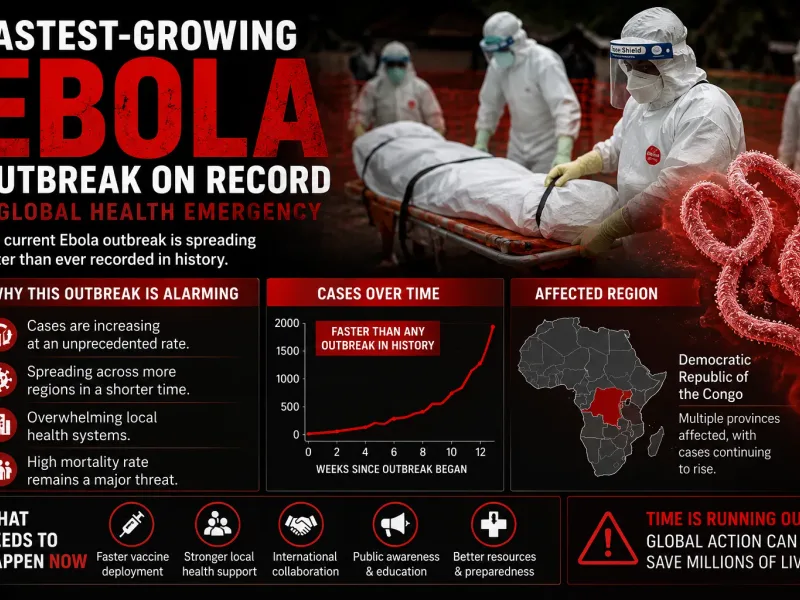
The Ebola outbreak in the Democratic Republic of the Congo is the fastest-growing Ebola outbreak ever recorded, according to the World Health Organization and Africa Centres for Disease Control and Prevention (Africa CDC). As of July 22, 2026, Africa CDC director-general Jean Kaseya confirmed more than 1,000 deaths since the virus emerged in May, out of over 2,400 confirmed cases. The outbreak reached 1,000 confirmed cases within roughly 40 days of its official declaration — compared to about 235 days for the 2018 North Kivu outbreak to hit the same milestone.
The 2014–2016 West Africa epidemic is still the largest Ebola outbreak in history by total deaths, ultimately killing more than 11,000 people over roughly two years. But the 2026 DRC outbreak has outpaced it in early velocity: Africa CDC has reported far more cases in the first six weeks of this outbreak than West Africa recorded in the same window back in 2014.
WHO officials have been explicit that this isn't just the fastest Bundibugyo-virus outbreak on record — it's the fastest Ebola outbreak of any species. It has already become the third-largest Ebola outbreak in total case count, trailing only the 2014–2016 West Africa epidemic and the 2018–2020 DRC North Kivu outbreak, and it's still growing.
Several numbers from WHO capture the gap between the virus and the response effort.
Roughly 80% of new cases are emerging from unknown chains of transmission, WHO Director-General Tedros Adhanom Ghebreyesus has said. That means most new patients have no identified link to a known case, which is close to the opposite of what functional contact tracing looks like. Contact tracing means identifying everyone who had contact with an infected person and monitoring them for symptoms before they can spread the virus further.
Tracing has improved since the outbreak's early weeks. In early June, contact tracing coverage was estimated at roughly 60%. By July 21, the European Centre for Disease Prevention and Control reported 82% of identified case contacts were under follow-up in the hardest-hit provinces — real progress, though still short of WHO's 95% benchmark.
A large share of deaths are still occurring in communities rather than in Ebola treatment centers, which WHO has flagged repeatedly. Deaths outside the formal health system are harder to record, harder to trace, and their burials — a major route of Ebola transmission — are harder to make safe.
[REVIEWER: add clinical insight here — e.g., what "community deaths" mean in practice for outbreak response, why patients or families may delay or avoid seeking care during an Ebola outbreak, and how health workers build trust in high-mistrust, conflict-affected communities]
Why This Particular Outbreak Spreads So Fast
No Vaccine, No Approved Treatment
The outbreak is caused by the Bundibugyo ebolavirus, a rare species not seen in a major outbreak in over a decade. No licensed vaccine or treatment exists specifically for it. The existing Ebola vaccine, rVSV-ZEBOV (Ervebo), targets the more common Zaire ebolavirus species, and WHO has advised against relying on it here due to insufficient evidence of cross-protection against Bundibugyo.
That gap is starting to close. In mid-July 2026, three Bundibugyo-specific clinical trials began enrolling patients in DRC and Uganda, testing candidates including the monoclonal antibody MBP134 and the antiviral remdesivir through the WHO-backed PARTNERS trial framework. But clinical trials take weeks to months to produce usable evidence, and the outbreak isn't waiting.
Late Detection
WHO's epidemiological analysis suggests the virus was likely circulating since January or February 2026 around Mongbwalu, a high-traffic mining town in Ituri Province — months before the outbreak was officially declared on May 15 following laboratory confirmation. By then, it had already seeded cases across multiple provinces and crossed into Uganda. That undetected head start helps explain the outbreak's unusually steep early growth.
Geography and Conflict
Ituri Province, the epicenter, sits at a border crossroads with Uganda and South Sudan, with an economy built around mining that drives constant population movement. It's also a region where armed groups operate and health facilities have come under attack. WHO's DRC representative has described population movement, insecurity, and a fragile health system as complicating factors that touch every part of the response. In some areas, health workers have gone on strike over unpaid wages, further straining an already stretched system.
The Council on Foreign Relations has described this as a crisis unfolding inside an existing crisis — an outbreak fighting for resources and access in a region already dealing with a long-running humanitarian emergency.
The Doubling Rate
Confirmed cases were doubling roughly every 28 days at the rate documented by Africa CDC in early July 2026. An epidemic doubling that quickly would grow more than tenfold over six months if left unchecked. Slowing that curve is the central goal of the current response.
What the Response Looks Like Now
The response has scaled up substantially, though officials say it still isn't enough.
Doctors Without Borders (MSF) has deployed more than 1,400 staff to DRC, running Ebola treatment centers in Bunia, Goma, and Mongbwalu. The United States pledged $112 million in bilateral assistance, and the European Union committed €15 million. Africa CDC has called for $1.4 billion in total disease and humanitarian funding — a figure meant to reflect the true scale of what's needed, not just what's been pledged.
Laboratory testing capacity has expanded dramatically, from around 30 tests a day early in the outbreak to more than 2,000 per day by mid-2026, according to Africa CDC. Faster testing means faster isolation of infectious patients and faster contact tracing.
As of the July 21 update, 737 patients were hospitalized in isolation and 482 had recovered. Early supportive care — hydration, treating complications, preventing secondary infections — remains the frontline clinical tool while the newly launched trials generate data on whether specific drugs improve survival.
[REVIEWER: add clinical insight here — e.g., what supportive care actually involves for a Bundibugyo virus disease patient in an Ebola treatment center, early warning signs that a patient may be deteriorating, and how healthcare workers manage their own infection risk in these settings]
The True Scale May Be Larger Than Confirmed Numbers Suggest
Health officials have said repeatedly that confirmed cases and deaths likely understate the real toll. WHO has assessed the risk as very high nationally within DRC and high regionally, in part because surveillance gaps make it hard to know how far the virus has actually spread. Some reporting has cited officials suggesting the true scale could run several times higher than confirmed figures.
The fact that a substantial share of deaths are still happening outside health facilities is central to that gap. Every unrecorded community death is a missed chance to trace contacts, arrange a safe burial, and cut off a chain of transmission — some of the most effective tools available in the absence of a vaccine.
FAQ
Why is the 2026 Ebola outbreak spreading faster than any previous outbreak? Several factors are compounding each other: the Bundibugyo virus circulated undetected for weeks before the outbreak was declared, no vaccine or approved treatment exists yet, contact tracing initially lagged well behind the virus, and the outbreak is unfolding in a conflict zone with population movement across borders and a health system under strain.
How does this outbreak compare to the 2014–2016 West Africa epidemic? West Africa remains the deadliest Ebola outbreak on record, with more than 11,000 deaths over about two years. The 2026 DRC outbreak has grown faster in its early weeks, reaching 1,000 confirmed cases in around 40 days versus roughly 235 days for the 2018 North Kivu outbreak to hit the same mark.
Does Ebola spread through the air? No. Ebola spreads only through direct contact with the bodily fluids of a person who is symptomatic or has died from the disease. It does not spread through casual contact or respiratory droplets over distance, which is why the global risk to people outside the affected region remains low.
Is there any treatment for the Bundibugyo virus? No treatment is yet approved specifically for it. As of mid-July 2026, three clinical trials testing candidates including the monoclonal antibody MBP134 and remdesivir began enrolling patients in DRC and Uganda. Early supportive care — hydration and symptom management — remains the primary approach and is lifesaving when started early.
Should travelers avoid DRC or Uganda right now? US CDC and WHO have issued travel advisories for the affected health zones in northeastern DRC. Cases in Uganda and imported cases in France and Germany have so far been linked to travel from DRC, without confirmed onward community spread. Travelers should check current CDC and WHO notices, avoid affected health zones in Ituri and North Kivu, and seek medical care immediately if fever or other symptoms develop within 21 days of travel to the region.
Practical Takeaway
This outbreak is historically unusual in its speed — driven by a virus with no approved vaccine, weeks of undetected spread before it was ever declared, and a response environment complicated by conflict and population movement. Contact tracing has improved from around 60% to 82% coverage since early June, and case fatality sits near 40%, underscoring both the progress made and how much ground still needs to be covered. The global risk to people outside eastern DRC and Uganda remains low. But anyone who has recently traveled to the affected region and develops fever, diarrhea, vomiting, or unexplained bleeding within 21 days should seek medical care immediately and tell their provider about their travel history.
This article must be reviewed and attributed to a named, qualified medical reviewer — such as a board-certified infectious disease physician with experience in outbreak medicine — before publishing. Case counts and outbreak statistics are updated daily; consult the WHO and CDC situation pages for the most current data. This article is intended for general education only and does not constitute medical advice.
Sources
World Health Organization (WHO). Ebola disease caused by Bundibugyo virus, Democratic Republic of the Congo & Uganda — Disease Outbreak News. who.int
European Centre for Disease Prevention and Control (ECDC). Ebola disease outbreak in the Democratic Republic of the Congo and Uganda. ecdc.europa.eu
Africa Centres for Disease Control and Prevention (Africa CDC) — statements by Director-General Jean Kaseya and emergency preparedness lead Wessam Mankoula, July 2026.
UN News. DR Congo: Ebola outbreak still expanding, WHO sees signs of stabilization, July 2026.
Al Jazeera. Ebola death toll in the Democratic Republic of the Congo surges above 1,000, July 22, 2026.
NPR. Ebola is spreading faster in eastern Congo than it can be tracked, as deaths pass 700, July 15, 2026.
Doctors Without Borders / MSF. Ebola Disease Outbreak 2026: How MSF Is Responding. doctorswithoutborders.org
Council on Foreign Relations. Africa Has Faced a Rare Ebola Outbreak for Months. Here's What to Know. cfr.org
US Centers for Disease Control and Prevention (CDC). Ebola Outbreak: Current Situation. cdc.gov
Category
Infectious Disease / Global Health / Public Health Emergencies
Image Suggestion
An editorial photograph of an Ebola treatment center in Bunia, Ituri Province — showing tents, outdoor triage areas, and PPE-clad health workers at work, taken in July 2026. This conveys the scale of the response without showing patients or identifiable faces. Avoid generic "microscope" or "virus cell" imagery.
Schema Suggestion
MedicalWebPage + FAQPage + NewsArticle — MedicalWebPage establishes YMYL/E-E-A-T credibility for health content; FAQPage enables rich-result display for the FAQ entries in Search and AI Overviews; NewsArticle supports Top Stories eligibility given the fast-evolving situation.