The First 1,000 Days: Why This Window Is Non-Negotiable
The campaign drew attention to the first 1,000 days of a child's life — the period spanning pregnancy, the first six months after birth, and the months up to twenty-four months of age. Nutrition, care and affection received in this window shape brain development, immunity, growth, learning ability and lifelong wellbeing, making breastfeeding one of the most effective interventions available for child survival and healthy development.
That phrase — "most effective interventions" — is worth sitting with. It doesn't mean breastfeeding is magic or that formula-fed children are at a permanent disadvantage. What it means is that at a population level, across millions of children, the outcomes gap between breastfed and non-breastfed infants in low- and middle-income settings is measurable and significant.
For families in India, especially in areas where safe water for formula preparation isn't guaranteed, this isn't an abstract statistic. Finding a trusted pediatrician near you who can give personalised feeding guidance is one of the most practical things a new parent can do in the first week after birth.
The Golden Hour: A Small Window With Outsized Impact
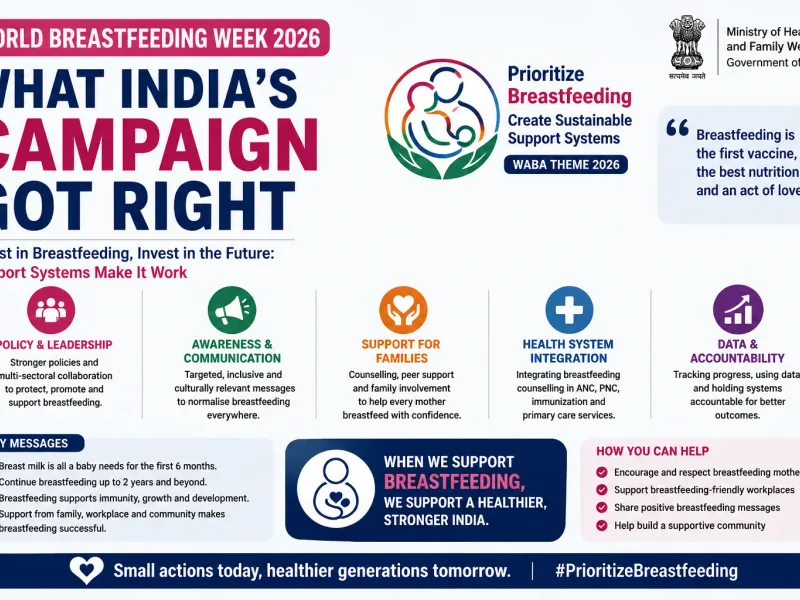
The Ministry urged families to ensure every newborn receives breast milk within the first hour after birth — the Golden Hour. The first milk, colostrum, often called the baby's first natural vaccine, is rich in antibodies and essential nutrition, and must not be discarded.
In clinical practice, this is one of the most commonly missed opportunities — not because mothers don't want to breastfeed, but because post-delivery fatigue, delayed skin-to-skin contact in busy ward settings, or well-meaning relatives offering "just a little water or honey" interrupts the process before it begins. Colostrum — that thick, yellowish first milk — is produced in tiny quantities, which sometimes makes families assume it isn't enough. It is enough. And it's the most immunity-dense feed the baby will ever receive.
Exclusive breastfeeding for the first six months means feeding the baby only breast milk — no water, honey, ghutti, glucose or formula. Breast milk alone meets all of an infant's nutritional and hydration needs during this period.
If you're unsure whether your newborn is feeding correctly or getting sufficient milk, the right step is booking a home visit with a doctor rather than switching to formula based on guesswork. Latch problems, supply concerns, and positioning issues are almost always fixable with early support — but they get harder to address the longer they're left.
After Six Months: Introducing Solids Doesn't Mean Stopping
From six months onwards, age-appropriate complementary foods should be introduced while breastfeeding continues up to two years and beyond.
This is the part of the conversation that tends to get lost. Many mothers stop breastfeeding at six months thinking that's the recommended endpoint — it isn't. Six months is when solid food starts, not when breastfeeding stops. The WHO and India's own nutrition guidelines both recommend continuing breastfeeding alongside appropriate foods until at least two years.
If you're not sure what foods to introduce and when, or if your child is showing signs of nutritional gaps — pale complexion, poor weight gain, delayed milestones — consult a pediatrician or reach out to a qualified dietitian for specific guidance on age-appropriate nutrition. Child health blogs on Doctar also cover complementary feeding in detail.
Working Mothers: The Gap the Campaign Tried to Address
Mothers returning to work are being counselled on expressing and safely storing breast milk so that feeding continues uninterrupted.
This is where policy and lived reality diverge most sharply. A mother who returns to work at three months — which is legally mandated maternity leave in most private sector jobs — is supposed to pump and store breast milk at the workplace. The law provides for it. The actual infrastructure, private rooms, refrigeration, and break time, is frequently absent.
The campaign is right to address this. But awareness without workplace support doesn't close the gap. Frequent feeding on demand and support from Anganwadi Workers, ASHA workers or the nearest healthcare facility whenever difficulty is faced are being emphasised throughout the week. If you're navigating this as a working mother, searching for a gynecologist who specialises in maternal health can help you build a realistic feeding plan before you return to work — not after.
Breastfeeding Benefits Mothers Too — and This Deserves More Attention
Breastfeeding also benefits mothers — supporting postpartum recovery and reducing the risk of breast and ovarian cancers, type-2 diabetes and postpartum depression. Press Information BureauSentinelassam
The maternal health angle tends to get buried under infant nutrition messaging, which is a missed opportunity. Women who breastfeed for longer cumulative periods have been shown in multiple studies to have lower rates of certain hormone-driven cancers. That's not a minor footnote. For women with a family history of breast or ovarian cancer, speaking to a gynecologist about how breastfeeding fits into a broader health picture is worth the conversation.
Postpartum depression is another area that often goes unaddressed in Indian clinical settings. If a mother is struggling emotionally after delivery — not just "baby blues" but persistent sadness, anxiety, or disconnection — mental health support and professional guidance are available. Searching for a general physician is a reasonable first step if you're unsure where to begin.
What POSHAN Abhiyaan Got Right (and Where the Gap Remains)
The 2026 theme calls on governments, health systems, workplaces, communities, civil society organizations, and families to build on successful experiences and strengthen the "Warm Chain of Support" for breastfeeding — noting that the interventions are proven and the economic returns are exceptional, with the remaining challenge being investment at sufficient scale.
POSHAN Abhiyaan's strength is its reach — Anganwadi workers going door to door in villages is something no digital campaign can replicate. The weakness, historically, has been follow-through: a mother who gets one counselling session during pregnancy and then no support post-delivery is unlikely to sustain exclusive breastfeeding through the inevitable difficulties.
The honest answer is that breastfeeding support is a women's health issue, a child health issue, a nutrition issue, and a workplace policy issue simultaneously. One week of awareness — however well-executed — doesn't resolve systemic gaps. But it creates openings for conversations that might not have happened otherwise.
If You're Struggling, That's Normal — and Solvable
Most breastfeeding difficulties aren't biological failures. They're positioning problems, latch issues, supply anxiety, or exhaustion — all of which respond well to early, skilled support. Problems compound when they're ignored for days or weeks. A mother who is in pain during feeds and thinks it's "supposed to feel that way" will often stop breastfeeding entirely within weeks.
If you're facing difficulty, book a home visit doctor or reach out to your nearest hospital with a lactation or maternity unit. For infants showing feeding problems — reflux, poor weight gain, constant crying after feeds — a pediatrician can rule out underlying issues that the mother is sometimes wrongly blamed for.
Women's health content on Doctar covers postpartum care in detail. Diagnostic centres near you can also run relevant blood and nutritional tests if there are concerns about maternal nutrition affecting milk supply.