Lateral septum brain discovery
New research is rewriting what we know about the brain's reward system. Scientists have identified the lateral septum — a small, often-overlooked region deep in the brain — as a likely control center for cravings, from hunger to drug urges.
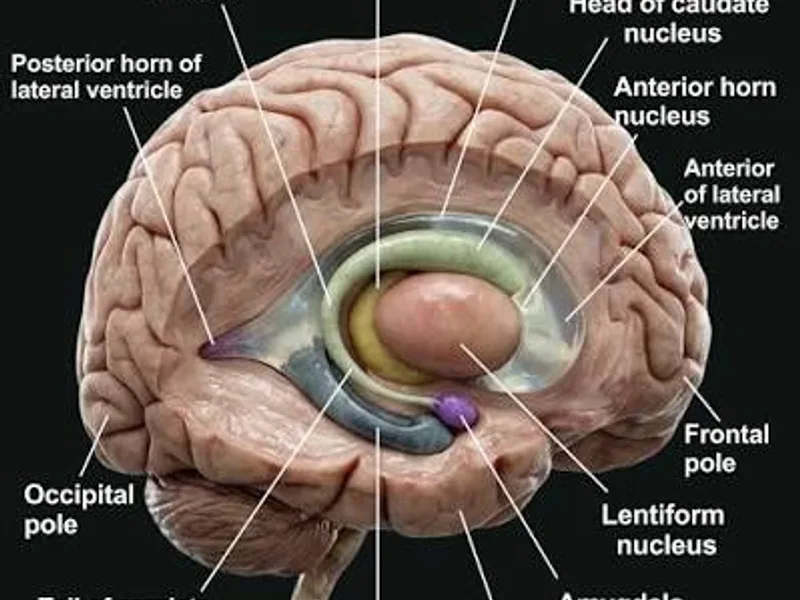
Something unexpected is happening with Ozempic. Patients using the weight-loss drug are reporting reduced urges not just for food — but for alcohol, cigarettes, and in some cases, other addictive substances. Scientists are increasingly tracing this effect back to a brain region called the lateral septum, which may act as a crucial control point between thinking about a reward and feeling compelled to pursue it.
This isn't a minor footnote in neuroscience. It could reshape how we understand addiction, obesity, and mental health — all at once.
What Is the Lateral Septum?
The lateral septum is a small, almond-sized structure tucked deep inside the brain, just above the brainstem. It sits at the midline of the brain as a subcortical structure — meaning below the thinking cortex — and has long been recognised as a critical regulator of social behaviours
For decades, it was treated as a side character in neuroscience. That's changed. The lateral septum is now understood to be anatomically positioned to play a critical role in directing information from the hippocampus and cortex to downstream subcortical structures, such as the hypothalamus. In plain terms, it sits at a kind of information crossroads in the brain.
If you're being seen by afor memory problems or mood disorders, the lateral septum is almost certainly involved in what they're evaluating — even if they don't name it directly.
A Brief History: From "Septal Rage" to Craving Science
Back in 1953, pioneering US behavioural researchers Joseph Brady and Walle Nauta coined the term "septal rage" when animals with damage in the lateral septum showed increased aggression, while direct stimulation of this brain region reduced aggression.
That was the first hint that this region had real power over behaviour. But it took another seven decades — and the surprise success of GLP-1 weight-loss drugs — to fully appreciate just how central it is.
In clinical neurology, this brain region is often mentioned in passing during lectures on limbic structures. In practice, patients with damage in this area can show dramatic shifts in temperament, impulsivity, or even social withdrawal — changes that get attributed to "frontal lobe dysfunction" or stress rather than the lateral septum specifically.
The Brain's Reward Circuit — And Where the Lateral Septum Fits
Most of us have heard of dopamine — the "feel-good" chemical. The brain regions that produce it, namely the ventral tegmental area (VTA) and nucleus accumbens, have been the focus of addiction research for years. Think of them as the engine of your reward system.
But one jump "upstream" from the dopamine-producing brain parts is the lateral septum. Much more recent work has placed it at the centre of a neural connectivity network, reframing how we think about its function.
The lateral septum inherits much of its primary input from a brain region called the hippocampus — well known as the place that lets us form long-term "episodic memories." The hippocampus tracks where you are, what time it is, and what happened there before. That information gets passed to the lateral septum.
Here's the crucial part. Key research has recently shown the lateral septum also contains place cells — neurons that fire corresponding to your position in space — but these cells strongly respond to rewards. They effectively add "what is good in this place" to the spatial information from the hippocampus.
So when you walk past a bar you used to drink at, or smell food from a place you love, your lateral septum is building the craving before your conscious mind has even processed the thought. This is why addiction is so hard to break — it's geography and memory fused with desire.
If you or someone you know is struggling with impulse control or addictive behaviours, speaking to a psychiatrist or general physician is a good first step.
The Ozempic Connection
GLP-1 agonists — drugs like Ozempic and Wegovy — mimic the GLP-1 hormone to stimulate insulin release, slow digestion, and increase feelings of fullness. They were originally used to treat type 2 diabetes because they help control blood sugar.
What nobody anticipated was that they'd also reduce cravings for substances that have nothing to do with food.
Human studies show that GLP-1 agonists reduce alcohol consumption. Preclinical animal studies suggest these drugs also reduce the use of cocaine, amphetamines, opiates, and nicotine.
Why? The likely answer lies in the lateral septum. It is absolutely loaded with GLP-1 receptors. These are the molecular docking points that GLP-1 drugs attach to in order to work. If the lateral septum is packed with them, it stands to reason that GLP-1 drugs are directly influencing craving behaviour through this region.
Research published in Neuron demonstrated that lateral septum neurons containing Esr1 — a particular receptor — are activated by both non-drug rewards like palatable food and social interaction, and drug rewards like methamphetamine.
In other words, the same neurons light up whether the reward is a slice of cake or a shot of amphetamine. That's a striking finding. It suggests the lateral septum doesn't discriminate between types of reward — it just signals wanting.
You can find a neurologist near you or a psychiatrist in Kolkata through Doctar if you want a professional opinion on neurological or addiction-related concerns.
What This Means for Addiction Treatment
Emerging research shows that GLP-1 activation directly in the lateral septum reduces food consumption in mice. More recently, another study showed the same for alcohol consumption.
The implication is significant. If GLP-1 drugs can dial down the lateral septum's craving signals, they might become tools not just for weight loss, but for treating alcohol dependence, nicotine addiction, and possibly opioid use disorder. This is still early-stage science — human clinical trials for these applications are ongoing, and no drug regulator has approved GLP-1 medications specifically for addiction treatment yet. Anyone considering these drugs for any purpose should consult their doctor first.
In humans, the lateral septum's subtle anatomy and poor delineation have historically limited systematic investigation — it's hard to study something that requires extremely precise brain imaging to even locate. But better neuroimaging tools are changing that.
For those dealing with conditions like anxiety, substance use, or compulsive behaviour, Doctar's mental health specialists and general physicians can guide you toward the right care. You can also explore diagnostic centres near you if neurological imaging is recommended.
Social Behaviour and the Lateral Septum
The lateral septum doesn't just handle cravings. Mouse studies have identified molecularly distinct neuronal populations within the lateral septum which control specific facets of social behaviour. Disruption in this region has been linked to aggression, social withdrawal, and reduced empathy in animal models.
Both kin- and aggression-related social information are organised along the dorsoventral axis of the lateral septum. Translated: different parts of this tiny structure handle different types of social information — whether something feels threatening or familiar, violent or nurturing. Journal of Neuroscience
This has real implications for conditions like autism spectrum disorder, social anxiety, and borderline personality disorder — all of which involve disrupted social processing. Researchers are cautious about drawing direct lines between animal data and human psychiatric diagnoses, but the connections are worth watching.
For patients with social anxiety or emotional regulation issues, seeing a psychiatrist or psychologist remains the appropriate first step. Doctar also lists mental health clinics across India.
What Happens When the Lateral Septum Is Damaged?
Damage to this region — from stroke, traumatic brain injury, or tumours — can produce a surprisingly wide range of symptoms. Patients may show increased aggression, reduced ability to feel satisfaction, disrupted social behaviour, and in some cases, changes in appetite. These symptoms are often attributed to broader brain injury rather than lateral septum damage specifically, because the region doesn't show up clearly on standard MRI scans.
If you've experienced a and noticed personality changes or unusual craving behaviours, it's worth discussing this with a neurologist. Doctar connects you with without the usual waiting time.
The Road Ahead
Neuroscience rarely moves in straight lines, and the lateral septum story is no exception. The transcriptional profiles, spatial arrangement, function, and connectivity of lateral septum cell types have not yet been systematically studied in humans — meaning this field is still, frankly, in its early chapters.
What researchers do agree on: this region is far more important than textbooks suggested twenty years ago. These findings are reshaping our understanding of how the brain processes rewards and have put the spotlight firmly on the lateral septum as the home of cravings.
If GLP-1 drugs continue to show efficacy in reducing substance cravings, we may be looking at a new class of addiction medicine — one that works not by blocking the reward system entirely, but by turning down the volume on craving at its source.