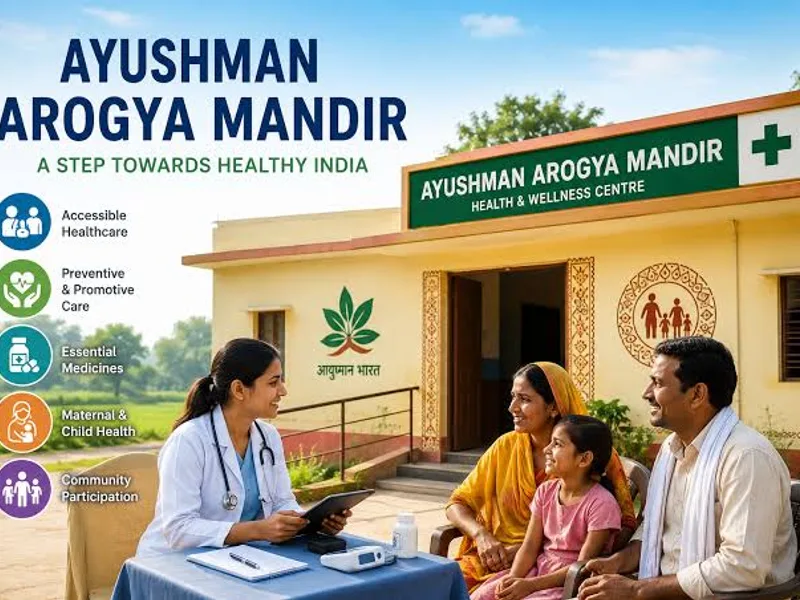
Patient footfall at Ayushman Arogya Mandirs in Jharkhand needs to be read carefully because there is no single, publicly available figure that represents every centre in the state.
A 2025 report on Ayushman Arogya Mandirs operating under the National AYUSH Mission in Barharwa block highlighted low patient turnout. The reported reasons included limited public awareness, gaps in infrastructure, shortages of doctors and staff, and inadequate availability of essential medicines.
That local picture should not be treated as the footfall figure for all Ayushman Arogya Mandirs in Jharkhand. Health facilities can perform very differently depending on population, staffing, opening hours, referral links and the services actually available.
For context, a Lok Sabha document records 185 functional Ayushman Arogya Mandir (Ayush) facilities in Jharkhand for 2024–25, following 249 in 2022–23 and 311 in 2023–24. These figures refer to AAMs under the AYUSH component and should not be confused with the much larger national network of comprehensive primary healthcare AAMs.
Why patient footfall matters
Footfall is more than a statistic. It gives health administrators an early indication of whether a facility is reaching the community it was created to serve.
An Ayushman Arogya Mandir is intended to take healthcare closer to people rather than making every patient travel to a district hospital or medical college. Depending on the facility and programme, services can include outpatient care, screening, wellness activities, medicines, diagnostics and teleconsultation.
The national Ayushman Arogya Mandir framework also emphasises patient-friendly facilities, referral systems, trained staff and regular monitoring of performance.
For residents looking for more advanced care after a referral, facilities such as RIMS Ranchi, Sadar Hospital Ranchi, and AIIMS Deoghar can form part of the wider healthcare network.
Why some Arogya Mandirs may see fewer patients
Awareness is one of the simplest explanations. People cannot use a service they do not know exists. In rural areas, residents may still associate specialist care with a hospital or private clinic and may not realise that preventive or basic treatment is available closer to home.
Staffing also matters. A centre may have a building and equipment but still struggle to attract patients if the doctor, community health officer, nurses or other personnel are not consistently available.
The same issue can arise with medicines and diagnostics. If patients repeatedly visit a centre and are then asked to travel elsewhere for commonly needed services, they may stop considering it their first point of care.
In clinical practice, this is often missed because a low OPD number can look like low demand when the real problem is low confidence in the service. Footfall should therefore be interpreted alongside staffing, medicine availability, waiting time, referral patterns and community outreach.
The experience reported from Barharwa is a useful example of why these factors should be examined together.
Telemedicine could change access
Telemedicine is another factor that can influence the usefulness of rural health centres.
In Jamshedpur, reporting in 2024 said Ayushman Arogya Mandirs were being used to provide telemedicine, with the aim of connecting patients with doctors while also reducing pressure on larger public hospitals. At that time, the district had opened many centres, although not every opened facility was yet providing medical services.
For people who need specialist advice, this can be particularly useful when travelling to a district hospital is difficult. However, teleconsultation cannot replace physical examination when a condition requires an in-person assessment.
People needing specialist care can also use General Physician services in Ranchi, Pediatricians in Ranchi, or Cardiologists near Ranchi when appropriate.
What national footfall figures tell us
National figures show that Ayushman Arogya Mandirs can generate substantial utilisation when services are operational and accessible.
The Ministry of Health and Family Welfare reported that 1,75,560 Ayushman Arogya Mandirs were operational by 31 December 2024, with cumulative footfall of 371.97 crore. The same report records extensive screening and wellness activity across the national network.
Government information has also reported that 11.56 crore beneficiaries used services through 12,500 operational AAM (Ayush) facilities during 2024. Visits by government teams found that footfall at upgraded facilities could increase when services expanded beyond routine OPD care to activities such as yoga, Prakriti Parikshan and community awareness.
These are national figures. They should not be presented as Jharkhand's footfall.
What Jharkhand needs to track
A more useful picture of Ayushman Arogya Mandir performance would include monthly OPD attendance for individual centres, repeat visits, teleconsultations, screenings, medicine availability, referral numbers and days when the facility was actually functional.
The number of people living in a centre's catchment area also matters. A centre serving a small population cannot be fairly compared with one located near a large settlement.
For comparison, CHC Bero and CHC Kanke illustrate the role of community-level facilities in providing primary and secondary care, referrals and preventive services.
Other useful reference points include SDH Bundu, Community Health Centre Jasidih, and Sadar Hospital Deoghar.
How residents can make better use of local services
Residents should check what their nearest centre actually provides before travelling. Services, staffing and operating arrangements can change, so information from the local health department or facility is more reliable than an old social-media post.
For specialist needs, DOCTAR also provides local healthcare directories such as Dermatologists in Ranchi, Urologists in Ranchi, and individual verified profiles such as Dr. DK Mishra, Dermatologist in Ranchi.
For mental-health care, Central Institute of Psychiatry, Ranchi is another specialised public healthcare reference.
People in Deoghar can also refer to the AIIMS Deoghar healthcare guide or the Deoghar emergency medical services guide for information about higher-level care.
The bigger question behind footfall
A high footfall is not automatically proof of good healthcare, just as a low footfall does not automatically mean people do not need the service.
The better question is whether people can access the right care at the right time and whether the centre has enough staff, medicines, diagnostics, referral support and community trust to make that possible.
Jharkhand's experience shows why local data matters. Reports of low turnout in Barharwa deserve attention, but they should not be generalised to every Ayushman Arogya Mandir in the state.