A Familiar Threat, Back Again
India is dealing with another Chandipura virus outbreak — and this one is moving fast. Gujarat has reported 35 laboratory-confirmed cases out of 184 suspected patients, with 22 child deaths linked to Acute Encephalitis Syndrome (AES). Rajasthan has confirmed cases in border districts as well. The Union Health Ministry has deployed a National Joint Outbreak Response Team (NJORT) to both states.
This is not a new virus. It is a deeply frustrating one — a pathogen researchers have known about for 60 years, that keeps coming back to kill children, and for which we still have no vaccine and no specific treatment.
If you live in western or central India, or have family there, here is what you need to understand right now. And if your child develops a fever during monsoon season in an affected area, do not wait — find a pediatrician near you on Doctar and act immediately.
What Is Chandipura Virus?
Chandipura virus, known as CHPV, is an RNA virus first identified during an outbreak investigation in 1965 in the village of Chandipura in Maharashtra — from which it takes its name. It belongs to the Vesiculovirus genus within the Rhabdoviridae family. Rhabdoviridae is the same broad family as the rabies virus. That context alone tells you something about how aggressively this infection targets the nervous system.
The virus is classified as an arbovirus, meaning it is spread through the bite of an insect vector. Sandflies, particularly the Phlebotomus species, are currently considered the primary suspected carrier.
CHPV is endemic in India, causing sporadic cases and outbreaks in western, central, and southern regions — especially during monsoon season when insect populations peak. Major outbreaks have occurred in Andhra Pradesh (2003), Gujarat (2005 and 2024), and now again across Gujarat and Rajasthan in 2026. The 2024 outbreak was described as the largest in 20 years. The current 2026 outbreak is a direct continuation of that pattern.
Understanding what you are dealing with is the first step. For broader guidance on seasonal illness in children, visit the Doctar health blog for expert-reviewed articles across conditions that spike during monsoon.
How Does Chandipura Virus Spread?
Unlike flu or COVID-19, Chandipura virus does not spread from person to person. There is no confirmed routine human-to-human transmission. The insect is the source, which means a child with the illness cannot infect siblings or parents in the same room.
The virus is transmitted through the bite of infected insects — most likely sandflies (Phlebotomus papatasi has been identified as a suspected vector in Gujarat). Sandflies are far smaller than mosquitoes. They are active primarily at dusk and in the early night hours, and they can pass through standard mosquito nets, which is why fine-mesh nets matter more than regular ones.
Here is something important that rarely gets said clearly: no confirmed field-caught sandfly has ever tested positive for CHPV during an active outbreak, even in the extensive sampling done in 2024. India's National Joint Outbreak Response Team is currently investigating whether mosquitoes, ticks, or mites may also contribute to transmission. The science is not fully settled, and that gap matters for how we think about prevention.
What is well established is that poor sanitation, open drains, cracked earthen walls, and accumulated organic waste create environments where sandfly populations thrive. Rural communities are disproportionately affected.
If you want to discuss monsoon-season risks with a doctor, you can consult a general physician near you through Doctar without needing to travel far.
Who Is Most at Risk?
Children. Almost always children.
The disease mainly targets children between the ages of 2 and 15 years. Their immune systems have had limited prior exposure to the virus, leaving them with little natural defence. Adults can get infected, but severe disease in adults is far less common — and the reason is not fully understood scientifically.
In clinical practice covering AES (Acute Encephalitis Syndrome) cases during monsoon, Chandipura is often not the first diagnosis considered — because the early symptoms look identical to dozens of other seasonal infections. By the time neurological deterioration becomes obvious, the window for effective supportive intervention has become dangerously narrow. That is why recognising it early matters.
The current 2026 outbreak has killed 22 children in Gujarat alone. If your child is under 15 and living in or visiting Gujarat, Rajasthan, or bordering areas, they are in the primary risk group. Book a consultation with a pediatrician proactively — having an established care contact before an emergency makes a genuine difference.
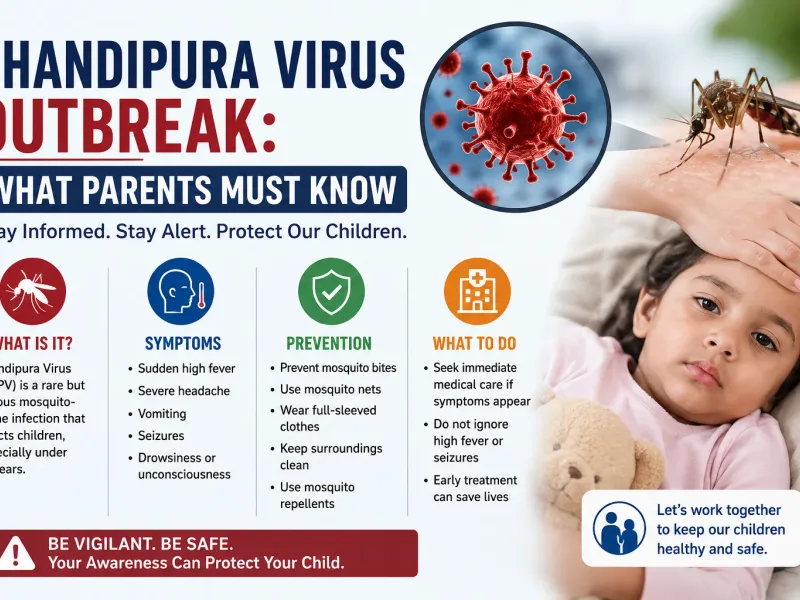
Symptoms: What to Watch For
The symptoms of Chandipura virus follow a pattern that parents in affected regions must recognise quickly.
Early signs — within the first 24 hours:
A sudden high fever is typically the first sign. Severe headache, persistent vomiting, and body weakness follow quickly. In the Gujarat investigations, vomiting was found to be significantly more pronounced in Chandipura cases than in other types of encephalitis — making it a useful early flag in combination with fever.
Rapid escalation — within 24 to 72 hours:
Febrile illness can progress rapidly to seizures (uncontrolled shaking or convulsions), altered mental status (confusion, disorientation, extreme drowsiness), and loss of consciousness. In severe cases, the patient can enter a coma. The case fatality rate in confirmed cases during the 2024 Gujarat outbreak was nearly 47%. That number underlines how little margin there is for delayed treatment.
Any combination of fever, vomiting, and unusual drowsiness or seizures in a child during monsoon season is a medical emergency. Go immediately to a hospital — do not try home management first. Find hospitals near you through Doctar so you already know where to go before a crisis develops.
If you suspect your child has been exposed, you can also look for emergency services near you through Doctar's platform.
Diagnosis: How Is It Confirmed?
Two tests are used to confirm Chandipura virus infection. RT-PCR testing — which detects the virus's genetic material — is most effective in the early phase of illness. IgM ELISA testing, which detects antibodies the immune system produces in response, is more useful in the later phase. Both can be performed on blood samples; cerebrospinal fluid (CSF) — the fluid surrounding the brain and spinal cord — may also be tested in suspected encephalitis cases.
Getting to the right diagnostic facility quickly matters. Find diagnostic centres near you on Doctar to identify labs that can handle urgent referrals.
One important clinical reality: Chandipura is only one cause of AES. In the 2024 Gujarat outbreak, CHPV accounted for roughly 23% of AES cases, meaning most AES cases had other causes. Accurate, timely testing is essential to confirm the diagnosis and guide appropriate care.
Treatment: There Is No Specific Cure
This must be stated plainly. There is no approved antiviral treatment for Chandipura virus. There is no vaccine. The case-fatality ratio in confirmed cases ranges widely across outbreaks — as high as 56–75% in some historical data — and in the 2024 Gujarat outbreak it was close to 47% among confirmed CHPV cases.
Treatment is entirely supportive, meaning doctors manage the symptoms and complications while the patient's immune system fights the virus. This includes:
Hospitalisation, intravenous fluids to manage dehydration, fever control with antipyretics (medicines that lower fever), and anticonvulsants (medicines that control seizures). In severe neurological cases, intensive care support for breathing and organ function becomes necessary.
Given these numbers, early hospitalisation is not a precaution — it is the primary variable that determines survival. Do not manage a suspected case at home.
Search for hospitals near you right now, before you need them urgently. If your area has a home visit doctor service, use it to get a medical assessment quickly if reaching a facility is difficult — but a confirmed or strongly suspected case must reach a hospital with ICU capacity.
Prevention: What You Can Actually Do
No vaccine exists, and no specific medicine protects against this virus. Prevention is the only real defence available.
Protect against insect bites. Apply insect repellent to exposed skin, particularly on children, in the evening and at night. Use fine-mesh bed nets — standard mosquito nets may not stop sandflies due to their smaller size. Dress children in full-sleeved clothing after sundown during the monsoon months.
Reduce breeding environments. Sandflies breed in moist soil, wall cracks, and organic debris near homes. Sealing cracks in walls, improving drainage, and clearing waste from around the house significantly reduces the insect population near your family.
Act immediately on warning signs. A fever combined with vomiting and any neurological symptom — drowsiness, confusion, or seizures — in a child during monsoon season is a reason to go to a hospital without delay. This is not a "watch for 24 hours" situation.
Know your nearest medical facility in advance. Find hospitals near you on Doctar. Locate emergency services in your area. Identify a trusted pediatrician before the monsoon peaks. This kind of preparation costs nothing and could save a child's life.
You can also search for doctors near you across all specialties on Doctar, book a consultation, and discuss personal risk factors for your family before the situation becomes urgent.
What the Government Is Doing
India's Union Health Ministry has deployed a National Joint Outbreak Response Team (NJORT) to Gujarat and Rajasthan. The team's mandate includes strengthening disease surveillance, conducting detailed epidemiological investigations, reinforcing laboratory testing capacity, and coordinating vector control measures including insecticide spraying in affected areas.
The 2026 response also applies a One Health framework — examining human cases alongside animal reservoir and environmental data simultaneously. This is a meaningful step, because a critical scientific gap has never been resolved: even with extensive field sampling during the 2024 outbreak, no sandfly collected from affected areas tested positive for CHPV. The 2026 NJORT investigation is explicitly testing whether other arthropods — mosquitoes, ticks, or mites — may also be involved in transmission.
Resolving that question would fundamentally change how prevention campaigns are designed and targeted.
In the meantime, state health authorities in Gujarat and Rajasthan have issued advisories, reinforced pediatric ICU capacity, and intensified surveillance in border districts.
Related Health Topics to Read on Doctar
While Chandipura virus dominates the monsoon health conversation right now, several related conditions also peak during this season. The Doctar health blog covers many of them:
You can also explore the full health blogs library on Doctar for expert-reviewed content on seasonal and infectious diseases.