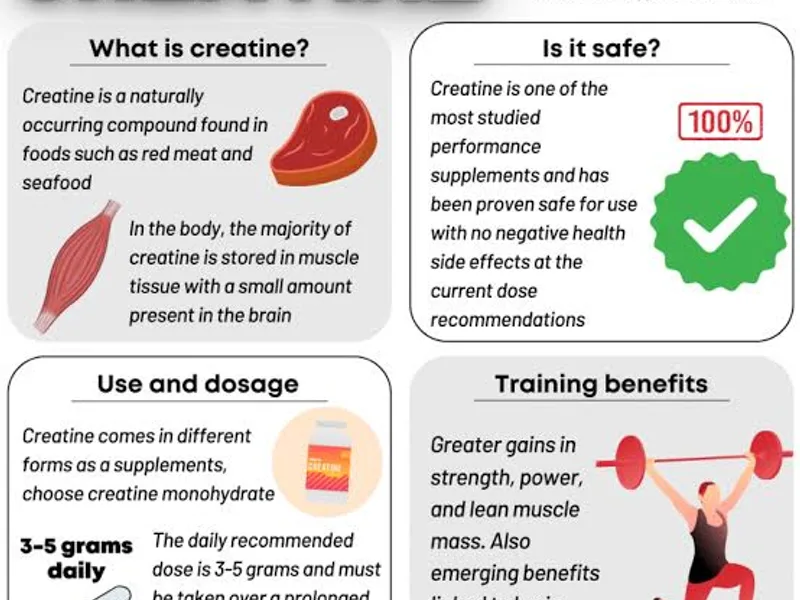
What is creatine?
Creatine is a compound the body naturally makes and stores mainly in skeletal muscle. It helps muscles produce energy quickly during short, demanding efforts such as lifting weights, sprinting or jumping.
The body also gets creatine from foods such as meat and fish. Supplements can increase the amount stored in muscle, which is one reason creatine has become so popular among people who strength train.
But creatine is not a replacement for exercise. Think of it as a tool that may help you get more from a well-designed training programme.
That distinction matters. Doctar's guide to muscle building and gaining strength similarly emphasizes the combined role of resistance training, nutrition and recovery in building muscle.
Creatine can improve strength and training performance
The strongest evidence for creatine is around high-intensity exercise and strength development.
Creatine helps replenish adenosine triphosphate, or ATP, the body's immediate energy source for muscular contraction. Having more readily available energy can allow a person to perform better during repeated, demanding efforts.
A 2024 systematic review and meta-analysis found that creatine combined with resistance training produced greater upper- and lower-body strength gains than resistance training with placebo in adults under 50.
That makes creatine particularly relevant to people following a structured strength programme. For readers learning how to track strength, Doctar's 1-rep max guide explains how strength can be assessed and monitored.
Creatine may also fit naturally with a progressive overload programme, where training gradually becomes more challenging over time.
It can support muscle growth
Creatine does not directly "build muscle" in the way social media sometimes suggests. The main benefit appears to come from helping people train harder and consistently enough to stimulate muscle growth.
Research also suggests that creatine supplementation can increase lean body mass when combined with resistance training. Some of the early increase in body weight can come from greater water storage inside muscle cells, so the number on the weighing scale should not automatically be interpreted as new muscle.
For a broader look at hypertrophy, Doctar's guide to muscle building covers resistance exercise, nutrition and recovery.
The same principle applies to exercise selection for different muscle groups. A supplement cannot compensate for poor training structure.
What about creatine and aging?
This is one of the more interesting areas of current research.
Muscle mass and strength tend to decline with age, increasing the risk of weakness, falls and loss of independence. This age-related decline is commonly called sarcopenia.
Creatine may help older adults maintain or improve muscle strength when paired with resistance exercise, although results vary between studies and individuals. It should be viewed as part of a broader strategy rather than a standalone treatment.
Doctar's article on physical decline after 35 discusses why preserving muscle earlier in adulthood can matter later in life.
Adequate dietary protein is another major part of that picture. See Doctar's guide to protein requirements and its protein sources for healthy aging.
Could creatine help the brain?
Possibly, but this evidence needs more caution.
Creatine is also present in the brain, where it participates in cellular energy production. Researchers have investigated whether supplementation can influence memory, attention and other aspects of cognitive performance.
A 2024 systematic review and meta-analysis reported potential improvements in some cognitive measures, including memory, but the evidence is not strong enough to treat creatine as a proven cognitive enhancer for everyone.
Research specifically involving adults aged 55 and older is also promising but limited. A recent systematic review found generally positive findings for memory and attention, while stressing that only a small number of studies were available and better trials are needed.
So, should people start taking creatine for brain health alone? The evidence does not justify that conclusion yet.
Is creatine safe?
For healthy adults, creatine, particularly creatine monohydrate, has a strong safety record when used appropriately. Long-running research has not established that creatine causes kidney damage in healthy people.
One source of confusion is creatinine, a substance measured in blood tests to help assess kidney function. Creatine supplementation can affect creatinine levels, which can complicate interpretation of a blood test without necessarily meaning that the kidneys have been damaged.
People with existing kidney disease, other significant medical conditions, or those taking medicines that affect kidney function should speak with a doctor before using a creatine supplement.
Doctar's muscle health guide also highlights hydration and muscle function as important parts of maintaining physical health.
Does creatine cause dehydration?
The old idea that creatine inevitably causes dehydration or muscle cramps has not held up well in controlled research.
Evidence reviewed by the International Society of Sports Nutrition does not support claims that creatine increases dehydration or muscle cramping in healthy users.
Still, normal hydration matters, particularly during hard training or hot weather. Doctar's healthy lifestyle guide discusses hydration alongside regular physical activity.
For people exercising heavily, Doctar also covers post-workout recovery and active recovery.
Who may benefit most?
Creatine is most relevant to people who regularly perform resistance training, sprinting or other activities involving repeated high-intensity efforts.
It may also have a role in healthy aging, particularly when combined with resistance exercise. But the size of the benefit varies, and not everyone will experience the same results.
In clinical practice, this is often missed because people focus on the supplement while overlooking the basics: progressive training, adequate protein, sufficient food, sleep and recovery. Creatine can support those foundations; it cannot replace them.
For example, Doctar's 5x5 strength-training guide discusses the importance of progressive training and rest.
Other useful strength resources include Doctar's guides to free weights versus machines, grip strength, and hip thrusts.
Creatine is not a shortcut
There is a reason creatine has survived decades of scientific scrutiny: it has a plausible biological mechanism and a substantial research base.
But marketing has stretched the evidence in some areas. Claims that creatine automatically produces dramatic muscle growth, prevents disease or guarantees better brain function go beyond what current evidence can support.
The same caution applies to complicated workout programmes. Doctar's conjugate strength-training guide and power-clean guide show why training technique and appropriate progression remain central to performance.
People recovering from injury also need a different approach. Doctar's at-home physical therapy guide explains how rehabilitation can be tailored around mobility and function.