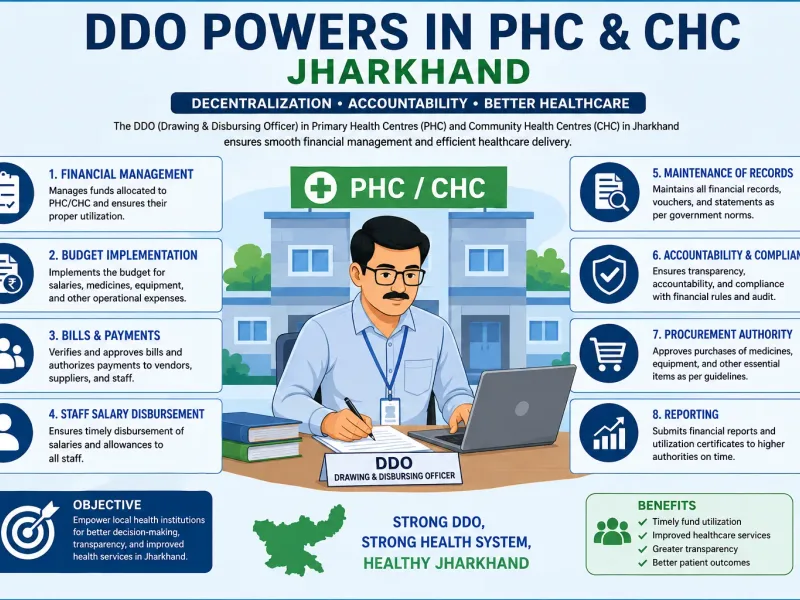
The Jharkhand government has granted Drawing and Disbursing Officer (DDO) powers to in-charges of Primary Health Centres (PHCs) and Community Health Centres (CHCs) as part of a move to decentralise healthcare administration. The decision was reported in June 2026, with the Health Department describing it as an effort to reduce operational bottlenecks and give health institutions greater responsibility for their day-to-day functioning.
In simple terms, a DDO is an authorised government officer who can draw bills and make payments on behalf of the government, subject to applicable financial rules and the authority delegated to that officer. Jharkhand's Financial Rules, 2025 define a DDO as the head of an office or another gazetted officer designated by the State Government to draw bills or cheques from the treasury and make government payments.
The practical question is obvious: will this make a difference to patients? It can, particularly when a PHC or CHC is waiting for routine financial decisions that affect medicines, equipment, maintenance or other operational requirements.
For a broader view of public healthcare in the state, readers can also explore Latehar Government Hospital and healthcare access and Koderma Government Hospital services.
Why has Jharkhand decentralised DDO authority?
The main reason is administrative speed. Under a more centralised system, local health-centre officials may have had to depend on district-level authorities for routine financial approvals and procurement-related decisions.
The reported reform gives medical officers-in-charge greater responsibility for managing their institutions. The change covers PHCs, CHCs and other public health facilities, with the stated objective of making health institutions more self-reliant.
This approach is not entirely theoretical. Jharkhand's own financial systems already identify medical officers-in-charge of PHCs and CHCs as DDOs in treasury records. For example, the State Finance Department's records list medical officers-in-charge of PHCs and CHCs under health-department DDO entries.
That distinction matters. The 2026 reform should be understood as a delegation and operational strengthening of financial responsibility, rather than an unlimited power to spend public money.
Readers looking at government facilities in Ranchi can compare this structure with CHC Kanke, CHC Bero and SDH Bundu.
What can a PHC or CHC in-charge do as a DDO?
The exact authority depends on the government order, budget head, delegation of financial powers and applicable financial rules. It should not be interpreted as a blanket licence to spend without limits.
According to the June 2026 reporting on the reform, the expanded local responsibility is intended to help health-centre heads handle operational requirements, including procurement of essential medicines and equipment and certain outsourced staffing requirements.
The reported annual operation-and-maintenance allocations also indicate the scale of decentralisation. The report said the Chief Minister Hospital Operation and Maintenance Scheme provides annual grants of ₹10 lakh for CHCs/referral hospitals and ₹5 lakh for PHCs, alongside higher allocations for district and sub-divisional hospitals.
These figures should be treated as reported scheme allocations, not as a universal spending limit for every transaction. Actual spending must follow the relevant sanction, budget availability, procurement procedures and financial delegation.
For context, Sadar Hospital Ranchi operates at a different level of the public-health system, while RIMS Ranchi functions as a major tertiary-care institution.
DDO powers do not mean unlimited financial authority
This is the part that can easily get lost in headlines.
A DDO cannot simply spend beyond the funds placed at the officer's disposal. Jharkhand's Financial Rules, 2025 state that a DDO cannot, on their own authority, authorise payment that exceeds the available allotment or appropriation. Where an excess is likely, the officer must obtain the required orders from the appropriate administrative authority and additional funding must be arranged through the prescribed process.
So, DDO status comes with responsibility as well as authority. Bills, expenditure records, supporting documents, treasury procedures and financial accountability remain important.
The State Finance Department also operates systems for DDO-level bill entry, fund management, treasury reporting and reconciliation.
For readers trying to understand how public facilities fit together, Hazaribagh Government Hospital, Lohardaga Government Hospital, Gumla Government Hospital and Dumka Government Hospitals provide useful local healthcare context.
How could the reform affect rural patients?
The strongest potential benefit is faster response to local operational problems.
A rural health centre may need a relatively routine item, repair or service without delay. If every small administrative requirement has to move through several layers of district approval, the process can become slow. Giving authorised officers more direct financial responsibility can shorten that chain.
In clinical practice, this is often missed because healthcare quality is discussed mainly in terms of doctors, medicines and equipment. But administration matters too. A functioning laboratory, stocked pharmacy, maintained building and reliable basic equipment all depend on routine operational decisions.
That does not mean every PHC or CHC will immediately improve. Staffing, infrastructure, supply chains and clinical capacity remain separate issues.
For a closer look at rural and public healthcare, readers can also see Government Hospitals in Giridih, Palamu Government Hospitals, and Find Hospitals in West Singhbhum.
What does this mean for accountability?
More local financial authority should ideally come with stronger local accountability.
The officer holding DDO responsibility is not only expected to facilitate payments. Financial transactions must remain within sanctioned budgets and prescribed government procedures. Treasury records, utilisation documentation and financial reconciliation are part of the wider control system.
Jharkhand's Finance Department maintains a searchable DDO system and treasury records, showing that DDO appointments are formally mapped to offices and codes rather than being an informal arrangement.
This is particularly relevant when public money is used for medicines, maintenance or equipment. Faster spending is useful only when the spending is properly authorised, documented and linked to genuine healthcare needs.
Readers can also refer to AIIMS Deoghar's government-hospital guide, Sub-Divisional Hospital Madhupur, and Community Health Centre Jasidih to understand different levels of public healthcare facilities in Jharkhand.
PHC and CHC DDO powers: what patients should know
Patients do not need to understand treasury procedures to use a PHC or CHC. What matters is whether the facility can provide the services it is responsible for and whether necessary resources are available.
A CHC may serve as a referral point for nearby PHCs. For example, DOCTAR's profile for CHC Bero describes it as a referral facility for PHCs and health sub-centres in the Bero block, while CHC Kanke is described as providing primary and secondary healthcare services and supporting nearby PHCs.
Patients requiring higher-level care may still need referral to a district hospital or tertiary centre. Sadar Hospital Ranchi and RIMS Ranchi illustrate those higher levels of care.
The reform therefore does not replace the referral system. Its purpose is to make the health facility responsible for its own routine administration more capable of responding to local needs.
What could make the reform successful?
Financial delegation alone cannot solve every problem in rural healthcare.
The real test will be whether health-centre heads receive timely funds, understand their delegated powers, have trained administrative support and can complete procurement and accounting requirements without unnecessary complexity.
There also needs to be clear oversight. Local autonomy works best when financial records are transparent and there are effective systems for audit, monitoring and correction.
This matters beyond PHCs and CHCs. Public healthcare is a connected system. Central Institute of Psychiatry Ranchi, Ranchi Cancer Hospital and Research Centre, and other government institutions have different mandates, funding structures and levels of specialist care.